
Last updated: May 30, 2026
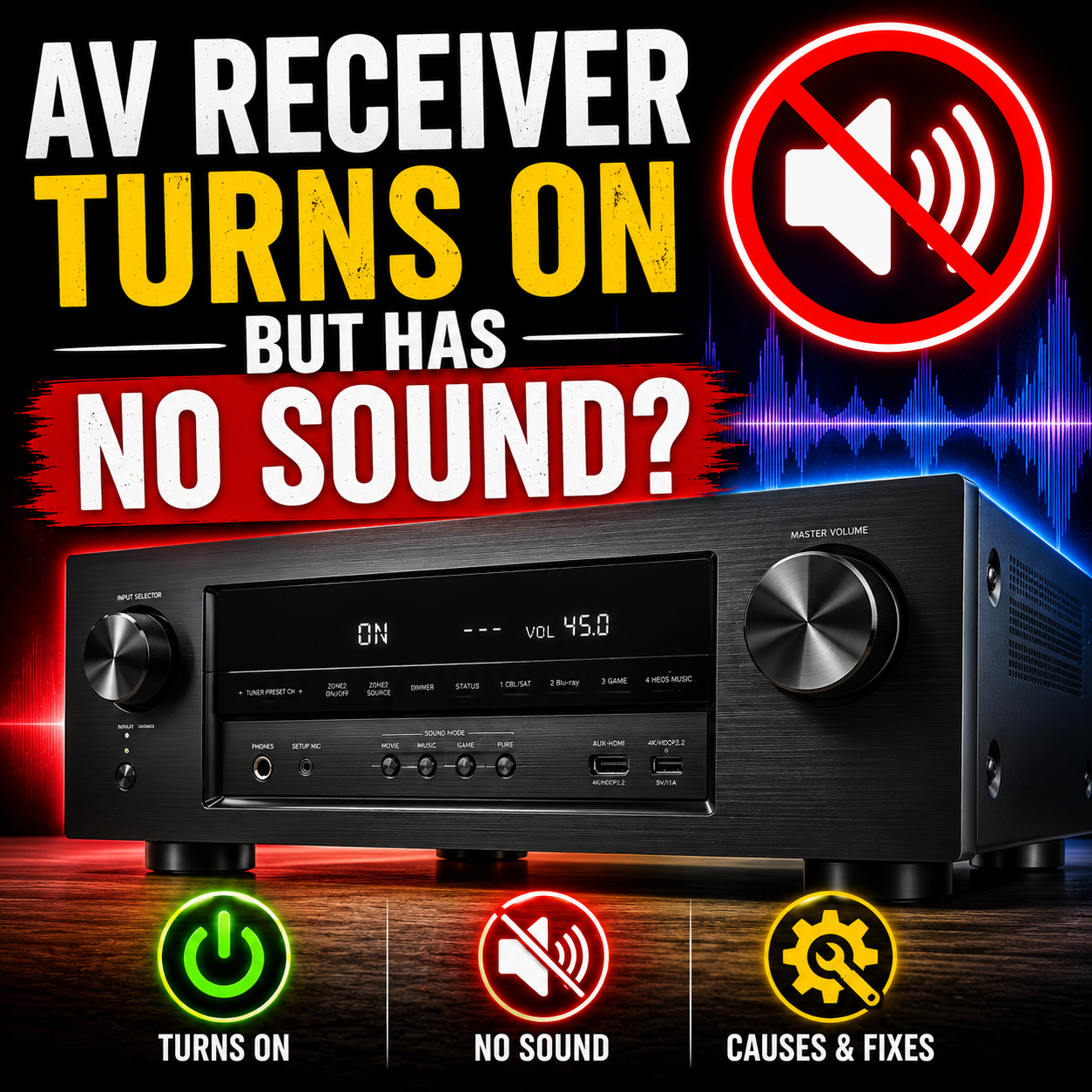
AV Receiver Turns On But Has No Sound? HDMI Board, DSP Board, or Repair?
When an AV receiver powers on but there is no sound, it is easy to assume the worst. But “no sound” can mean a lot of different things.
Sometimes it is a simple input setting. Sometimes it is an HDMI handshake problem. Sometimes ARC or eARC is misconfigured. And sometimes, yes, the HDMI board, DSP board, amplifier board, or power supply has actually failed.
This guide is meant to help you slow down and sort the problem into the right bucket before you replace a perfectly good receiver — or keep fighting with one that is clearly ready for repair.
Quick answer: if it powers on, the next clue is what is missing
An AV receiver that turns on but has no sound is not automatically dead. The best first step is to figure out what is missing:
Those three situations point in different directions. A missing speaker icon can be more suspicious than a simple “wrong input” issue. HDMI video passing but no audio is different from no HDMI signal at all. ARC/eARC failure is its own animal.
Safety first: Do not open the receiver while it is plugged in. AV receivers can contain power-supply sections, large capacitors, amplifier rails, and AC mains wiring. Internal diagnosis should be handled by someone qualified.
First, what kind of “no sound” problem do you have?
This sounds basic, but it matters. Two receivers can both “have no sound,” but one may only have a settings issue while the other needs board repair.
The receiver powers on, menus work, and one source is silent
This is often where settings, input assignment, source audio format, HDMI cable, TV audio output, or ARC/eARC configuration should be checked before blaming the receiver.
Every source is silent, HDMI acts dead, or speaker icons disappear
When all inputs fail, HDMI is not detected, video/audio disappear together, test tones do not work, or speaker indicators vanish, board-level failure becomes more realistic.
| Symptom | Common direction | Why it matters |
|---|---|---|
| One HDMI input has no sound | Cable, source setting, input assignment, HDMI handshake | One bad input path is different from total receiver failure |
| All HDMI inputs fail | HDMI board, firmware/control issue, power to HDMI section | Multiple failed inputs make hardware more suspicious |
| Video passes but no audio | Audio decoding, HDMI audio setting, DSP section, source format | The HDMI path may not be completely dead |
| No speaker icons | DSP/decoder problem, internal communication issue, firmware/control fault | Missing speaker indicators can be a stronger clue than silence alone |
| Receiver clicks then shuts down | Protection mode, speaker short, amplifier board, power supply | This is usually not an HDMI-only problem |
| ARC/eARC stopped working | TV settings, HDMI Control/CEC, cable, port choice, firmware, HDMI board | ARC/eARC problems often involve both the TV and receiver |
The simple checks worth doing before calling it a board failure
Before mailing in a receiver, do the boring stuff first. It is not glamorous, but it saves people from sending in a receiver that was muted, assigned wrong, or fighting with a TV setting.
Good test: Try the receiver’s built-in test tone or speaker setup test. If the receiver cannot produce its own test tone, that tells you something different than one HDMI source being silent.
HDMI handshake problem or HDMI board failure?
HDMI can be maddening because it is not just a cable. The receiver, TV, source device, resolution, refresh rate, copy protection, audio format, CEC, ARC/eARC, and firmware all have to play nicely.
A handshake problem can look like a broken receiver. But a failing HDMI board can also look like a handshake problem. The difference is usually in the pattern.
| What you see | More likely | What to try or document |
|---|---|---|
| One device fails, others work | Handshake, source setting, cable, resolution, HDCP issue | Try a different source, lower resolution, different cable, and direct-to-TV test |
| All HDMI inputs fail | HDMI board, control issue, firmware issue, internal power issue | Document every tested input, source, and cable |
| Video passes but no audio | HDMI audio setting, source output format, DSP/decoder path, HDMI audio section | Test PCM/stereo output from source and receiver test tones |
| No HDMI video or audio | HDMI board failure or severe HDMI communication issue | Try receiver menu output, multiple inputs, multiple sources, and a known-good TV input |
| Works after unplugging, then fails again | Handshake instability, failing HDMI section, heat-related board issue | Record how long it works and whether heat changes the behavior |
HDMI board failure becomes more believable when several HDMI inputs fail, resets do not help, multiple sources and cables have been tested, and the receiver otherwise powers on normally.
ARC/eARC not working is its own problem
ARC and eARC are convenient when they work, but they can fail for reasons that are not the same as normal HDMI input failure.
If your receiver works with a Blu-ray player or game console but does not get sound from the TV’s apps, you may be dealing with an ARC/eARC setup issue rather than a dead receiver.
ARC/eARC clue: If normal HDMI sources work through the receiver but TV app audio does not return, focus on ARC/eARC settings before assuming HDMI board failure.
No speaker icons, missing surround modes, or DSP symptoms
A lot of people overlook this clue. If the receiver display used to show speaker icons, surround indicators, decoder modes, or channel activity — and now those indicators are gone — that can point beyond a simple cable problem.
The DSP or decoder section is involved in processing digital audio, surround formats, and channel output. When that side has trouble, the receiver may power on but never really “locks in” to audio.
- No speaker icons on the front display
- No sound from HDMI, optical, or coaxial sources
- Surround modes do not appear or behave normally
- Video may pass but audio is missing
- Receiver test tones do not work
- Reset does not restore audio processing
Missing speaker icons can be a serious clue, but still check speaker configuration, input mode, source audio format, mute, zone settings, and headphone/Bluetooth output first.
Protection mode, amplifier board, and speaker wiring symptoms
Not every no-sound receiver is an HDMI problem. If the receiver clicks, shuts down, flashes protection, or only fails when speakers are connected, look at the amplifier and speaker side.
| Symptom | Possible direction | Why it matters |
|---|---|---|
| Receiver shuts off after relay click | Protection mode, amplifier fault, shorted speaker wiring | The receiver may be protecting itself from damage |
| One channel is dead | Amplifier channel, speaker output stage, relay, speaker wiring | One-channel failure is different from total HDMI failure |
| Works with speakers disconnected | Speaker wire short, speaker issue, impedance/load problem | A bad speaker or wire can make a good receiver shut down |
| Burning smell or visible heat damage | Power supply, amplifier board, failed component | Stop using it and do not keep testing |
| No sound from any speaker, test tone fails | DSP, amplifier, power supply, control logic | More than a single cable or source issue may be involved |
Do not bypass protection mode. Protection is there to prevent bigger damage. If the receiver shuts down repeatedly, stop forcing it to run.
Brand examples and common patterns
This symptom can happen across many AV receiver brands. The pattern matters more than the logo on the front.
Denon and Marantz owners may search for HDMI audio/video loss, ARC/eARC issues, missing output, or no sound after resets and cable swaps. Onkyo owners often search for no sound, no speaker icons, HDMI board failure, or DSP board repair. Yamaha Aventage and Pioneer Elite owners may search around HDMI input failure, no audio from digital sources, or protection behavior.
Those searches can sound similar, but the repair path is not universal. HDMI boards, DSP chips, firmware, amplifier sections, and power supply layouts vary by model.
Model rule: Always identify the exact model number before assuming parts, boards, firmware, or repair options are the same across brands.
When the receiver is worth mailing in
AV receivers are one of the better mail-in repair candidates because the whole unit is usually shippable and the failure is often electronic, not installation-based.
Mail-in repair becomes more interesting when the receiver is expensive, out of warranty, otherwise clean, and showing a repeatable failure that points toward a board-level issue.
Depending on the model and failure, the repair path may involve the whole AV receiver, HDMI board, DSP board, amplifier board, power-supply board, or logic board. Do not remove boards unless instructed; many users should send photos and videos first.
What to send before shipping a receiver
Good documentation helps avoid wasted shipping and wrong assumptions. Before mailing in a receiver, gather the basics.
Repair vs replacement scorecard
AV receivers can be expensive to replace, but repair does not always make sense. Use the situation, not just the symptom, to decide.
A good receiver with a failed HDMI or DSP section may be worth saving. A low-cost receiver with multiple failures and outdated HDMI support may not be.
What not to do
Receiver repair forums are full of shortcuts. Some are harmless. Some are a good way to make the repair worse.
Do not use heat-gun reflow or “baking the board” as a real repair strategy. People discuss it online, especially around older HDMI/DSP failures, but it is risky, temporary at best, and can damage surrounding components.
- Do not open the receiver while plugged in.
- Do not jumper relays or bypass protection mode.
- Do not keep forcing the receiver on if it shuts down repeatedly.
- Do not assume every no-sound problem is the HDMI board.
- Do not buy random used boards without matching the exact model and revision.
- Do not reset the receiver without saving important settings if you have a complex home theater setup.
Limited tools and product links
Disclosure: Some links in this section may be affiliate links. If you buy through them, we may earn a commission at no extra cost to you. These are for simple external checks only, not internal receiver repair.
Helpful for safe external troubleshooting
These can help rule out basic setup issues before you assume board failure.
Buying rule: Do not buy HDMI boards, DSP boards, amplifier boards, or power supply boards unless the exact model, revision, failure, and repair path are confirmed.
FAQ
Why does my AV receiver turn on but have no sound?
It could be a simple setting, muted output, wrong input, speaker wiring issue, source audio setting, ARC/eARC problem, HDMI handshake problem, protection mode, HDMI board failure, DSP board failure, amplifier issue, or power supply problem.
What does it mean if my receiver has no speaker icons?
Missing speaker icons can point toward speaker configuration, input mode, source format, or a deeper DSP/decoder issue. If the receiver used to show speaker icons and now shows none across all sources, document it before repair.
Why does my receiver pass video but have no audio?
Video passing with no audio can involve source audio settings, HDMI audio output, receiver input settings, ARC/eARC configuration, or the receiver’s DSP/audio decoding path. It does not always mean the HDMI board is completely dead.
Why are my HDMI inputs not working on my receiver?
HDMI inputs can fail because of cable issues, source compatibility, resolution or HDCP problems, firmware/handshake trouble, or HDMI board failure. If multiple HDMI inputs fail after cable and source testing, board failure becomes more likely.
Why is ARC or eARC not working with my receiver?
ARC/eARC depends on the correct TV HDMI port, correct receiver HDMI output, TV audio settings, HDMI Control/CEC settings, cable capability, firmware, and source audio format. It should be troubleshot separately from normal HDMI input failure.
Can an HDMI board in an AV receiver be repaired?
In some cases, yes. Repair depends on the model, board design, failure type, part availability, heat damage, and whether the issue is actually on the HDMI board instead of the DSP, amplifier, power supply, or settings.
Can a DSP board cause no sound?
Yes. A DSP or decoder-board issue can cause no audio, missing speaker icons, no surround decoding, or video passing without sound. But simple settings and source-format issues should be checked before assuming DSP failure.
Should I try heat-gun reflow on an HDMI or DSP board?
No. Heat-gun reflow and board baking are risky temporary hacks people discuss online, not reliable repairs. They can damage the board further and make professional repair harder.
Is my receiver worth repairing or should I replace it?
Repair is more likely to make sense for higher-end receivers with a clear board-level failure and high replacement cost. Replacement may make more sense for older entry-level receivers, units with repeated failures, severe heat damage, or outdated HDMI support.
What should I send before mailing in an AV receiver for repair?
Send the model and serial number, a video of the front display, whether speaker icons appear, HDMI input test results, test tone results, speaker wiring photos, and notes on resets, firmware updates, sources, TVs, and cables already tested.


%20(7).png)