%20(6).png)
Last updated: June 8, 2026
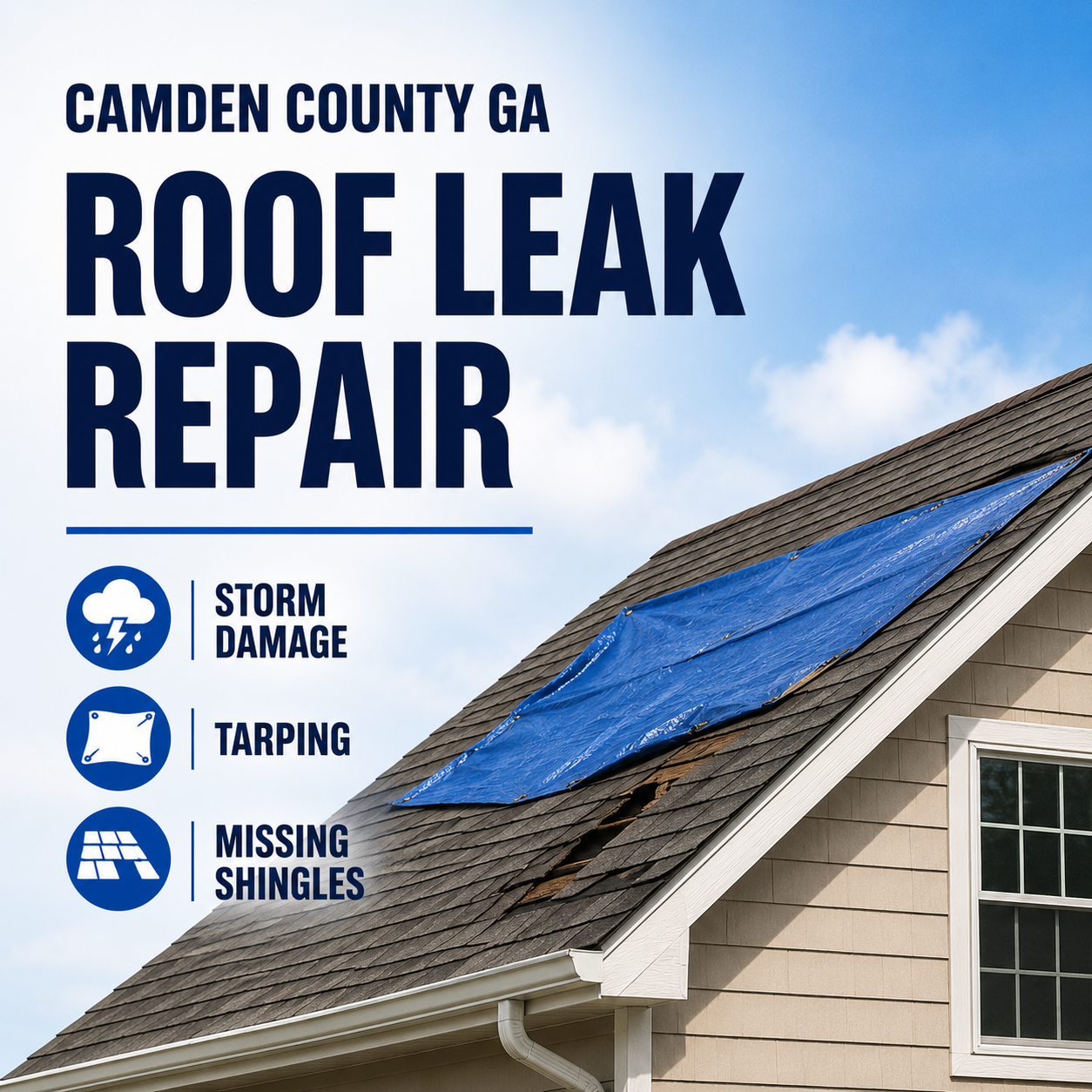
Roof Leaking After a Storm in Camden County? Stop the Water Before It Gets Worse
A roof leak has a way of turning a normal day upside down. One minute the house is quiet. The next minute there is a brown ceiling spot, water dripping into a bucket, shingles in the yard, or somebody saying the roof needs to be replaced right away.
If you are in Kingsland, St. Marys, Woodbine, Waverly, White Oak, Tarboro, Harriett’s Bluff, Dover Bluff, or another part of Camden County, the first job is simple: keep the water from doing more damage. After that, the question becomes whether you need emergency tarping, a small roof leak repair, missing-shingle repair, flashing repair, roof-deck work, tree-damage help, insurance documentation, or a second look before you approve a bigger job.
If the roof is leaking right now, think in stages
A roof leak is stressful because the clock matters. The longer water gets in, the more likely it is to reach insulation, ceiling drywall, attic framing, flooring, wiring, cabinets, or personal belongings. But moving too fast can also cause problems if you climb on a wet roof, skip photos, or sign a storm-repair contract you do not understand.
Do not climb onto a wet, steep, or storm-damaged roof. The safest useful photos are usually from the ground, from inside the attic if the area is safe, or from a contractor who has the right equipment.
Water coming in right now? Start inside the house.
When water is dripping from the ceiling, most people want to run outside and look at the roof. That is understandable, but the safer first move is usually inside the house. Get people away from hazards, protect what you can, and document the damage before everything gets moved around.
What kind of roof leak does this look like?
Water does not always show up directly under the hole. It can run along rafters, roof decking, underlayment, pipes, wires, or ceiling framing before it drips into a room. That is why the inside stain and the outside roof damage may not line up perfectly.
| What you see | What it may point to | Question to ask |
|---|---|---|
| Missing shingles after wind | Wind damage, exposed fasteners, torn tabs, damaged underlayment, or a leak path that opens during the next rain. | “Is the roof dry-in intact, or do we need a tarp before more rain?” |
| Lifted or creased shingles | Wind-lifted shingles may not be obvious from the ground but can let wind-driven rain underneath. | “Are the shingles sealed down, creased, or damaged beyond a small repair?” |
| Leak near a bathroom or kitchen vent | Pipe boot failure, vent flashing problem, cracked rubber boot, or fastener issue. | “Is this a pipe boot or flashing repair instead of a whole-roof problem?” |
| Leak near a wall, chimney, or roof edge | Step flashing, counterflashing, kickout flashing, siding transition, fascia, or roof-wall intersection issue. | “Was the flashing inspected closely, not just the shingles?” |
| Leak around a skylight | Skylight flashing, seal failure, curb issue, cracked skylight, or roof slope/installation problem. | “Is the skylight itself leaking, or is the flashing around it leaking?” |
| Metal roof drip or stain | Fastener, seam, flashing, panel overlap, ridge cap, boot, or coating issue. | “Are the fasteners, seams, and roof penetrations being checked?” |
| Tree limb or debris impact | Punctured shingles, cracked decking, broken rafters, gutter damage, or hidden roof-deck damage. | “Is this only a roof repair, or does decking/framing need inspection too?” |
| Water at soffit, fascia, or gutter line | Gutter overflow, fascia rot, drip edge issue, roof edge leak, or wind-driven rain. | “Is the water entering through the roof surface or backing up at the edge?” |
Plain English: a leak near a vent boot is a different repair than a tree limb through the roof. A missing shingle is different from a flashing problem. The better the leak source is narrowed down, the less likely you are to be pushed into the wrong scope.
Emergency tarp now or permanent roof repair now?
Tarping is not the same as fixing the roof. It is a temporary dry-in step used to reduce more water intrusion until the permanent repair can happen. Sometimes a roofer can safely repair the leak right away. Other times, tarping is the practical move because more rain is coming, materials are not available, the roof is unsafe, or insurance documentation is still being sorted.
Ask what the tarp covers and how long it is meant to last. A tarp is not a roof. It can loosen, shift, leak at fasteners, or fail in more wind if it is not installed correctly.
Why Camden County storm context matters
Camden County is a coastal Georgia county, so roof leaks can show up after tropical rain, wind-driven rain, strong thunderstorms, falling limbs, and storm debris. The county’s hurricane preparedness information lists hurricane hazards such as storm surge, high winds, tornadoes, and flooding. That does not mean every roof leak is hurricane damage. It means storm history is important when you describe the problem.
Camden County also has a real housing base. U.S. Census QuickFacts lists 60,143 people and 25,155 housing units for Camden County in 2025, plus 446 building permits in 2025. More homes means more roofs, more storm exposure, and more repair decisions after bad weather.
Roof leak, storm damage, or old wear?
This is where homeowners get stuck. A leak may start during a storm, but that does not automatically prove the storm caused every problem. A roof may also have old worn shingles, cracked sealant, aging pipe boots, clogged gutters, previous repairs, or flashing that finally failed during heavy rain.
The goal is not to guess. The goal is to document what happened, stop further damage, and ask the roofer to explain what they actually found. If insurance may be involved, talk to your insurance company before committing to storm-related repairs.
| Situation | What it may mean | What to document |
|---|---|---|
| Shingles in the yard after wind | Possible wind damage, especially if the roof was intact before the storm. | Photos of shingles, roof slope from the ground, storm date, and leak location inside. |
| Old ceiling stain got darker | Old leak may have reopened, or the same weak area may be letting water in again. | Before/after photos, date noticed, attic photos if safe, prior repair records. |
| Only leaks in hard rain | Could involve flashing, wind-driven rain, roof slope, gutter overflow, or a small opening. | Which direction the rain came from, where water appeared, and any exterior clues. |
| Leak near chimney, skylight, or wall | Often a flashing or transition problem, not always a full roof failure. | Photos of the transition area, interior stain, and any previous sealing or caulking. |
| Tree hit the roof | May involve shingles, decking, framing, gutters, soffit, fascia, or electrical service. | Tree/debris photos, roof impact area, interior leak, and any emergency work invoices. |
| Roofer says replacement only | May be accurate for major damage or old roof condition, but ask what makes repair unrealistic. | Written scope, photos, roof age if known, damaged areas, and repair-vs-replacement explanation. |
Take the photos before everything gets cleaned up
You do not need perfect photos. You need enough photos to show what happened. If you later talk to a roofer, insurer, restoration company, or local office, the first photos can help explain the timeline.
Storm repairs in Georgia: slow down before signing
Storm damage brings urgency, and urgency can attract bad actors. Georgia’s consumer guidance warns that storm victims can be vulnerable to home-repair fraud because they are trying to get back to normal quickly. It also warns homeowners to be careful with contractors who ask for large upfront payments, pressure people after storms, or offer deals that sound too easy.
If insurance may be involved, talk to your insurance company before committing to storm-related repairs. A roofer can inspect and explain damage, but Georgia Consumer Ed says roofers are not allowed to file claims for customers unless the roofer is, or employs, a licensed public adjuster. Georgia Consumer Ed also says roofers are not allowed to pay a storm victim’s insurance deductible.
Good rule: stop the water, document the damage, talk to your insurer if a claim may be involved, and verify the company before approving a large storm-repair contract.
Permit, business-license, and contractor questions
Roof leak repair is not always permit-heavy, but the rules can depend on the address and the scope. A few replacement shingles may not be treated the same way as structural roof work, roof-deck repair, manufactured-home work, storm rebuilding, electrical damage, or work tied to an addition.
St. Marys says roofing or replacing shingles does not require a building permit, but anyone hired to do work in St. Marys must have a Georgia Occupational Tax license from the city or county where their business is located. Camden County’s online portal lists permit applications for building, electrical, manufactured home, accessory structure, pool, and demolition permits, plus occupational tax certificates for businesses located in unincorporated Camden County.
| Where the home is | Question to ask | Why it matters |
|---|---|---|
| St. Marys | “Does this scope require anything beyond normal shingle replacement, and does the contractor have the required occupational tax license?” | Simple shingle replacement may not require a building permit, but hired contractors still need proper local business credentials. |
| Kingsland | “If decking, structure, electrical, or major storm repair is involved, what does the city require?” | More than a small leak repair may bring permitting, inspection, or contractor-verification questions. |
| Woodbine | “Is this a simple repair, or does the city need to be contacted because the scope is bigger?” | City rules can differ from unincorporated county rules, so address matters. |
| Unincorporated Camden County | “Does this repair involve building, electrical, manufactured-home, or structural work that should go through the county portal?” | Camden County has an online portal for multiple permit types and inspection requests. |
| Manufactured or mobile home | “Is this roof work tied to manufactured-home rules, roof-over work, or structural damage?” | Manufactured-home work can follow a different path than a standard site-built shingle roof. |
Georgia wording matters: roofers are not required to hold a Georgia state roofing license the way some other trades are regulated. Ask for business-license information, insurance, references, written warranty terms, and permit handling when the repair scope calls for it.
Mobile or manufactured home roof leaking in Camden County?
A manufactured-home or mobile-home roof leak can be a different repair conversation than a site-built asphalt-shingle roof. Georgia’s manufactured-housing wind-zone guidance places Camden among the coastal counties affected by Wind Zone 2 requirements for manufactured homes, which is one reason wind and roof details should not be brushed aside in coastal areas.
That does not mean every manufactured-home roof leak is complicated. It does mean the roofer or repair company should understand the roof type, fastening, seams, roof-over work, ceiling panels, vents, and any storm-related uplift or water intrusion.
Kingsland, St. Marys, Woodbine, and nearby Camden County areas
This guide is countywide, but the location still helps sort the next step. A homeowner in St. Marys may have different city questions than a homeowner outside city limits. A Kingsland roof leak after wind may need fast tarping before more rain. A rural property may need tree work, driveway access, or unincorporated county permit questions.
Who should you call first?
A roof leak can involve more than one kind of professional. The right first call depends on whether water is actively coming in, whether a tree is on the roof, whether electrical hazards are present, and whether insurance may be involved.
| Situation | Likely first call | Why |
|---|---|---|
| Water is actively coming in | Roofer or emergency roof tarp service | The immediate need is to stop more water from entering, then plan the permanent repair. |
| Tree or large limb hit the roof | Tree service plus roofer | The tree may need safe removal before the roof can be inspected or tarped. |
| Water near electrical fixtures | Electrician or emergency services if unsafe | Wet electrical systems can be dangerous and should not be handled casually. |
| Ceiling, walls, or flooring are wet | Roofer and possibly water-damage mitigation company | Stopping the roof leak is step one; drying wet materials may be another job. |
| Insurance claim may be involved | Insurance company plus roofer for documentation | Talk to your insurer before committing to storm-related repairs if a claim may be opened. |
| Only a small old stain is visible | Roofer for leak inspection | A small stain may still point to a vent, flashing, roof edge, or shingle issue that should be checked. |
| Major decking or structural damage | Roofer, contractor, local permit office | More than a simple shingle repair may bring structural, permit, or inspection questions. |
Questions to ask before approving roof leak or storm-damage work
A good roofer should be able to explain what they found in normal language. If the scope sounds rushed or confusing, ask for details before you approve the work.
Roof leaking now? Send photos before the next rain.
If you are not sure whether you need a tarp, a small roof repair, storm-damage documentation, a second opinion, or a different kind of contractor, send what you have. A few clear photos and a short description can help sort the next question.
Need help sorting a Camden County roof leak?
Start with the basics: where is the water showing up, when did it start, what changed outside, and is more rain coming? Then gather photos, keep invoices, and ask the roofer to explain whether this is a leak repair, emergency tarp, storm-damage repair, flashing issue, roof-deck concern, or replacement conversation.
Mad Labs Local Repair Help can help you organize the next questions before you sign — whether that means calling a roofer, emergency tarp service, insurer, water-damage company, tree company, electrician, or local permit office.
FAQ
Do you provide roof leak repair in Camden County?
No. Mad Labs does not perform roof repair. We provide Local Repair Help by helping homeowners sort whether their issue looks like an active roof leak, emergency tarp need, missing-shingle repair, flashing leak, wind damage, tree damage, insurance documentation issue, permit question, or second-opinion situation.
What should I do first if my roof is leaking right now?
Move people and belongings away from the leak, avoid wet electrical areas, catch water safely, take photos before cleanup, and call a roofer or emergency tarp service if water can keep entering. Do not climb onto a wet or storm-damaged roof.
Does a missing shingle mean I need a new roof?
Not always. A missing shingle may be repairable, but it depends on the roof age, surrounding shingle condition, underlayment, decking, leak location, and whether there is wider wind damage. Ask the roofer to explain why repair is or is not realistic.
When does emergency roof tarping make sense?
Emergency tarping may make sense when water is actively entering, more rain is expected, shingles or decking are exposed, a tree damaged the roof, or the permanent repair cannot be completed right away. A tarp is temporary, not a permanent roof repair.
Should I call my insurance company before the roofer?
If a claim may be involved, talk to your insurance company before committing to storm-related repairs. You may still need a roofer for emergency dry-in or documentation, but do not sign a large claim-related contract before you understand your insurer’s process.
Can a roofer file my insurance claim for me in Georgia?
Georgia Consumer Ed says roofers are not allowed to file claims for customers unless the roofer is, or employs, a licensed public adjuster. A roofer can inspect damage and provide repair information, but claim handling has rules.
Can a roofer pay my insurance deductible?
Georgia Consumer Ed says roofers are not allowed to pay a storm victim’s insurance deductible. Be careful with anyone who offers to cover, waive, absorb, or rebate your deductible.
Are roofers licensed by the state of Georgia?
Georgia consumer guidance says roofers are among the specialty occupations not required to be licensed by the state. That makes it important to ask for business-license information, proof of insurance, local references, written scope, warranty terms, and permit handling when needed.
Does roof repair in St. Marys require a permit?
St. Marys says roofing or replacing shingles does not require a building permit, but anyone hired to do work in St. Marys must have a Georgia Occupational Tax license from the city or county where their business is located. Bigger scopes, structural work, electrical issues, manufactured-home work, or other repairs may need separate review.
What photos should I take after storm roof damage?
Take photos of the ceiling stain or leak, wet floors and belongings, attic if safe, missing shingles, roof debris, tree limbs, gutters, vents, flashing, skylights, tarps, and any invoices or written estimates. Take roof photos from the ground unless a professional is doing the inspection safely.
What Camden County areas does this guide cover?
This guide is for homeowners in Camden County, including Kingsland, St. Marys, Woodbine, Waverly, White Oak, Tarboro, Harriett’s Bluff, Dover Bluff, and nearby unincorporated areas.


%20(7).png)