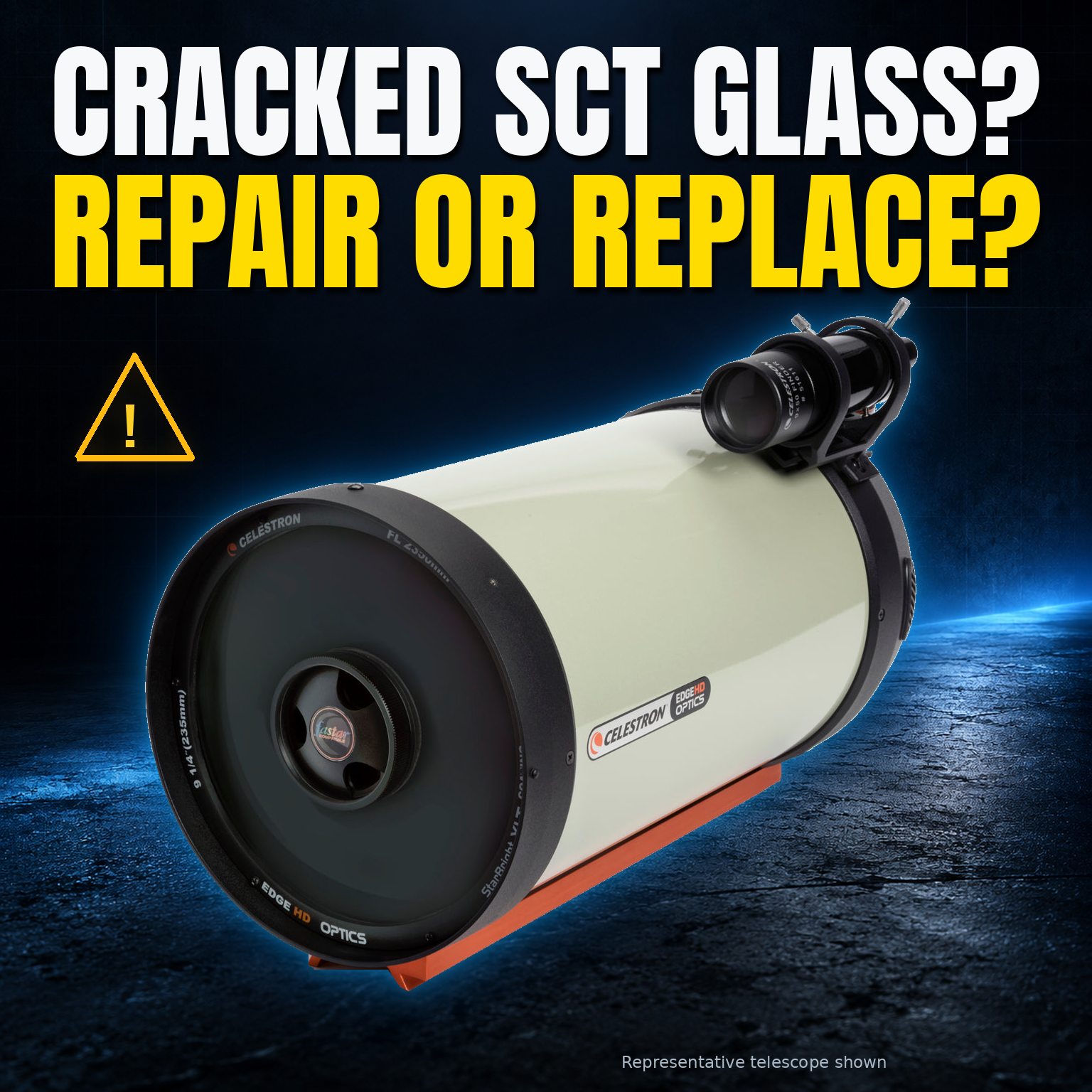
Cracked glass at the front of your telescope does not, by itself, tell you to throw away the whole telescope. The useful comparison is a complete repair of your existing tube against a compatible working replacement tube. If neither route is clear or worthwhile, leaving the telescope unrepaired is a reasonable decision too.
This guide covers physically damaged front glass on Celestron traditional Schmidt-Cassegrain telescopes, usually called SCTs, and Celestron EdgeHD tubes. The optical tube assembly, or OTA, is the tube with its optics, separate from the mount and tripod. Traditional SCT and EdgeHD designs should not be treated as interchangeable repair jobs.
If the glass is cracked, loose or shattered, stop using the telescope and leave the optics and fragments alone. Do not remove the plate, loosen retaining hardware, rotate the optics, apply glue or tape, or keep testing the view. Get handling guidance for the actual damage before moving or packing it. Photos are optional: use only ones you already have or can take from a safe existing position without reaching near the broken glass.
Start with the glass you can see
The front corrector plate is the large glass optical component across the front of the tube. It works with the telescope’s mirrors to form the image; it is not simply a protective window. The central secondary assembly is a different component, as are an eyepiece or a reducer/corrector accessory attached at the rear.
You do not need to know the optical terminology to describe the problem. Use what you can already see, without opening anything or trying to find more damage.
- “There is a crack across the front glass” or “a piece is missing.”
- Describe the visible break and what happened before you noticed it. That is enough to start a physical-damage inquiry. It is not a reason to inspect the mirrors yourself or collect loose pieces.
- “There is a small mark near the edge.”
- Say where it is and whether it appeared after an impact, cleaning attempt or another event. Appearance alone cannot establish whether it is a chip, how stable it is or what work is appropriate. A photograph should not be used to declare it harmless or prescribe replacement of every optic.
- “It looks cloudy or dirty, but I cannot see a break.”
- That is a different starting point. Ask about care or assessment for the exact telescope rather than assuming it needs a breakage repair. Do not clean a suspect mark to find out whether it is a chip.
“I don’t know what condition the mirrors are in” is a useful, honest answer. Do not remove a cap that could contact damaged glass, shake the tube, touch fragments or try a star test to fill that gap. Further examination belongs in an accepted assessment with appropriate handling.
This is not a guide to ordinary dust, cleaning, blurry-view troubleshooting, mount electronics or rear accessories. It also does not cover other telescope designs such as refractors, Newtonians, Maksutovs or RASA tubes. If you are unsure what you own, start with its identification rather than a repair assumption.
Get the tube identity right before discussing parts
A telescope may have been sold as a package, changed mounts or acquired accessories over the years. The name on the mount, an old advertisement or a family member’s recollection may not identify the tube accurately enough for a repair assessment.
Gather the details you can find in existing receipts, manuals, listing records or safely accessible labels. You do not need to detach a tube, turn it over or alter hardware to complete the list.
- The tube: Celestron model name, stated aperture and whether it is a traditional SCT or EdgeHD. Include a serial number or approximate age if readily available.
- The mount: its separate model name and whether the tube is still attached to it. Say if it is a fork-mounted setup rather than guessing how it should come apart.
- The event: a fall, impact, attempted cleaning, earlier disassembly or an unknown history. “I inherited it like this” is enough if that is all you know.
- Other known problems: missing parts, visible tube-body damage or focusing and mount faults noticed before the break. Report observations, not a diagnosis.
- Changes and previous work: modifications, earlier service and any estimate already received. Keep the estimate’s stated scope with it so a loose-part offer is not mistaken for a complete repair.
The result should be a short description of one specific tube, its known damage and its unknowns. A mount that still powers on does not establish that the setup escaped the impact undamaged. Likewise, a familiar aperture or model family does not establish that a provider will accept this particular age, condition or modification history.
These details also keep the replacement comparison honest. If your mount was damaged in the same fall, buying another OTA may leave you with a second unresolved problem. Its condition needs to be accounted for separately.
Ask for a complete repair scope, not a loose plate price
Finding a corrector plate for sale can make the decision look simpler than it is. A matching diameter or familiar model label does not establish that the part is suitable for your tube, that someone will install a customer-supplied part, or that the finished telescope will be aligned and checked.
A useful proposal describes an accepted repair of the optical tube. It should distinguish what is known now from what can only be determined after inspection. The important questions are:
- Will this exact telescope be accepted? Confirm the model, age, damage and modifications. Ask what might prevent work from proceeding after inspection and whether required parts are confirmed or still uncertain.
- What will be replaced and what will be retained? Ask which findings support that scope. Do not assume that every damaged corrector requires a new optical set, or that a donor plate is interchangeable.
- What does the total cover? Ask about inspection, the necessary optical work, alignment or collimation, and checks of the reported complaint. Have other known faults and excluded work stated separately.
- What happens if the scope changes? Establish which changes need your approval before work continues. Ask about assessment charges, declining the repair and having the tube returned unrepaired.
- What will document the result? Ask what testing and written repair record are provided, what warranty or adjustment terms apply, and who will handle a remaining problem after return.
An assessment may identify work beyond the visible break; the proposal should explain why that work is needed.
Where the manufacturer route fits
Celestron has a service-return process. That is a route to investigate, not confirmation that every damaged, older or modified tube will be accepted. Celestron requires a return authorization (RA/RMA) before a service return; submitting an inquiry is not permission to ship.
The receiving provider may need the assembled optical tube rather than a loose piece of glass, and may not need the mount or tripod. Let that provider specify the required assembly and preparation for the actual damage. Do not strip the telescope down to match something another owner sent.
You can use an existing manufacturer assessment or another genuinely accepted repair proposal in the comparison below. A MadLabs inquiry is optional, and no inquiry should be treated as proof of repair availability.
Check what a working replacement tube would change
If the rest of your equipment is useful, replacing the whole telescope package may be unnecessary. Compare the repaired existing OTA with a complete, working replacement OTA that suits your use. Do not automatically use the cost of a new computerized mount and tripod to make repair look attractive.
“Same brand and aperture” is not a compatibility check. Before treating an offer as your alternative, confirm the following for the actual replacement and retained equipment with an appropriate equipment specialist or manufacturer:
- Optical design and intended use. Is it the configuration you want for visual observing or imaging? A switch between a traditional SCT and EdgeHD deserves its own check rather than being treated as an identical tube.
- Mounting and clearance. Does the mounting interface or dovetail suit the mount? Are capacity and physical clearance appropriate for the setup you intend to use? Do not assume that an adapter alone settles those questions.
- Accessories you need to keep. Check the particular rear observing or imaging accessories, not just whether something is described as “for an SCT.” Transfer across optical designs or sizes should not be promised without confirmation.
- What is included and working. Establish the actual equipment supplied, current condition, known repair history and how working status has been demonstrated. Ask about trial or return terms rather than relying only on exterior photographs.
- What it takes to put into service. Include necessary accessories, adaptation, setup or professional handling. If the existing tube is attached to forks or a mount, obtain advice about the practical options without attempting removal.
A new OTA, a tested used OTA and an untested auction tube are different alternatives. So are a complete tube and an incomplete donor. A sold-out listing or an old asking price can give context, but it cannot supply a working replacement you can actually buy.
For a used offer, keep a record of the stated condition, included equipment and return terms alongside the figure you use. If those facts are missing, mark them as unknown. A low advertised amount does not resolve the risk of another damaged or unsuitable tube.
Replacing the OTA may let you keep a serviceable mount and useful accessories. Whether it does so in your case is a question to settle before committing to the purchase, not after the replacement arrives.
Compare the total cost, then choose a branch
Use a current, complete repair proposal and a real replacement offer. Keep any unconfirmed entry visibly marked unknown; do not turn it into zero. If a fee is already included in a quoted total, label it as included rather than adding it again.
The worksheet below has no suggested prices. It is a place to organize your own figures and terms, not a telescope repair price guide. Separate the cost of completing each route from the charges you would face if you stop or return something.
| Repair your existing OTA | Buy a compatible working OTA |
|---|---|
| Accepted work and assessment Necessary repair, inspection charges and any confirmed additional damage. Note what remains excluded. Your figure or unknown: __________ |
The actual replacement offer A complete, available tube with suitable specification and established working condition. Record what is included. Your figure or unknown: __________ |
| Other necessary costs and tax Any separately quoted work or preparation needed to complete this route, plus applicable tax. Your figure or included: __________ |
Required extras and tax Necessary accessories, adaptation, setup or immediate known service, plus applicable tax. Your figure or included: __________ |
| Approved packing and both journeys Packing appropriate to the damage, outward and return transport, and the agreed transit coverage. Your figure or unknown: __________ |
Delivery and collection Transport for this replacement and any required handling. Note separately what a return would involve. Your figure or unknown: __________ |
| Total to complete the accepted repair: __________ | Total to put the replacement into use: __________ |
| If you decline after assessment Record assessment charges, unrepaired-return costs and any other agreed charges. Keep these separate from the completed-repair total. |
If the replacement must be returned Record the return window, conditions and costs. Do not assume delivery or required accessories will be refundable. |
On a narrow screen, scroll the worksheet sideways to see both columns. If you intend to sell the damaged tube, account for as-is proceeds separately and only when you have a credible offer. Do not invent a salvage value to make the replacement total look better.
Then look beyond the cash total. Which option leaves you with the optical configuration you want? What useful condition remains in the original tube? How firm is the timing, how difficult is transport, and what written coverage applies? Personal attachment can matter too, but keep it separate from a claim that repair will pay for itself.
Repair may be the better choice
Your existing tube is otherwise useful, its model and condition have been accepted, and the proposal addresses the damage and other known faults. Once assessment, freight and terms are included, you prefer that outcome to the available compatible replacement.
A valuable tube can leave room for repair costs, but its original purchase price does not settle the decision. The accepted scope and the equipment you will have afterward matter more than how expensive it was when new.
Replacing the tube may be the better choice
You have found a suitable tested replacement, confirmed its fit with the equipment you will keep, and established its full cost. Repair and transport may come too close to that option, or repair may leave significant problems unresolved.
This can be relevant to an older, lower-value tube, but age or aperture is not an automatic verdict. An unavailable bargain is not a replacement plan, and an untested tube may simply move the uncertainty to a different purchase.
Declining or deferring may be the better choice
No one has accepted the model and condition, required parts or work remain unresolved, or safe transport is impractical. The tube may also be incomplete or extensively damaged, or neither finished setup may suit what you want to do. In those circumstances, pausing is more sensible than buying loose glass or shipping speculatively.
If you inherited the telescope and intend to sell it, obtain a credible as-is valuation before committing to major work. Restoration spending is not guaranteed to come back in a sale. Choosing not to repair is a legitimate result of the comparison, not a failure to appreciate the instrument.
Agree on handling and shipping before moving it
A damaged SCT needs instructions for its actual condition. A generic telescope packing guide, another owner’s shipping story or the fact that you still have the original box does not establish that your broken-glass shipment is suitable.
Before the telescope leaves you, settle these points with the receiving provider:
- Acceptance and destination: the exact model and described damage have been accepted for assessment, the correct destination is confirmed, and any required return authorization or reference has been issued.
- The assembly they want: which parts of the setup should be sent, and whether a tube still attached to a mount or forks needs qualified handling or a different route.
- Damage-specific preparation: how the broken glass, available packaging, protective case and modifications affect the plan. Ask rather than improvising fragment removal, optical removal or hardware changes.
- The full journey: packed dimensions and weight for the actual assembly, both freight legs, transit coverage and responsibility if there is further damage.
- What happens after assessment: approval of changed work, any decline and return charges, and the arrangements if repair cannot proceed.
Do not assume that a heavy protective case, an old shipping box or ordinary parcel insurance solves the handling and coverage questions. If the telescope cannot be moved safely, say so before a shipment is planned. A tube-only job and a large fork-mounted system can have very different practical constraints.
If you believe a warranty, insurance policy or other coverage may apply, establish the relevant requirements before authorizing paid work. Do not assume accidental damage is covered or that a prior repair quote establishes eligibility.
Also agree on what happens after return: what checks will be documented, how you should report a remaining complaint and who handles it. Ask about the terms for this job without assuming factory-new performance, a particular turnaround time or automatic coverage of later problems.
Questions owners ask about a damaged corrector
- Can I buy only the front glass?
- A part may be offered separately, but that does not secure an installed repair. Before buying it, establish whether the exact tube can be accepted, what work is required and whether a customer-supplied part would be accepted at all.
- Does the whole optical set always need replacing?
- Do not assume a universal answer in either direction. Ask which components the proposal replaces or retains and why. A donor plate should not be treated as interchangeable simply because it came from a similarly named telescope.
- Can I keep my mount and replace only the tube?
- That may be possible if the mount is serviceable and the replacement’s mounting interface, capacity, clearance and accessories are confirmed for the setup. A tube still attached to forks also needs a practical handling plan, not home removal instructions.
- Is a small edge chip worth repairing?
- The appearance of the chip alone cannot settle its effect, stability or the best response. Describe what is already visible and seek an assessment for that model and condition; do not test, clean or handle the damaged area to decide for yourself.
Send MadLabs the details, not the telescope
MadLabs helps review repair inquiries and investigate possible next steps. We are not the workshop carrying out this optical work, and whether a suitable service route is available for your particular telescope must be confirmed.
If you would like us to review the situation, send the tube and mount model where known, a plain description such as “cracked front glass,” and what happened. Include any missing parts or modifications, previous service or estimate, your location and any budget or timing constraints that affect the decision. Existing safely obtained photos can help; do not open, move or test a damaged telescope to gather more information.
You do not need a complete diagnosis to ask. “Unknown” is fine for details you cannot establish safely. An inquiry is not a repair acceptance, quote or shipping authorization, and we cannot guarantee that a repair route will be available.
Keep the telescope with you until acceptance, terms and handling instructions are confirmed. The next useful step is a clear assessment route and a fair comparison, not a parcel sent on the hope that someone can repair it.