
Last updated: June 1, 2026
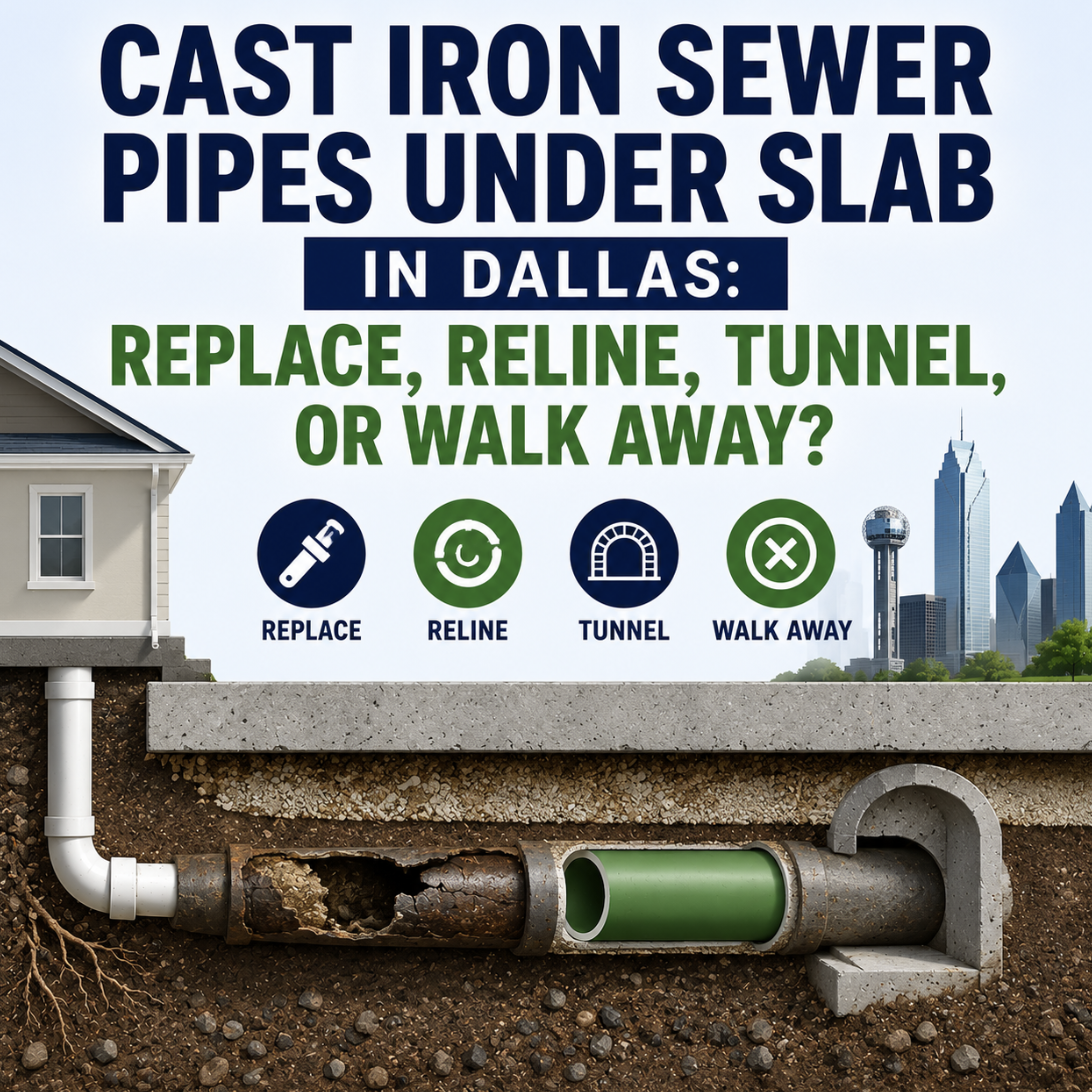
Cast Iron Sewer Pipes Under Slab in Dallas: Replace, Reline, Tunnel, or Walk Away?
A sewer scope can turn a normal Dallas-area home inspection into a very expensive question fast.
The camera goes under the slab, the plumber says the cast iron is cracked, channeling, holding water, or near the end of its life, and suddenly you are hearing words like tunnel, full replacement, pipe lining, hydrostatic test, or even walk away.
This guide is for the homeowner or buyer who is trying to slow the whole thing down and make a clear decision. Not panic. Not sign the first huge quote. Not ignore the problem either.
Start here: the pipe is not the only decision
When cast iron sewer pipe is under a slab, the repair question is rarely just “how much does pipe cost?” The real decision is about access, risk, timing, documentation, and whether the sewer video actually proves the repair being recommended.
You are choosing a repair path
You may be deciding between cleaning, monitoring, spot repair, pipe lining, tunneling, full under-slab replacement, or replacing the yard line too.
You are choosing a real estate move
You may be deciding whether to negotiate, ask for repairs, request a credit, extend your option period, get a second scope, or walk away.
Big warning: A sewer quote should match the sewer video. If the quote says “full replacement,” but the video does not clearly show where the failure is, what branches are included, and why lining or spot repair is not enough, you need more information before signing.
Why this comes up in Dallas and North Texas
A lot of older Dallas-area homes were built with cast iron drain and sewer piping. Many of these homes are on slab foundations, which means the pipe is not sitting in an easy basement ceiling where someone can simply open a panel and swap it out.
Once that pipe is buried under concrete, every repair method has tradeoffs. You may be dealing with access tunnels, interior floor cuts, trenchless lining, yard excavation, city tap questions, or a combination of all of them.
North Texas also has a lot of clay soil that moves as moisture conditions change. That does not mean every sewer issue is caused by soil movement, but it does explain why under-slab plumbing, foundation performance, drainage, leaks, and moisture control often get talked about together in this region.
Plain English: This is not just “old pipe.” It is old pipe, under concrete, in a region where foundation and moisture issues already make homeowners nervous.
Do not start with the quote. Start with the sewer scope.
Before you compare replacement, relining, tunneling, or walking away, you need to know what the camera actually saw.
A good sewer scope should not just say “cast iron is bad.” It should help answer where the pipe is damaged, how much is damaged, whether the problem is under the slab or outside in the yard, and whether all branches were inspected or only the main line.
| Scope detail | Why it matters | Question to ask |
|---|---|---|
| Pipe material | Confirms whether the line is cast iron, PVC, clay, or a mix of materials. | Where does cast iron start and stop? |
| Location | Under-slab pipe, yard pipe, and city connection work can have different repair paths. | Is the defect under the slab, outside the house, or both? |
| Distance footage | Helps match video defects to a physical location. | Does the video show footage and a marked layout? |
| Branches | Bathrooms, kitchen, laundry, and other branches may not all be included in one camera run. | Were all branches scoped or only the main line? |
| Flow and standing water | Water sitting in the pipe may point to slope, sag, blockage, or pipe shape issues. | Is there a belly, blockage, or broken section holding water? |
| Before/after cleaning | Heavy scale can hide the pipe wall, cracks, or missing bottom. | Was the line cleaned before the final video? |
Be careful with vague reports. “Cast iron is old” is not the same as “this exact section is cracked, collapsed, leaking, and not a lining candidate.”
What bad cast iron can look like on camera
Cast iron can fail in a few different ways. Some problems are mostly maintenance headaches. Others point toward structural failure and a bigger decision.
None of these words automatically means one specific repair. The point is to connect the video evidence to the right repair option.
Replace, reline, tunnel, spot repair, or wait?
There is no single answer for every Dallas slab home with cast iron pipe. A good recommendation depends on the video, the pipe layout, access points, how many branches are affected, the slope, the condition of the pipe, and whether this is a home you own or one you are trying to buy.
| Option | When it may fit | Watch out for |
|---|---|---|
| Clean and monitor | Minor scale or slow drains with no strong evidence of structural failure. | Repeated cleaning can hide a bigger problem if backups keep returning. |
| Spot repair | One known break, offset, or isolated bad section. | The quote should explain why nearby pipe is not being replaced. |
| CIPP / pipe lining | Pipe can be cleaned, accessed, measured, and lined without major defects blocking installation. | Bad sags, collapse, severe misalignment, or missing structure may rule it out. |
| Under-slab tunneling | Physical pipe replacement is needed below the slab and interior demolition is being avoided. | Ask about tunnel safety, inspections, backfill, compaction, and plumbing support. |
| Interior floor access | Sometimes used when tunneling is not practical or the work area is already being remodeled. | Flooring, concrete, dust, interior protection, and restoration can become major issues. |
| Full system replacement | Widespread failure, multiple branches, poor pipe condition throughout, or repeated failures. | Make sure the quote clearly includes what is and is not part of the system. |
Good rule: If the recommendation is expensive, the video and written scope should be specific enough that another qualified plumber can understand exactly why that repair path was chosen.
When relining may or may not make sense
Pipe relining can be a useful option, but it is not magic. A liner does not make every bad pipe a good candidate. The old pipe still has to be cleanable, accessible, measured correctly, and suitable for the lining method being proposed.
A relining contractor should be able to explain what they saw on the camera, how the pipe will be cleaned, how service openings or branch connections will be handled, and what final video or testing you receive after the work.
Good lining candidate signs
- The pipe can be cleaned enough to inspect and prepare.
- The pipe is not collapsed.
- There is enough access to install the liner properly.
- The pipe shape and slope are acceptable for the method.
- Branches and tie-ins are clearly planned.
Bad lining candidate signs
- Collapsed or severely broken sections.
- Major sags that hold water.
- Serious misalignment or offsets.
- Obstructions that cannot be cleared.
- Unclear branch layout or missing access.
Ask this directly: “What makes my pipe a good lining candidate, and what did you see that would make lining a bad idea?”
What tunneling under a slab really means
Tunneling is common enough in North Texas plumbing conversations that people sometimes talk about it casually. But for the homeowner, it is still a big deal.
Tunneling means workers access the under-slab plumbing from outside the home by digging under the foundation. The goal is to reach and replace pipe without cutting open finished floors. That can be helpful, but it brings its own questions about safety, engineering, inspections, backfill, compaction, and warranty.
| Topic | Why it matters | Question to ask |
|---|---|---|
| Tunnel route | You need to know what areas of the slab are being accessed. | Can you show the tunnel path on a plumbing layout? |
| Pipe support | New plumbing needs proper support under the slab. | How will the new pipe be supported before backfill? |
| Inspections | Local rules may require permits and inspection before the tunnel is closed. | Who pulls the permit and schedules inspection? |
| Backfill | Poor backfill can create future settlement or void concerns. | What backfill method is included, and is compaction addressed? |
| Foundation concerns | Homes with existing foundation movement may need extra care. | Should a foundation specialist or engineer be involved? |
| Warranty | The warranty should say what is covered and what is excluded. | Does the warranty cover pipe only, labor, tunnel work, or restoration? |
Practical tip: If tunneling is part of the quote, make sure it is not treated like a small line item. Ask how the tunnel will be opened, inspected, closed, and documented.
Should you negotiate, extend the option period, or walk away?
If you are buying a Dallas-area home and the sewer scope finds bad cast iron under the slab, you are not just making a plumbing decision. You are making a real estate risk decision.
This is not legal advice, and your agent or attorney should guide the contract side. But from a repair perspective, these are the questions that matter.
- How clear is the video? If the video is vague, you may need a second scope before making a decision.
- How much pipe is involved? One branch is different from the whole under-slab system plus the yard line.
- Does the quote include everything? Tunneling, permits, testing, backfill, concrete, flooring, landscaping, and cleanup may not all be included.
- Will the seller negotiate? A major sewer issue matters more if the seller refuses repair, credit, or price movement.
- Are there other major repairs? Foundation, roof, HVAC, electrical, and sewer all at once can change the risk.
- How much time is left? A rushed option-period decision with incomplete information is where buyers make expensive mistakes.
Walking away is not automatically the right answer. Buying is not automatically the wrong answer. The point is to understand whether the pipe problem is priced into the deal and whether the repair plan is real.
Questions to ask before signing a big sewer quote
This is where a lot of homeowners can save themselves from confusion. A good quote should not just say “replace cast iron.” It should tell you what sections are included, how the work will be accessed, how it will be inspected, and what happens after the pipe work is done.
Red flag: Be careful with any quote that pressures you to commit before you understand the video, the layout, the access method, and what is excluded.
Who to call first in Dallas / North Texas
The right first call depends on where you are in the decision. A buyer under contract may need a different first step than a homeowner with sewage backing up into the tub.
| Situation | Usually call first | Why |
|---|---|---|
| You have no sewer video yet | Sewer scope / camera inspection provider | You need evidence before comparing repair options. |
| The scope shows under-slab damage | Licensed plumbing company experienced with under-slab sewer work | You need a real repair plan, not just a drain-cleaning visit. |
| Relining is being offered | Trenchless lining contractor plus second opinion if needed | You need to confirm the pipe is actually a good lining candidate. |
| Tunneling is being recommended | Under-slab replacement plumber or tunneling/plumbing specialist | You need details on tunnel route, support, backfill, permits, and inspections. |
| You are buying the house | Real estate agent plus sewer/plumbing second opinion | You need repair facts and contract strategy before the deadline. |
| Foundation movement is also present | Plumber plus foundation specialist or engineer if appropriate | Plumbing leaks, soil moisture, and slab movement may need coordinated review. |
Texas hiring tip: For plumbing work, ask for the Responsible Master Plumber information, confirm licensing, check whether permits and inspections are required, and get written estimates that clearly describe the work.
What not to do after a scary sewer scope
When people hear “cast iron under the slab,” they often jump to extremes. Either they ignore it completely, or they assume the whole house is doomed. Neither reaction is helpful.
What to upload for Mad Labs Local Repair Help
If you are staring at a sewer scope, a giant quote, and a deadline, send the details. The goal is to help you understand the decision, organize the right questions, and avoid spending money on the wrong next step.
What we help sort: what the video appears to show, what questions the quote does not answer, whether you need a second opinion, and which local repair path makes the most sense to investigate next.
Need help making sense of a Dallas cast iron sewer scope?
You do not need to become a plumber overnight. But you do need to understand enough to avoid a bad decision.
If the camera found cast iron pipe under a slab, Mad Labs Local Repair Help can help you review the report, organize the repair options, and prepare better questions before you negotiate, hire a contractor, or walk away from a deal.
FAQ
Should I buy a Dallas-area house with cast iron sewer pipes?
Not automatically yes or no. The decision depends on the sewer scope, how much pipe is affected, whether the damage is under the slab, the repair cost, seller negotiation, your timeline, and whether other major issues are present. A second opinion is often worth getting during the option period.
Does cast iron under a slab always need to be replaced?
No. Some cast iron issues are limited, while others are widespread or structural. The sewer video, pipe condition, slope, branches, access, and history of backups should guide the recommendation.
Can cast iron sewer pipe under a slab be relined?
Sometimes. Relining may be an option if the pipe can be cleaned, accessed, measured, and lined properly. Severe collapse, major sags, bad misalignment, or uncorrected obstructions may make lining a poor fit.
Is tunneling under a slab safe?
Tunneling is a common method for accessing under-slab plumbing, but it needs to be planned and performed correctly. Ask about tunnel route, pipe support, inspections, backfill, compaction, warranty, and whether a foundation specialist should be involved.
What is channeling in cast iron pipe?
Channeling usually refers to the bottom of a cast iron drain pipe wearing away or becoming deeply grooved. It can be a sign that the pipe is deteriorating and may no longer be carrying wastewater inside a complete, smooth pipe.
Does a sewer scope show everything?
A sewer scope is very useful, but it depends on access, cleaning, camera quality, visibility, and which branches were inspected. Heavy scale, standing water, bends, or limited access can hide some conditions.
Should I get a hydrostatic test?
A hydrostatic test may be recommended in some real estate or plumbing situations to check for leakage, but it is not the same thing as a sewer camera inspection. Ask a qualified plumber or inspector whether it makes sense for your situation and what the results would prove.
Does homeowners insurance cover cast iron sewer replacement?
Do not assume coverage. Policies vary, and old pipe deterioration or wear may be treated differently than sudden damage. Ask your insurance agent or carrier before counting on insurance to pay for cast iron sewer work.
Do I need a permit for under-slab sewer repair in Dallas or nearby cities?
Permit and inspection rules depend on the city and the exact work. Ask the contractor who pulls the permit, what inspections are required, and whether the work will be documented before the tunnel or slab access is closed.
What should a cast iron sewer replacement quote include?
A good quote should explain what pipe is included, how it will be accessed, whether tunneling or concrete cutting is included, whether yard line work is included, who handles permits and inspections, what restoration is excluded, and what warranty is provided.


%20(7).png)