Removable medium-format backs · After a drop or handling damage
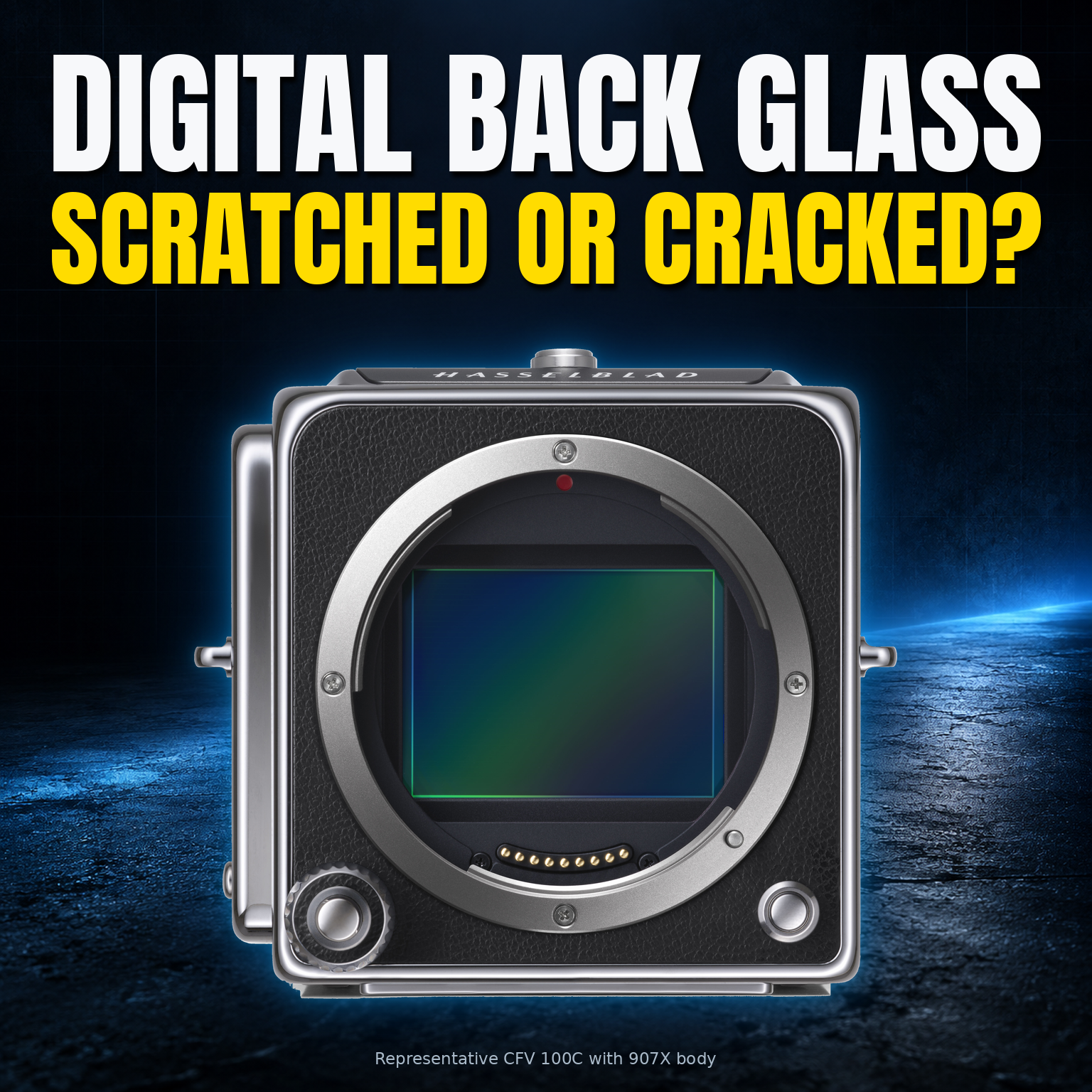
A dropped digital back is a horrible thing to look down at. If you can see a scratch or crack near the sensor, it is easy to assume you need another back. Before spending that money, find out what was damaged and what a repair would actually cover.
The short answer: damaged protective glass may be a separate repair from damage to the image sensor. But a photo of the glass cannot tell you whether the rest of the back survived. Start with the exact back, its camera system and the incident history, then ask for an assessment before approving glass replacement.
This guide concerns removable medium-format digital backs used for ordinary visible-light photography. The glass discussed here faces the lens when mounted; it is not the rear LCD screen. Integrated camera bodies and intentional infrared conversions need different guidance.
Stop before trying to clean the mark away
If the back has been dropped, or the sensor-side glass may be scratched or cracked, pause use and handling. Do not take fresh test shots, remount it to see whether it still works, or try another cleaning pass. Keep the files and observations you already have.
Hasselblad's CFV-50c manual describes protective IR-filter glass in front of the sensor. It also warns against user access to the sensor and removal of the filter. That distinction is useful when discussing repair, but it does not diagnose your damage.
Write down whether the back fell while attached to the camera, was dropped separately, or was marked during mounting or cleaning. Include any action taken afterward. “I haven't operated it since the fall” is useful information; you do not need to prove the fault.
Identify the back, its mount and the camera around it
The body name alone can send an inquiry in the wrong direction. A removable back is its own imaging component, and the assessor needs to know which back is fitted to which camera. Use purchase records, service paperwork or an already accessible label. Leave anything uncertain marked “unknown.”
| Item | What to record | What it helps settle |
|---|---|---|
| Digital back | Exact make, model and suffix; serial privately. | Which unit needs assessment. Copy CFV-50c in full, for example, rather than shortening it to “CFV.” |
| Back mount | Documented mount or fitting; any adapter. | Compatibility. Even an IQ180 replacement comparison needs the mount identified. |
| Camera system | Body or technical-camera model, lens and relevant adapter or connection. | What equipment or information is needed to assess the reported problem. |
| Optical history | Previous glass work or infrared/full-spectrum conversion, if known. | What is installed now and what normal-color restoration would mean. |
| Incident | Attached or detached at the time; what struck what; changes already noticed. | Whether the assessment should extend beyond the visible glass. |
If paperwork only says “sensor repaired,” include it without interpreting it. It may not tell you whether the glass or a larger assembly was changed. Do not remove the back, open it or power it up just to complete this table.
Make normal-color photography part of the request
Digital-back glass repair can appear alongside infrared and full-spectrum conversion services. Those options have different goals. A service mentioning “IR” might concern the filter that blocks infrared, or a modification intended to capture it. Read the proposed result, not just the service heading.
State your goal plainly: “I want the back assessed for repair for ordinary visible-light color photography. I am not requesting an infrared or full-spectrum conversion.”
Ask what replacement optical material is proposed, why it suits your exact back, and whether any change in color response or focus is expected. If material names differ between a listing and the written estimate, get that clarified before approving work. There is no need to choose a glass type yourself.
Focus deserves a specific question. The Phase One XF IQ4 manual, page 124, explains that focus accuracy depends on the presence of its IR filter. This is IQ4-system guidance, not a replacement specification for every older back. Ask how focus and ordinary-color results will be checked for your actual setup.
A proposed normal-color repair still needs assessment. It does not establish that the glass is the only damaged part or promise factory-identical color afterward.
Ask what the impact assessment will cover
The visible scratch is the easiest thing to describe. The more important question is whether a glass-only job would address the whole complaint. Tell the assessor about a bent-looking fitting, loose part, changed focus, communication error or other behavior already noticed after the incident. These are observations to investigate, not diagnoses.
- Can the proposed assessment consider damage beyond the filter? Ask about the underlying imager, mount or alignment concerns, and any reported electronic symptoms.
- What system is needed for a meaningful check? Supply the body and lens details first. Ask whether the back alone is sufficient or particular equipment must accompany it.
- What finding would change or stop the job? Require a revised proposal before additional work if inspection finds more damage or cannot establish a suitable repair path.
Check the original manufacturer or dealer route and any existing repair or accidental-damage coverage before choosing paid work. Hasselblad lists a US service-inquiry route; Phase One distinguishes supported products from models at end of service. Confirm your exact model and reported damage rather than assuming every older back has the same options.
The outcome might be professional cleaning if the suspected scratch is contamination, glass replacement, broader repair, replacement of the back or a decision not to proceed. Ask for the findings that support the recommendation.
Compare a complete repair with a compatible working back
Two estimates called “IR-glass replacement” can include different work. Put the scope beside the total: assessment, proposed material, installation, cleaning, agreed checks and any work beyond the filter. Clarify shipping in both directions, tax, warranty terms and what you owe if the repair is declined or unsuccessful.
Ask which charges are already included and what needs fresh approval. A parts-only price or a glass-service headline is not the cost of resolving an uncertain impact fault.
Make the replacement earn its place in the comparison
Start with the back you would actually buy: the exact model or a confirmed suitable alternative, the right mount, and compatibility with your body or technical-camera setup. Include any necessary adapter, cables or other accessories missing from the offer.
Then ask about that unit's condition, previous glass work or conversion, known faults, documented function checks and return terms. A cheap untested back leaves a different amount of uncertainty than a verified working one. An expensive unrelated camera is not a useful benchmark.
Compare both complete costs with the time you would be without usable equipment. Count the damaged back's resale value only if it is realistically recoverable. There is no fixed repair percentage that makes the decision for you: repair may make sense when the accepted scope resolves the problem; broader impact damage, unavailable work or unacceptable uncertainty may favor replacement.
Send the evidence first; agree what should travel
A useful inquiry does not require a technical verdict. Combine the identification details above with a short incident history and existing original files, if you have them. Keep unedited originals; a marked-up copy can point out the concern. If there are no post-incident files, say so rather than taking new ones.
A short request you can fill in
- Back and system
- [Exact back, mount, body or technical camera, lens; unknown details noted.]
- What happened
- [When, attached or detached, what was struck, visible damage and any behavior already observed.]
- Existing evidence and history
- [Available original files or photos; earlier glass work, conversion or cleaning.]
- Requested result
- Assessment for ordinary visible-light color photography, including whether damage extends beyond the glass.
- Practical limits
- [Location, deadline, spending limit and whether keeping this particular back matters.]
You can use Mad Labs Repair's contact form to ask whether an assessment route is available for your back and system. If attachments are unsuitable, describe what you have and ask how to provide them.
Keep the equipment until a receiving provider accepts the case. Confirm the destination, fees, return arrangements and exactly which components or accessories are needed. Neither “send just the back” nor “send the whole kit” should be the default.
Obtain handling and packaging instructions that account for the actual damage, especially suspected loose glass or a compromised mount. Agree on transit coverage and responsibility in both directions. Do not detach suspect parts to match an intake checklist.
Agree on what will show the problem was resolved
Before authorizing work, ask what the service record will document: the reported defect, work completed, cleanliness, focus and ordinary-color checks relevant to the approved scope. Clarify which camera setup will be used and what cannot be verified if only the back is supplied.
Ask how any remaining defect should be reported and which parts, labor and shipping costs the repair warranty covers. Replacing the filter does not renew every component in an older back. What matters is a clear account of the original problem, the agreed work and the result.
Unsure whether to repair or replace yours? Start with the back's identity and what happened. You can ask Mad Labs about assessment availability without choosing a repair in advance.
A contact request is an inquiry, not repair acceptance or permission to ship.