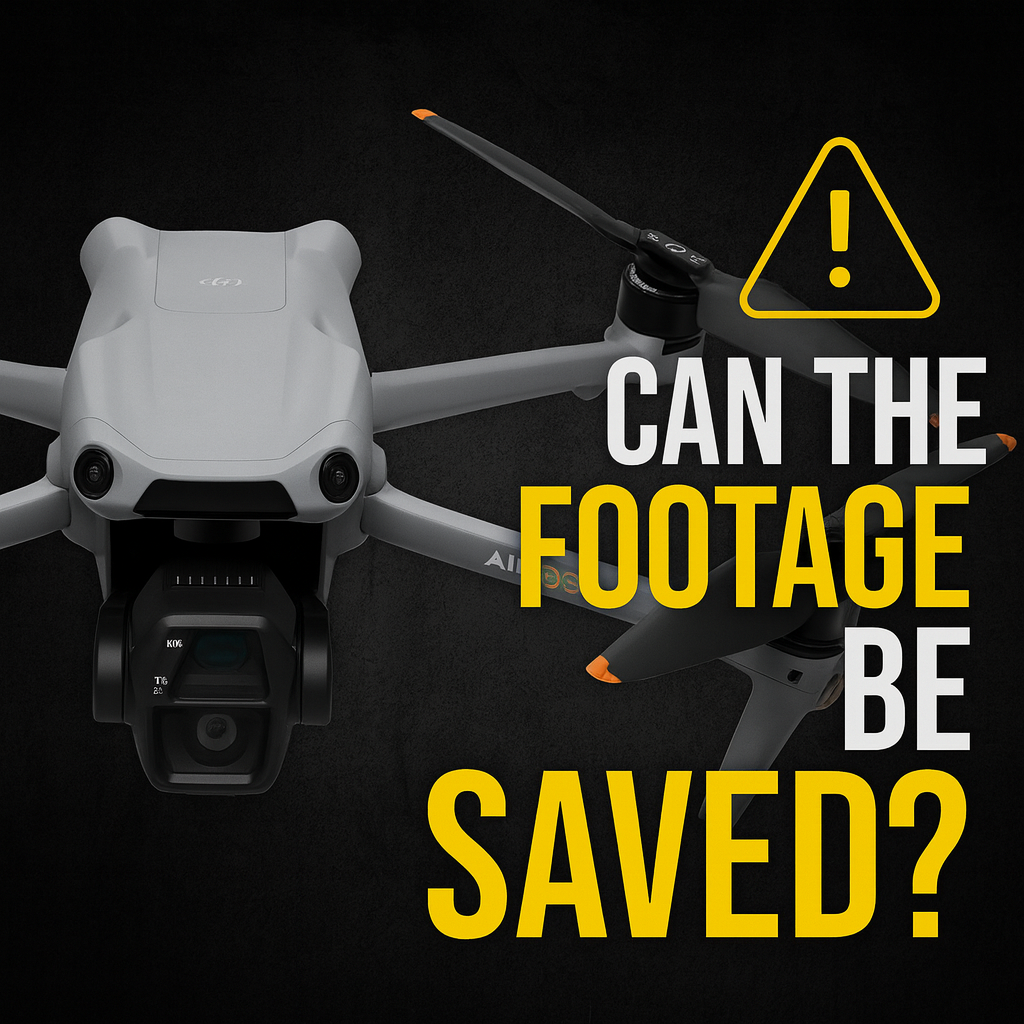
You land from a great flight, plug in the microSD, and suddenly:
- Some clips are missing
- Files won’t play
- The drone or computer says “SD card error”, “card needs to be formatted”, or it just won’t read at all
Gut feeling: “My DJI corrupted my SD card, my entire trip is gone.” (Reddit)
The good news: yes, in many cases the footage can still be recovered – especially if you stop using the card right now.
The bad news: a few common “quick fixes” can quietly make things worse.
This guide is written for real-world DJI pilots (Mini / Air / Mavic / Inspire / Phantom, etc.) — not for engineers — and it’s focused on protecting your data first, then talking about recovery options.
Quick answer (TL;DR)
- Yes, your DJI footage is often recoverable from a corrupted or “unreadable” microSD card.
- Your #1 job is to stop flying and stop writing to that card immediately.
- Don’t format, don’t record more, and be very careful with “repair” tools that write to the card.
- If the footage is important, treat this like a data recovery problem, not a “settings” issue.
DJI’s own support notes that if the memory card is damaged, there’s no guaranteed fix and it’s recommended to use a professional third-party data recovery service if the data is important. (DJI Repair)
What “missing or corrupted” looks like on a DJI microSD
You might see one or more of these:
- Drone screen: “SD card error”, “incompatible SD card”, or “slow SD card, recording may stop” (Recovery Squad)
- Only some files show up on the computer; others show as 0 bytes, unknown format, or won’t copy
- Video files that won’t play in any player (black screen, error on open)
- The card suddenly asks to be formatted in the drone or in Windows/macOS
- Computer doesn’t recognize the card at all or constantly disconnects (DJI Inspire Drone Forum)
All of these point to file system corruption, card failure, or both – not just a random glitch.
Why this happens (DJI + microSD, in plain English)
Common real-world causes:
- Power loss mid-recording
- Battery dies, crash, or you shut the drone off before recording fully stops → the file headers never get written. DJI’s own manuals say a corrupt last file can sometimes be fixed by putting the card back in the camera and power cycling it so the drone can repair it. (DJI Mavic, Air & Mini Drone Community)
- Removing the card too fast
- Pulling the card while the drone is still writing can damage the file system and directory structure.
- Slow, fake, or worn-out card
- DJI drones expect UHS-I U3 / V30-class cards (or better) for 4K and higher; using cheap/slow or counterfeit cards is a big cause of errors and corrupt video. Pilots often report errors clearing up with known-good V30 cards. (DJI Mavic, Air & Mini Drone Community)
- File system issues (FAT32 / exFAT)
- DJI drones typically format ≤32GB cards as FAT32 and larger ones as exFAT. If that file system gets corrupted, devices start asking to “format” the card. (Reddit)
- Physical problems with the card
- Bad sectors, internal controller failures, or wear. Once this starts, repeated retries can make things worse.
First: what not to do (if the flight matters)
If you care about the footage from that flight (client work, travel footage, crash investigation, etc.), avoid:
- Don’t format the card yet
- Formatting (in the drone or on your PC) rewrites the file system and can make recovery harder. Some labs can still recover after a quick format, but your odds drop sharply if you keep recording afterwards. (DJI Spark Drone Forum)
- Don’t keep flying / recording onto the same card
- Every new clip risks overwriting fragments of the “missing” ones.
- Don’t run aggressive “repair” tools on the live card
- Commands like
CHKDSK or tools that “fix” file systems will write new structures to the card. DJI’s own article mentions CHKDSK, but warns that these methods “cannot guarantee the recovery of all photos and videos” and recommends professional recovery if the footage is important. (DJI Repair)
- Don’t clone random internet advice step-for-step if the footage is irreplaceable
- Most guides are written for “I just want my card working again,” not “these files are priceless.”
Safe steps that don’t make things worse
If you’re okay doing minimal technical steps, here’s the “do no harm” route:
1) Stop using the card immediately
Power down the drone, remove the microSD gently, and set it aside. No more flights, no more attempts to “test” record.
2) Try a known-good card reader and a different device
Use a quality USB reader with your computer or a different machine. A lot of “card is dead” reports end up being cheap readers or flaky USB ports. (Repairit)
- If the card shows up as a drive at all, that’s a good sign.
- Don’t agree to format if the OS asks.
3) Copy anything you can see (read-only mindset)
If some files/folders are visible:
- Copy them off to your computer immediately.
- Don’t move/rename them on the card – just copy out.
- If a file partially copies or throws an error, skip it for now; you don’t want to stress the card.
4) If you’re more technical: image the card before experiments
Professionals almost always do a byte-for-byte clone (disk image) of the microSD and run recovery against the image, not the original. That way:
- If something goes wrong, you still have the original.
- The card only gets read once, which is safer if it’s failing.
If that sounds too technical → skip it and go straight to a lab referral; don’t risk learning on your only copy.
When should you call in a professional data recovery lab?
Treat it as a pro case if you see any of this:
- The card is not recognized at all or shows as 0 bytes / uninitialized
- It keeps disconnecting or making the OS hang
- Footage is for a client, legal matter, a once-in-a-lifetime trip, or a crash incident
- You already tried one or two things and nothing changed, and you’re nervous to do more
DJI’s own support language is clear: when the memory card is damaged, DIY commands and tools are not guaranteed, and for important footage, you should “find a professional third-party data recovery service.” (DJI Repair)
Professional labs can:
- Handle corrupted file systems on microSD (FAT32/exFAT)
- Recover data from cards that don’t mount properly
- Work around bad sectors / failing controllers
- Reconstruct DJI video files even when the file headers are broken
No one can promise a perfect outcome without examining the card, but your chances are always higher if you stop using it early.
How Mad Labs Repair fits in (your neutral “first call”)
Mad Labs Repair (what you’re reading right now) doesn’t crack open your microSD in a back room. Instead, we act as a calm, specialist triage layer:
- You tell us your DJI model, card size/brand, and what exactly happened (error message, crash, battery die, etc.).
- We tell you whether this looks like:
- a simple scenario (where you might not need a lab), or
- a “don’t mess with this anymore” case perfect for a professional data recovery partner.
- For serious cases, we point you toward a trusted lab that handles microSD/flash recovery every day (RAID/NAS/server labs usually also handle camera/drone cards).
We stay honest:
- No “100% guaranteed recovery” hype
- No scare tactics
- Just: “Based on what you’ve described, here’s the safest next step that protects your footage.”
FAQ
Can DJI drones fix corrupted video files themselves?
Sometimes. DJI manuals and community posts mention that if the drone was powered off before recording stopped, putting the card back into the camera and power-cycling it can sometimes repair the last file’s header. That’s only for a single file, though, not an entire corrupted card. (DJI Mavic, Air & Mini Drone Community)
If I already formatted the card, is it game over?
Not always. A quick format mainly rebuilds the file system structures; underlying data can still be present until overwritten. Many labs (and some software) can recover footage from a formatted microSD as long as you stopped using it right after formatting. (handyrecovery.com)
Should I run CHKDSK or card “repair” tools on my DJI card?
Only if you’ve already decided you don’t need professional recovery. DJI’s own help article includes CHKDSK as an option, but explicitly says these methods can’t guarantee photo/video recovery and recommends a third-party data recovery service if the data is important. (DJI Repair)
Is this a DJI problem or an SD card problem?
Often it’s the card (slow, fake, old, or worn), user behavior (power loss mid-recording / pulling card too soon), or a mix of both. DJI expects cards that meet certain speed specs (e.g., UHS-I U3 / V30); using random cheap cards can cause errors and corrupted clips. (Recovery Squad)
What you should do right now
If your DJI drone footage is missing or your microSD looks corrupted:
- Stop using the card immediately.
- Don’t format it or record new flights onto it.
- If the footage matters, treat this as a data recovery situation, not a minor glitch.
Then:
👉 Send your situation to Mad Labs Repair (which DJI model, card brand/size, exact error, and what you’ve tried).
We’ll help you avoid the dangerous “fixes,” and, if it’s serious, connect you with a data recovery lab that works these DJI microSD cases.
You get an honest assessment first — before you gamble with your footage.

%20(7).png)