
Last updated: May 24, 2026
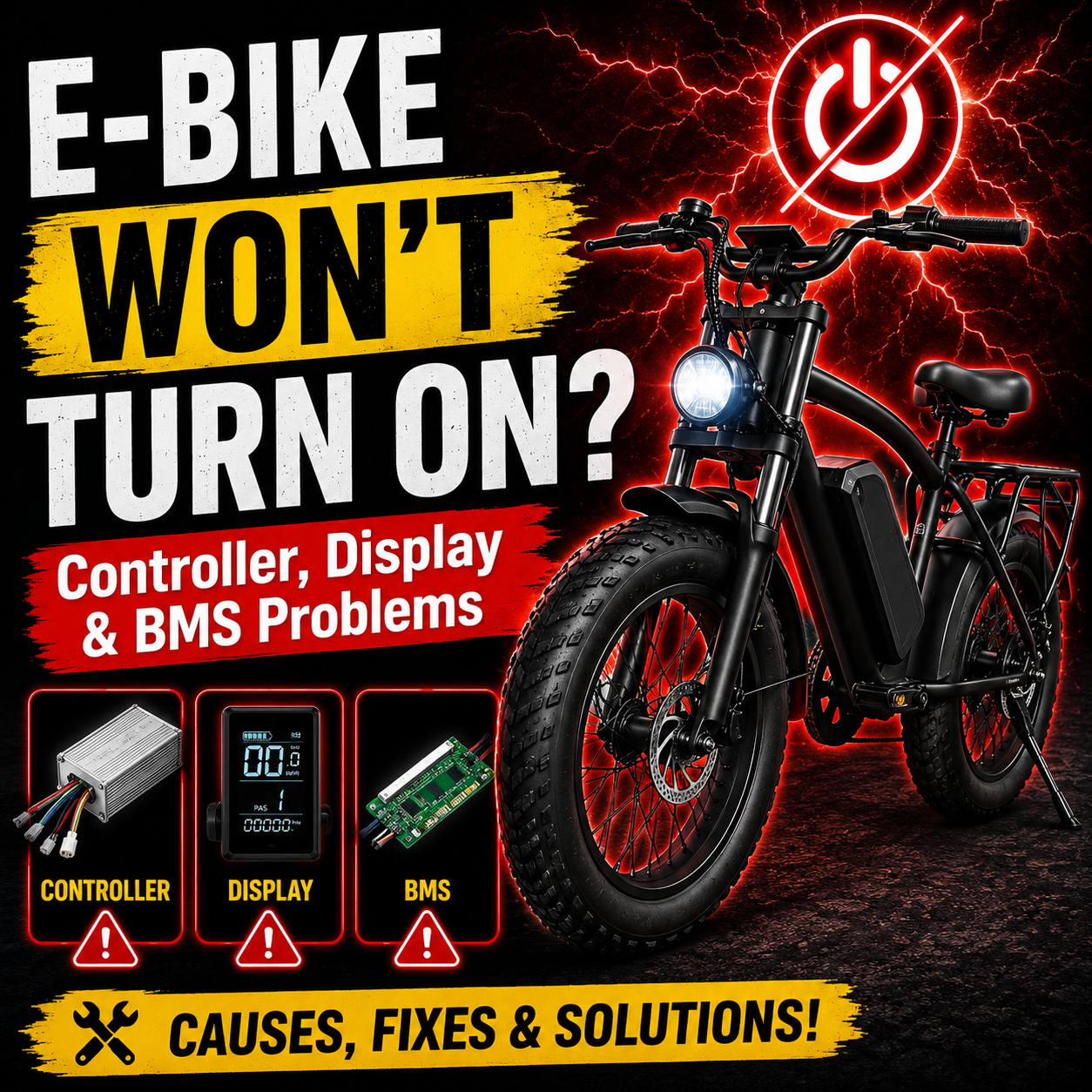
E-Bike Won’t Turn On? Controller, Display & BMS Problems Explained
When an e-bike goes dead, it is easy to blame the battery right away. Sometimes that is true. But a dead e-bike can also be caused by a bad display, blown fuse, loose connector, brake cutoff switch, failed controller, damaged throttle, corroded wiring, or a battery management system that has shut the pack down for safety.
The real trick is not guessing. The trick is following the power path. If you can figure out where the power stops, you can avoid buying a random battery, charger, display, or controller that does not fix the problem.
This guide covers common symptoms like e-bike won’t turn on, display not working, motor cuts out while riding, battery won’t charge, throttle not working, PAS not working, and controller failure after rain. It also explains what may be safe to check at home, what parts must match exactly, and when the controller or display can be removed and mailed in for repair.
Start with the e-bike power path
Most e-bike electrical problems fall somewhere along this path. Start at the battery and work forward. Skipping steps is how people end up replacing good parts.
If the display never wakes up, you are still near the battery, fuse, power switch, display, or communication wiring. If the display works but the motor will not drive, move toward brake cutoffs, throttle, PAS, controller, and motor wiring.
Battery safety note: Do not open, ship, charge, or keep using an e-bike battery that is swollen, hot, smells strange, has water inside, has burned contacts, or was involved in a crash. Lithium-ion e-bike batteries can create serious fire risks. Damaged packs may also have special disposal requirements. When in doubt, stop using the battery and follow local hazardous-waste guidance.
Quick answer
If your e-bike will not turn on, check the charger, battery charge, battery fuse, key switch, battery mount contacts, display connection, and main harness before blaming the controller. If the display turns on but the motor does not run, check brake cutoffs, throttle, pedal-assist sensor, speed sensor, motor cable, and controller output.
The controller becomes more suspicious when the bike has battery power, the display works, the brake/throttle/PAS signals are normal, the motor cable is not damaged, but the motor still will not drive. A controller can also fail after water exposure, hill-climb overheating, a phase-wire short, a melted connector, or a battery spark/surge.
Best shortcut: Controller and display units are often better mail-in repair candidates than full battery packs. Battery packs are a separate safety category and should not be casually opened, rebuilt, or shipped if damaged.
Three common failure lanes
The fastest way to organize an e-bike problem is to put it into one of these three lanes.
No display, no power
Think battery, charger, fuse, key switch, battery mount, display cable, or main harness. The controller may be fine if it never receives power.
Display on, no motor
Think brake cutoff stuck on, throttle/PAS fault, speed sensor issue, motor cable damage, controller failure, or communication error.
Cuts out under load
Think weak battery, BMS protection, corroded connector, voltage sag, overheating controller, bad phase wire, or motor/controller mismatch.
E-bike has no power or blank display
A blank display does not automatically mean the display is bad. The display may simply not be getting power. Before replacing the display, work backward through the power path.
Common causes
- Battery is deeply discharged.
- Charger is the wrong voltage or not working.
- Main fuse is blown.
- Key switch or power button is not waking the controller.
- Battery mount contacts are burned, pitted, loose, or corroded.
- Display cable is loose or damaged at the handlebar.
- Controller’s low-voltage supply is not powering the display.
If the battery has a charge indicator, check it. If the charger LED never changes, check the charger and charge port. If the battery shows charge but the display is dead, inspect the battery mount, fuse, power switch, and display connector. Many “dead bike” repairs are actually bad contacts or broken wiring, not a dead controller.
Display works but the motor will not run
This is where controller repair becomes more likely, but it is still not the first thing to replace. The controller may refuse to drive the motor if it thinks you are braking, if the throttle signal is invalid, if the pedal-assist sensor is missing, or if the motor cable has a fault.
Do this before blaming the controller
- Make sure both brake levers fully release.
- Unplug brake cutoff sensors one at a time if your system allows safe testing.
- Check throttle connector alignment and damage.
- Inspect the PAS sensor and magnet ring near the crank.
- Check the motor cable near the rear axle for cuts or pinching.
Controller gets suspicious when
- The display works normally.
- No brake cutoff is stuck active.
- Throttle/PAS signals are present.
- Battery voltage reaches the controller.
- The motor cable and phase wires are not damaged.
- The controller still will not send power to the motor.
E-bike cuts out while riding
Cutouts are frustrating because the bike may work fine on the stand and then fail as soon as you ride uphill or hit a bump. That usually means the problem only shows up under load, vibration, heat, or high current.
What cutouts usually point to
- Battery voltage sag: The pack looks charged but drops too low under load.
- BMS protection: The battery shuts off to protect itself from over-current, low voltage, or cell imbalance.
- Loose connector: Vibration breaks contact for a split second.
- Controller overheating: Long hills, high load, poor airflow, or an undersized controller can trigger shutdowns.
- Damaged phase wires: A short or partially melted motor cable can make the controller shut down or fail.
If the bike cuts out mostly on hills, with heavy riders, or at high assist levels, do not ignore the battery and controller load side. If it cuts out when the handlebar turns or the rear wheel moves, suspect wiring and connectors first.
Controller board failure signs
The e-bike controller is the box that takes battery power and controls the motor. Inside it are power components such as MOSFETs, capacitors, voltage regulators, gate-driver circuits, shunts, and connectors. Heat, moisture, shorts, and overloaded phase wires are some of the most common ways controller boards fail.
| Sign | What it may mean | Repair direction |
|---|---|---|
| Burnt smell from controller | Overheated MOSFET, phase short, burned capacitor, or melted connector | Do not keep testing; inspect controller and motor wiring |
| Bike died after rain | Water ingress, connector corrosion, shorted display/controller wiring | Dry and inspect connectors before reconnecting power |
| No 5V sensor power | Failed regulator or controller logic supply | Board-level diagnosis |
| Motor jerks or stutters | Phase/hall wiring fault, controller output issue, or motor cable damage | Check motor cable before replacing controller |
| Display works but no drive | Brake cutoff, throttle/PAS issue, controller output fault, or motor issue | Follow the full signal path before buying parts |
Battery and BMS problems
The BMS, or battery management system, protects the battery pack. It watches cell groups, charging, discharging, temperature, and current. If something looks unsafe, the BMS may shut the pack down. That can make the bike look dead even when some cells still have charge.
Common BMS-related symptoms
- Battery will not charge.
- Battery shows full on the charger but the bike dies under load.
- Battery works briefly, then shuts off.
- Battery output disappears after a hill climb.
- Battery stays at 0% or wakes only when the charger is connected.
- The bike died after rain, washing, or storage.
Important: This page is not recommending DIY cell rebuilding. Replacing individual lithium cells, bypassing a BMS, charging a damaged pack, or shipping a questionable battery can be dangerous. A separate BMS board may be repairable in some cases, but a swollen, water-damaged, crashed, or overheated pack should be treated as a safety issue first.
Brand and system notes
E-bike electronics are not universal. A controller from one system usually will not just plug into another, and many displays are locked to specific controllers, voltage ranges, firmware, or communication protocols.
Bafang and conversion kits
Good repair-intent searches include Bafang display not working, Bafang controller repair, BBSHD no power, BBS02 error code, throttle not working, and PAS not working. These systems are often more modular than closed OEM systems.
Rad Power, Aventon, Lectric, Juiced
Common issues include display not turning on, battery not charging, controller replacement, water-damaged connectors, brake cutoff problems, and bikes that cut out under load. Always match exact model year and connector style.
Bosch, Shimano STEPS, Yamaha, Brose
These systems are more integrated and may require official diagnostics, firmware tools, or dealer service. Independent repair opportunities may be more limited to displays, wiring, connectors, and removable modules rather than full system reprogramming.
Generic controllers and displays
Generic 36V, 48V, and 52V controllers are common, but compatibility is tricky. Match voltage, current rating, motor type, connector type, hall/phase wiring, throttle voltage, PAS type, display protocol, and brake cutoff style.
Safe checks before buying parts
These checks are meant to help you narrow the problem without opening a battery pack or touching live controller terminals.
DIY tools, parts, and Amazon links
These links are limited on purpose. E-bike parts must be matched carefully by voltage, connector, model year, controller protocol, and part number. Do not assume one charger, controller, display, or BMS fits your bike.
Useful DIY searches
Use these for diagnosis and exact-match part searches. Read labels and match specifications before ordering.
Buying note: The safest DIY parts are usually external tools, chargers matched by label, brake sensors, connectors, or exact-match displays/controllers. Battery BMS boards and cell-level repairs should be treated as advanced, safety-sensitive work.
Repair, replace, or upgrade?
The right answer depends on which part failed. A display or controller can often be removed and mailed in. A battery pack is different. Batteries are heavy, regulated, fire-sensitive, and may not be safe to ship if damaged.
| Component | Good repair candidate? | Best path |
|---|---|---|
| Display / console | Often, yes | Check wiring first, then repair or exact-match replacement |
| Controller board | Often, yes | Mail-in diagnosis if MOSFETs, regulators, connectors, or capacitors failed |
| Motor cable / connectors | Often, yes | Repair damaged harnesses, burned connectors, or loose pins |
| Separate BMS board | Sometimes | Only if safely removable and compliant; do not bypass safety protection |
| Battery cell pack | High caution | Do not ship or open damaged packs casually; check warranty, replacement, or hazardous-waste guidance |
Upgrade option if repair is not worth it
If the bike has a bad battery, controller, display, wiring harness, and motor problems all at once, replacement may be smarter than chasing parts. If you upgrade, look for a bike with strong parts support, a clear warranty, a reputable battery system, and safety certifications such as UL 2849 for the e-bike system and UL 2271 for the battery pack.
To compare current options, start with a limited search for UL 2849 certified electric bikes on Amazon. Do not buy only by motor wattage or screen size. Battery safety, parts availability, and serviceability matter more when you plan to keep the bike.
What not to do
- Do not bypass a BMS to “prove” the battery works.
- Do not replace a fuse with a higher-rated fuse.
- Do not charge a wet, swollen, hot, crashed, or corroded battery.
- Do not ship a damaged lithium battery without checking shipping rules.
- Do not buy a controller just because the voltage matches.
- Do not mix random displays and controllers unless the protocol and wiring are known to match.
- Do not keep riding a bike that cuts out under load until the connector, battery, and controller are checked.
- Do not assume a closed Bosch, Shimano, Yamaha, or Brose system can be fixed like a generic kit without proper diagnostic tools.
FAQ
Why won’t my e-bike turn on?
The most common causes are a dead battery, bad charger, blown fuse, bad key switch, corroded battery mount, loose display connector, damaged harness, failed display, BMS shutdown, or controller power-supply failure. Start at the battery and follow the power path forward.
Why is my e-bike display blank?
A blank display may mean the display is bad, but it can also mean the display is not getting power. Check the battery, fuse, key switch, display connector, and main harness first. On some systems, a controller low-voltage supply failure can also leave the display dead.
Why does my e-bike display turn on but the motor does not run?
The motor may be blocked by a brake cutoff, throttle fault, pedal-assist sensor issue, speed sensor error, motor cable damage, controller output failure, or motor fault. Do not replace the controller until the cutoff sensors and motor cable are checked.
How do I know if my e-bike controller is bad?
A controller is more likely bad when battery voltage reaches the controller, the display works, brake/throttle/PAS inputs are normal, motor wiring checks out, but the controller will not drive the motor. Burnt smell, melted connectors, no 5V sensor rail, or failure after rain also point toward controller repair.
Can an e-bike controller be repaired?
Often, yes. Common repairable failures include burned MOSFETs, failed voltage regulators, bad capacitors, damaged shunts, cracked solder joints, corroded connectors, or burned wiring pads. Repair depends on damage level, parts availability, and whether the motor or battery caused the failure.
Can an e-bike BMS be reset?
Sometimes a BMS can wake back up after proper charging, balancing, or reconnecting. But if the pack is damaged, wet, swollen, or has bad cells, forcing a reset can be unsafe. Do not bypass the BMS. It is there to protect the battery and rider.
Can I mail in my e-bike battery for repair?
A damaged lithium-ion battery may be restricted or unsafe to ship. Controller boards and displays are usually better mail-in repair candidates. If a battery is swollen, hot, water-damaged, crashed, burned, or corroded, treat it as a safety issue and check local hazardous-waste or manufacturer guidance.
Why does my e-bike cut out on hills?
Hill cutouts usually happen under high load. Possible causes include battery voltage sag, BMS over-current protection, overheating controller, weak cells, corroded connectors, damaged phase wires, or a controller that is undersized for the motor and riding conditions.
Should I repair my e-bike or replace it?
Repair makes sense when the bike is otherwise solid and the issue is isolated to the display, controller, connector, or wiring harness. Replacement may make more sense when the battery, controller, motor, harness, and frame all have issues, or when parts are unavailable for a low-cost bike.

%20(7).png)