Last updated: June 1, 2026
Failed a Florida 4-Point Inspection? Here’s What Repairs Actually Matter for Insurance
If your Florida 4-point inspection came back with problems, it can feel like the whole house just failed. But most of the time, that is not the right way to look at it.
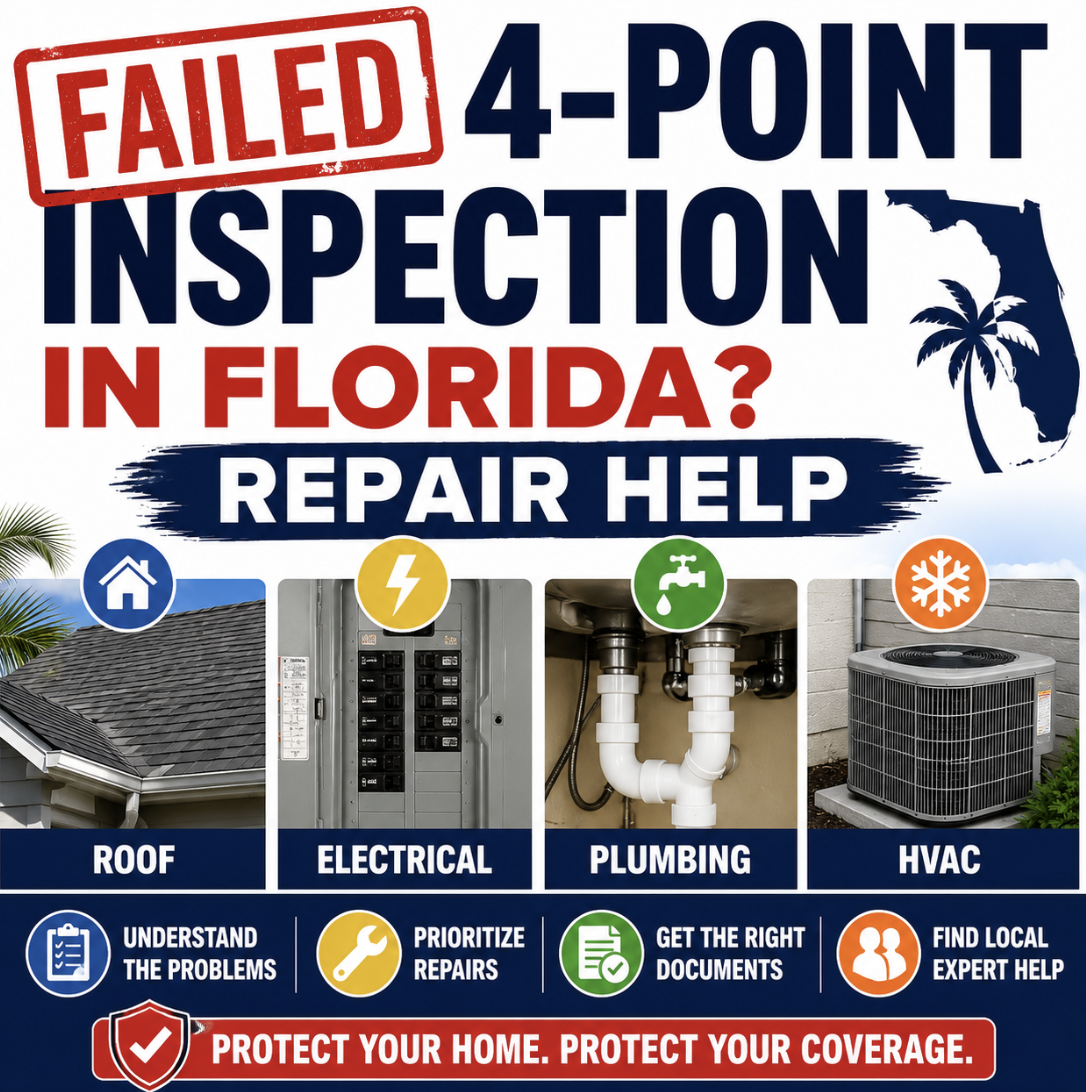
A 4-point inspection is focused on four systems insurance companies care about: roof, electrical, plumbing, and HVAC. When something gets flagged, the real question is not just “what is a 4-point inspection?” The real question is: what repair is blocking insurance, who should you call first, and what proof does the insurance company want after it is fixed?
This guide is for Florida homeowners, buyers, sellers, and agents who already have a failed or messy 4-point report and need to make a smart next move before a closing, renewal, cancellation notice, or new policy deadline becomes a bigger problem.
The short answer: find the actual insurance problem first
Do not start by guessing. A roof note, an electrical hazard, a plumbing leak, and a non-working AC system are four different problems. They may need four different contractors, and they may need different proof for insurance.
Important: Fixing a flagged item does not guarantee insurance approval. Carriers have their own underwriting rules. Before spending serious money, ask your insurance agent or carrier what they need to see.
Find the item that is actually blocking insurance
A 4-point report can include checkboxes, comments, photos, ages, and inspector notes. Some notes are serious. Some are maintenance items. Some are only a problem because the insurance company wants clearer documentation.
Your first job is to separate the report into three piles:
What a Florida 4-point inspection is and is not
A 4-point inspection is usually requested for homeowners insurance. It looks at four major systems: the roof, electrical, plumbing, and HVAC. It is not the same thing as a full buyer’s home inspection, and it is not the same thing as a city or county code inspection.
An insurance-focused report
The inspection helps an insurance company look at the visible condition, age, type, and possible hazards in the four major systems.
Not a full repair plan
The report may flag a problem, but it does not always tell you the cheapest, fastest, or most practical way to solve it.
| Inspection type | What it is for | Why it matters |
|---|---|---|
| 4-point inspection | Insurance review of roof, electrical, plumbing, and HVAC. | It can affect whether a carrier accepts, renews, or continues a policy. |
| General home inspection | Broader buyer/seller inspection of the home. | It may mention the same systems, but it is not the same insurance form. |
| Roof certification | Roof-specific documentation. | A roof issue on a 4-point may lead to a separate roof document. |
| Wind mitigation inspection | Looks for wind-resistant features that may affect insurance credits. | It is separate from a failed 4-point repair issue. |
| Code inspection | Government or permit-related inspection. | A 4-point insurance issue is not automatically the same as a code violation. |
Plain English: The inspector documents what they see. The insurance company decides what it will accept. Your agent can help you find out what proof the carrier needs.
If the roof failed the 4-point inspection
Roof problems are one of the biggest panic points in Florida insurance. A report may flag roof age, visible damage, missing shingles or tiles, leaks, patchwork, roof covering type, permit history, or remaining useful life.
A failed roof section does not always mean you need a full roof replacement. But it does mean you need to find out exactly what the carrier is worried about before you pay for a repair, roof certification, or replacement quote.
| Report issue | Possible next step | Proof to ask about |
|---|---|---|
| Visible damage | Call a licensed roofer for repair options. | Before/after photos, paid invoice, repair description. |
| Roof age concern | Ask agent whether a roof certification or roof condition form helps. | Roof age, permit history, condition statement. |
| Leak noted | Repair the leak and document any interior damage. | Leak repair invoice, photos, restoration proof if needed. |
| Carrier will not accept roof | Get written clarification before committing to replacement. | Carrier requirement, roof quote, permit and completion records. |
If electrical failed the 4-point inspection
Electrical failures can sound scary because the report may use safety language. Common issues include exposed wiring, open junctions, missing panel covers, double-tapped breakers, overheating marks, improper repairs, grounding concerns, aluminum branch wiring concerns, or outdated equipment.
Be careful with blanket advice online. Not every insurance company treats every electrical issue the same way. The safer move is to have a licensed electrician identify the actual defect, fix it correctly, and provide the documentation your carrier asks for.
Safety note: Do not remove panel covers, move breakers, or touch live wiring just to get photos. Hire a qualified electrician when electrical defects are flagged.
If plumbing failed the 4-point inspection
Plumbing issues can range from a small leak to a major repipe concern. A report may mention active leaks, evidence of leaks, pipe material, corrosion, water heater age or condition, missing temperature-pressure relief discharge piping, drain leaks, or water damage.
Do not assume every plumbing failure means a full repipe. Sometimes the fix is a repaired leak, corrected water heater issue, plumber letter, or better photos. But if the report flags widespread pipe problems or repeated leak evidence, you may need a plumber or repipe contractor to look deeper.
| Report issue | Possible repair path | Documentation to collect |
|---|---|---|
| Active leak | Targeted repair may be enough if the issue is isolated. | Invoice, after-photo, description of leak source. |
| Water heater issue | Repair, correct installation issue, or replace depending on condition. | Invoice, model/age if replaced, corrected safety photos. |
| Pipe material flagged | Ask agent whether the carrier requires replacement or plumber documentation. | Plumber letter, pipe type, repair or repipe quote. |
| Water damage evidence | Confirm whether it is old or active, then document the repair. | Repair proof, photos, restoration paperwork if relevant. |
Before approving a big repipe quote: Ask whether the carrier specifically requires repiping, whether a plumber’s letter is acceptable, and whether the quote separates pipe work, drywall, permits, fixtures, and cleanup.
If HVAC failed the 4-point inspection
HVAC failures usually come down to whether the system is present, working, safely connected, and in acceptable visible condition. The report may flag a system that does not cool or heat, heavy rust, leaking air handler, condensate drain problem, unsafe disconnect, or missing service documentation.
Some HVAC issues can be solved with a service call and proof that the system is working. Other times, the system may need repair or replacement because it is nonfunctional, unsafe, or in poor condition.
What proof insurance may ask for
A failed 4-point inspection is not always just a repair problem. Sometimes it is a proof problem. The work may be done, but if the insurance company does not get the right documentation, the file can still get delayed.
Ask your agent or carrier what they need before the repair starts. Depending on the issue, they may ask for:
- Before and after photos showing the exact issue and the corrected condition.
- Paid invoice with contractor name, work description, date, and property address.
- Contractor letter explaining what was wrong and what was fixed.
- Permit and final approval if the work required a permit.
- Roof certification or roof condition form if the roof was the problem.
- Updated 4-point inspection if the carrier wants a new report after repairs.
- System-specific proof such as an HVAC service note, electrician invoice, plumber letter, or roofer report.
The goal is simple: make it easy for the agent or underwriter to see that the exact flagged issue was handled.
Closing deadline vs cancellation deadline
The right repair plan depends on why the 4-point inspection happened. A buyer trying to close has a different problem than a homeowner facing renewal, cancellation, or a new carrier application.
| Situation | Main risk | What to do first |
|---|---|---|
| Buying a home | Insurance delay can affect closing or lender requirements. | Ask the agent and carrier what must be fixed before binding coverage. |
| Selling a home | Buyer may ask for repair, credit, or updated documentation. | Separate insurance-blocking items from normal maintenance items. |
| Renewal issue | Carrier may request repairs before renewal. | Get the deadline and accepted proof in writing if possible. |
| Cancellation concern | Time may be short, which makes rushed repairs risky. | Prioritize the exact carrier-required item and document every step. |
| Switching carriers | Different carriers may view the same report differently. | Ask the new agent what that carrier will accept. |
Do not wait until the last day. Repairs, permits, reinspection, photos, and underwriting review can all take time.
Who to call first after a failed 4-point inspection
Calling the wrong trade can waste days. Start with the system that was actually flagged.
| Problem | Usually call first | Also ask |
|---|---|---|
| Roof age, leak, damage, or remaining life | Licensed roofer or qualified roof inspector. | Does the carrier need repair proof, roof certification, permit history, or replacement? |
| Electrical hazard or panel issue | Licensed electrician. | Is the issue repairable, does it need a permit, and what proof will be provided? |
| Plumbing leak, water heater, or pipe concern | Licensed plumber or repipe contractor. | Is this a spot repair, documentation issue, water heater issue, or repipe concern? |
| HVAC not working or in poor condition | Licensed HVAC contractor. | Can the system be serviced and documented, or is replacement needed? |
| Unclear report wording | Insurance agent or original inspector. | What exactly is blocking approval, and what proof is acceptable? |
License check: Before hiring anyone, verify licensing through Florida’s official licensing resources and make sure the person is qualified for the trade and work involved.
Where My Safe Florida Home fits
Florida homeowners often ask whether My Safe Florida Home can help after a failed 4-point inspection. It may be worth checking, but it is not a magic fix for every 4-point problem.
My Safe Florida Home is focused on wind-mitigation inspections and approved hurricane-hardening upgrades. That may be relevant for some roof or opening-related improvements, but it does not directly solve a failed electrical panel, active plumbing leak, water heater defect, or non-working HVAC system.
Wind mitigation upgrades
Roof-related improvements, opening protection, garage door reinforcement, and other approved wind-hardening items may be worth researching if you qualify.
Failed 4-point repairs
Electrical, plumbing, HVAC, and carrier-specific repair issues still need to be handled through the right trade and insurance documentation path.
Program caution: Funding, eligibility, timing, and approved work categories can change. Check the current program rules before counting on grant money.
What to upload for Mad Labs Local Repair Help
If you are stuck looking at a failed 4-point report and do not know what to fix first, send the details. The goal is to help you understand the likely repair category, what proof may be missing, and which local trade should be contacted first.
What we help sort: what likely matters first, who to call, what documentation may be missing, and what to ask before spending money on the wrong repair.
Need help reading a failed Florida 4-point inspection?
A failed 4-point inspection is not always a huge repair problem. Sometimes it is a documentation problem. Sometimes it is one urgent licensed-trade repair. Sometimes it is a bigger roof, electrical, plumbing, or HVAC issue that needs a careful quote before you commit.
Mad Labs Local Repair Help can help you organize the report, identify the likely repair priority, and prepare better questions for your insurance agent, inspector, or contractor.
FAQ
What happens if my Florida 4-point inspection fails?
One or more of the four systems was flagged in a way that may affect insurance. The carrier may ask for repair, replacement, documentation, clarification, or a new inspection before moving forward.
Does a failed 4-point inspection mean the house is unsafe?
Not always. Some issues are serious safety concerns, especially electrical hazards, active leaks, or major roof problems. Other issues are age, condition, documentation, or underwriting concerns.
Is a 4-point inspection the same as a home inspection?
No. A 4-point inspection focuses on roof, electrical, plumbing, and HVAC for insurance. A general home inspection is broader and is usually used in a real estate transaction.
Is a 4-point inspection the same as a code inspection?
No. A 4-point inspection is not the same as a city or county code-compliance inspection. It is usually an insurance-focused report.
What should I fix first?
Fix the item that is blocking insurance, closing, renewal, or cancellation resolution first. Ask your agent what the carrier specifically requires before spending money.
Will insurance approve me after I fix the failed item?
There is no guaranteed approval. Fixing the issue may help, but underwriting rules vary by carrier. Confirm what proof is needed with your agent or carrier.
Does a failed roof section always mean I need a new roof?
No. Some roof issues can be handled with repair, photos, roof certification, or updated documentation. Other roof issues may require replacement.
Does a failed plumbing section always mean I need a repipe?
No. Some plumbing failures are targeted leak repairs, water heater corrections, or documentation issues. A repipe may be needed if the report or carrier flags broader pipe concerns.
Can My Safe Florida Home help with a failed 4-point inspection?
It may be worth checking for wind-mitigation or approved hurricane-hardening improvements, especially roof or opening-related upgrades. It does not directly solve electrical, plumbing, or HVAC failures.
What documents should I send after repairs?
Ask your agent or carrier first. Common proof includes paid invoices, before/after photos, contractor license details, permits and final approvals if required, contractor letters, roof certifications, and updated 4-point reports.


%20(7).png)