
Last updated: May 30, 2026
The Screen Is Black at the Helm. Is Your Fish Finder Actually Dead?
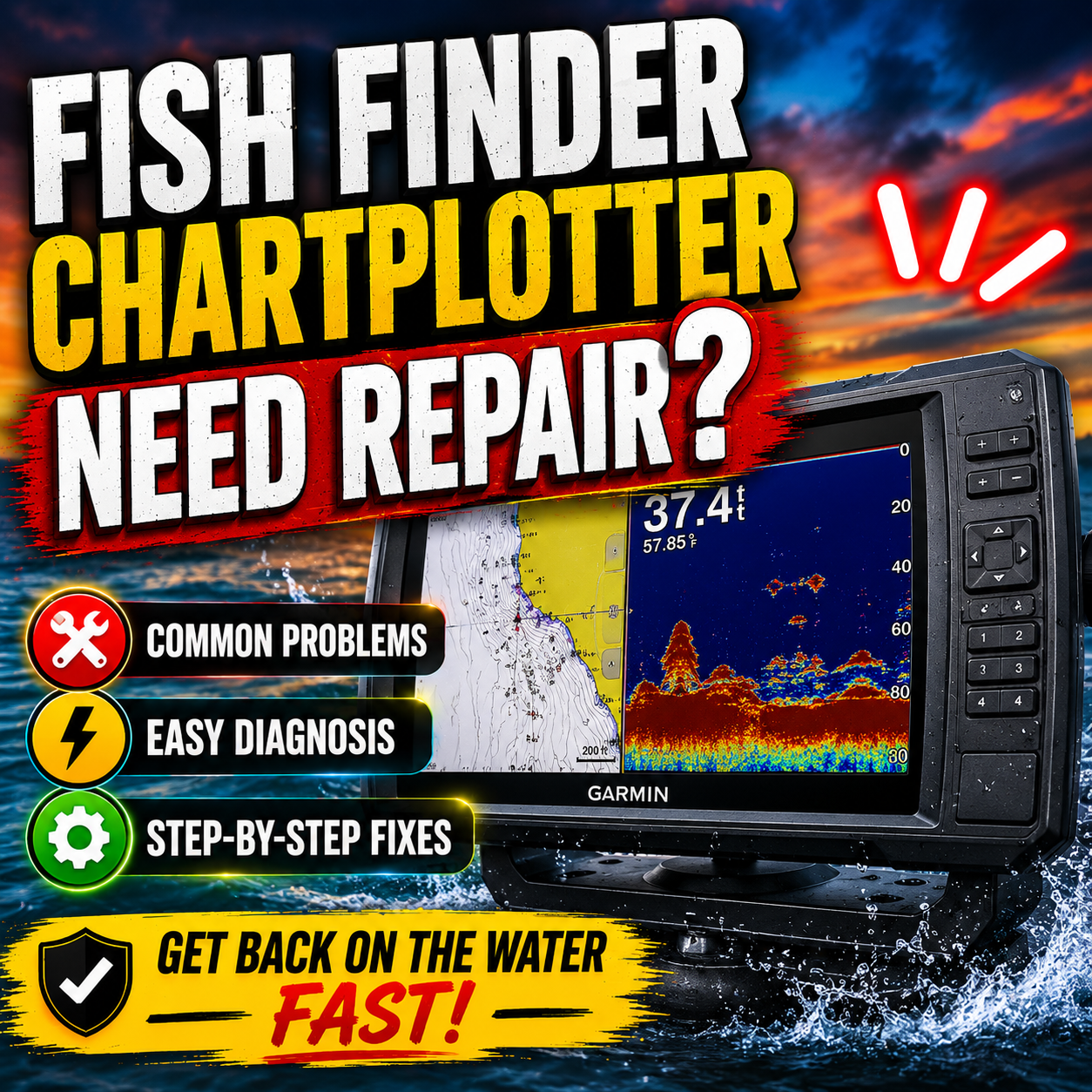
A fish finder or chartplotter that will not power on can make you feel like the whole day is already shot. You turn the key, press the power button, and the screen stays black. No chart. No sonar. No waypoints. Nothing.
But a black screen does not always mean the unit is dead. Sometimes the boat is not feeding it clean power. Sometimes the fuse holder is corroded. Sometimes the unit is on, but the backlight or screen has failed. Sometimes a map card or software issue is keeping it from booting. And sometimes, yes, the internal power board, screen, connector, or main board needs repair.
This guide is for higher-value fish finders, chartplotters, marine GPS units, and MFD displays where repair is worth thinking about before you spend hundreds or thousands replacing the whole setup.
Two questions save the most money
Before you mail anything in or order a new display, answer these two questions:
Is clean power actually reaching the unit?
A dead screen at the helm can be caused by the boat: battery, fuse, switch panel, bad ground, corroded connector, damaged power cable, or voltage drop.
Is the unit off, or is the display just not showing anything?
If the unit beeps, the keypad lights up, it appears on a network, or you can see a faint image with a flashlight, the screen/backlight side may be the problem.
Safety first: Do not bypass fuses, oversize fuses, test with loose hot wires, or keep powering a wet or corroded unit. Marine DC wiring can overheat, arc, and damage electronics when connections are poor.
What this guide covers
This page is for marine displays that look dead, half-dead, or stuck before they finish booting.
Not every fish finder is worth repairing. This page is mainly for higher-value displays and modules where replacement is expensive or the unit is tied into an existing boat setup.
Start with the boat-side power path
Nobody wants to hear “check the wiring,” but this is where a lot of fish finder no-power problems live. The display can be perfectly repairable — or perfectly fine — while the boat is feeding it bad power.
| Check | What can go wrong | Why it matters |
|---|---|---|
| Battery voltage | Battery looks charged but drops too low under load | Marine electronics can shut off or fail to boot on unstable voltage |
| Fuse and fuse holder | Blown fuse, corroded holder, loose cap, wrong fuse rating | A bad fuse holder can mimic a dead display |
| Power cable | Cut wire, pinched cable, bad splice, undersized wire, poor crimp | Voltage may be fine at the battery but not at the unit |
| Ground connection | Loose, corroded, shared with noisy equipment, or poorly crimped | A bad ground can cause black screens, resets, or random shutdowns |
| Connector pins | Bent, broken, pushed in, green corrosion, salt residue | The head unit may not receive power even if the cable has voltage |
| Switch panel | Bad rocker switch, breaker, accessory panel, or intermittent feed | The unit may work only when the connection happens to make contact |
Fuse warning: Do not install a larger fuse to “see what happens.” The correct fuse protects the wiring and electronics. Oversizing it can create a fire or board-damage risk.
Black screen, but the unit may still be on
A black screen is tricky because the unit can be alive while the screen is not showing it. That is a very different repair path from a unit that is truly dead.
Signs the head unit may still be running
- Buttons beep when pressed
- Keypad or power button lights up
- You can see a faint image with a flashlight
- The unit gets slightly warm
- Other networked devices can see it
- It makes normal startup sounds
What this can point toward
If the unit seems alive but the screen stays black, the issue may be the LCD, backlight, display cable, screen driver, button board, main board display output, or water/corrosion damage inside the unit.
A quick flashlight check can be useful. Shine a light at the screen from an angle. If you can barely see menus or a logo, the display may be working without a backlight. If there is no faint image, the issue may be deeper than the backlight alone.
Remove cards before you panic
Map cards and software issues can make a chartplotter look broken. Before you assume the main board is bad, remove any SD or microSD cards and try a clean startup.
Good clue: If the unit boots with the card removed, the issue may be the card, card slot, software, or chart data — not necessarily a dead display.
Water, corrosion, and connector damage
Marine electronics live in a rough place. Sun, vibration, salt, rain, spray, condensation, and bad connectors all take a toll.
| Clue | What it may mean | What to do next |
|---|---|---|
| Green or white corrosion on pins | Connector corrosion or salt exposure | Photograph it before cleaning or scraping anything |
| Fogging or moisture under screen | Seal failure, condensation, or water intrusion | Stop powering it until it is evaluated |
| Cracked screen | Physical screen damage, possible internal display damage | Repair depends on screen availability and unit value |
| Unit got soaked or submerged | Water intrusion and corrosion risk | Do not keep powering it to “dry it out” |
| Intermittent power when cable moves | Damaged plug, connector, cable, or internal jack | Record a short video and inspect pins carefully |
Do not keep powering a wet marine display. Moisture plus electricity can turn a repairable corrosion issue into a dead board.
When internal repair becomes realistic
Once the boat-side power path has been checked and the unit still has no power, black screen, boot failure, or display problems, internal repair becomes more realistic.
The likely repair path depends on the exact model and symptoms.
| Possible repair area | Common symptom | Repair note |
|---|---|---|
| Power board / power section | No power, shuts off, failed after reverse polarity or bad power event | Often worth evaluating on higher-value units |
| LCD / backlight | Black screen, faint image, dim screen, lines, no backlight | Depends heavily on screen size and parts availability |
| Main board | Boot loop, no display signal, frozen startup, no response | Can be repairable or not depending on board damage |
| Button board / keypad | Power button not responding, buttons stuck, keypad lights but no control | More likely when the screen works but controls do not |
| Connector repair | Bent pins, loose jack, intermittent power, damaged port | Often a good repair candidate if board damage is limited |
| Water/corrosion repair | Salt exposure, fogging, green pins, random shutdown, dead unit | Outcome depends on how far corrosion spread |
What can be mailed in?
This is why fish finder and chartplotter repair is such a clean mail-in category. The boat stays home. The display or module gets shipped.
Best practice: Do not remove internal boards from a sealed marine display unless instructed. Most owners should send the complete head unit, not random internal parts.
What should be fixed on the boat instead?
Mail-in repair is for the unit. It will not fix a bad power feed at the helm.
| Boat-side issue | Why mail-in repair may not help |
|---|---|
| Bad battery or low voltage | The unit may work fine when connected to clean power |
| Corroded fuse holder | The replacement or repaired unit may still not power on |
| Bad ground or switch panel | Intermittent power can mimic internal failure |
| NMEA/network power issue | Network problems can look like display or accessory failure |
| Transducer or sonar cable install problem | A display repair will not fix a bad transducer cable or install issue |
| Damaged mount or bracket | Physical mounting problems are usually local repair or replacement |
Simple test: If the unit works on another boat, another power cable, or a known-good bench power setup, the problem may be your boat wiring, not the display.
High-value units this can apply to
This guide is not really about a $120 entry-level fish finder. The repair conversation makes the most sense when the unit is expensive, integrated into the boat, or hard to replace without reworking the whole setup.
A Garmin fish finder with no power, Lowrance HDS black screen, Humminbird unit frozen at startup, Simrad display not powering on, or Raymarine chartplotter blank screen may all sound similar from the driver’s seat. The repair path still depends on the exact model, power cable, connector style, software, screen size, and damage history.
Compatibility warning: Do not buy used screens, boards, cables, or modules based only on the brand name. Match the exact model, generation, connector style, and part number.
Photos and videos to send before shipping
A good repair request can save days of back-and-forth. Before shipping a fish finder or chartplotter, gather the basics.
Repair it, replace it, or fix the boat wiring?
The right answer depends on the value of the unit, the condition of the boat wiring, and how isolated the failure is.
- Repair may make sense when the display is expensive, larger-screen, out of warranty, tied into your current setup, and the failure appears internal.
- Boat-side repair may make sense when the unit works elsewhere or power at the helm is unstable, corroded, or dropping under load.
- Warranty support may make sense when the unit is newer, not water-damaged, and the manufacturer repair/replacement path is available.
- Replacement may make sense when the unit is low-cost, obsolete, severely corroded, cracked beyond economical repair, or repair cost is close to a new unit.
The biggest mistake is replacing a good fish finder because the boat wiring was bad — or repairing a display and putting it right back onto a corroded power feed that damages it again.
Limited tools and product links
Disclosure: Some links in this section may be affiliate links. If you buy through them, we may earn a commission at no extra cost to you. These are for basic external checks and documentation only, not internal marine electronics repair.
Helpful for safe dockside checks
These can help you document the issue and rule out obvious power problems before assuming the head unit is dead.
Do not open a sealed chartplotter just because you have tools. Internal screens, boards, seals, and connectors are easy to damage. For most owners, the safest repair path is external checks first, then mail-in evaluation if the head unit is still suspect.
FAQ
Why won’t my fish finder power on?
A fish finder may not power on because of a weak battery, blown fuse, corroded fuse holder, bad ground, damaged power cable, bad switch panel, connector pin damage, voltage drop, internal power board failure, water damage, or main board failure.
Does a black screen mean my chartplotter is dead?
Not always. A black screen can mean the unit has no power, but it can also mean the unit is on and the LCD, backlight, display cable, or screen driver is failing. Beeps, keypad lights, network presence, or a faint image can all be clues.
What should I check before mailing in a fish finder for repair?
Check battery voltage, fuse, fuse holder, power cable, ground, switch panel, connector pins, SD or map cards, and whether the unit behaves differently on a known-good power source.
Can a map card make a fish finder freeze or not boot?
Yes. A bad or corrupted SD or microSD card can sometimes cause startup freezes, slow booting, or loading problems. Remove cards and try a clean startup before assuming the internal board is bad.
Can water damage in a fish finder be repaired?
Sometimes, but it depends on how much water entered, whether it was saltwater, how long it sat powered, and how far corrosion spread. Stop powering a wet unit and document the damage before repair.
What fish finder parts can be repaired by mail?
Depending on the model and damage, mail-in repair may involve the whole display/head unit, LCD or backlight, power board, main board, button board, connector, or live sonar module. Most owners should send the complete unit rather than removing internal boards.
Should I repair or replace my fish finder?
Repair is more likely to make sense for higher-value units, larger displays, chartplotters, MFDs, and units tied into an existing boat network. Replacement may make more sense for cheap entry-level units, severe corrosion, cracked screens with no parts, or repair costs close to replacement.
Can bad boat wiring damage a repaired fish finder?
Yes. If the original failure was caused by reverse polarity, voltage spikes, corrosion, bad grounds, or unstable power, the repaired unit can fail again unless the boat-side issue is fixed.
Does this apply to Garmin, Lowrance, Humminbird, Simrad, and Raymarine?
Yes, the same broad symptoms can apply across brands, but the repair path is model-specific. A Garmin ECHOMAP no-power issue, Lowrance HDS black screen, Humminbird frozen display, Simrad power failure, or Raymarine blank screen may require different handling.
What should I send before shipping my chartplotter?
Send the model and serial number, screen photos, power connector photos, fuse/wiring photos, a short startup video, and notes about water exposure, power surge, software updates, SD cards, or recent wiring changes.


%20(7).png)