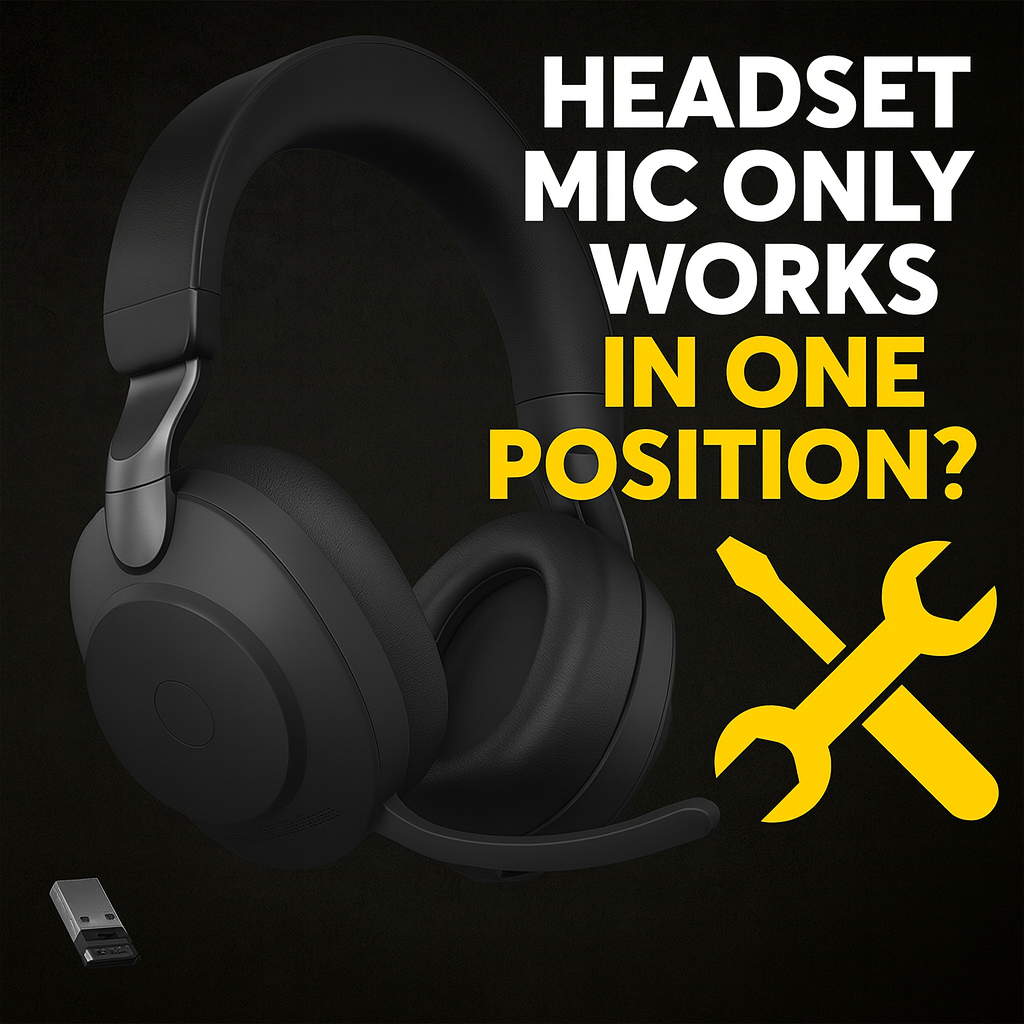
If your headset mic only works in one weird position, you’re in the right place.
You know the move:
People with HyperX Cloud Stinger, Cloud II, Logitech G430, Sony Inzone H9, Turtle Beach XP/Z‑series, Jabra office headsets and more all describe the same thing: crackling, cutting out, and a mic that only works at one angle.
This article is here to help you figure out:
And if you already know you’re done fighting the “sweet spot”:
Mad Labs CTA:
Click “Start a Repair” on this page to get a mail‑in repair quote for your headset.
Here’s the classic pattern we see:
On forums, HyperX Cloud Stinger owners describe the mic:
“First making crackling noises when moved, then eventually it only wanted to work in one certain position.”
HyperX Cloud II owners talk about a 3.5 mm plug that only works when the cable is bent just right, making one side or the mic flaky.
Sony Inzone H9 users report mics that only pick up sound in certain positions, with repair techs pointing to broken joints or wires inside the boom.
Logitech G430 and other wired gaming headsets? Same story: tangled or curled cords that make audio change or cut out when you move the cable, diagnosed as frayed or broken wires.
If that’s you, this is no longer “just a Windows bug.”
Before you assume the hardware is toast, do the quick five‑minute sanity check:
If the mic cuts in/out in the same way, especially when you move the wire or boom, that’s a huge hint it’s physical, not software.
If you fix a setting and everything works even when you wiggle the cable, it was probably just configuration. If the mic still freaks out every time the wire moves, keep reading.
This one’s simple:
If the mic crackles, cuts out, or only works at one exact angle, that’s the textbook symptom of a physical connection problem—not drivers.
Modern headsets — whether it’s a HyperX Cloud Stinger, Logitech G‑series, Sony Inzone H9, Turtle Beach or office models like Jabra Evolve — all have the same weak point:
Thin wires + constant bending = something eventually gives.
The common stress zones:
Over time:
That’s why people describe:
No setting in Windows or Discord knows you just bumped the cable.
If physical movement decides whether your mic works, you’re looking at a hardware‑level fault that needs diagnosis and repair.
Here are a few real‑world examples of the same symptom, different headset:
So if your gaming headset, work headset, or call‑center headset is doing the “only works when I hold it here” thing, you’re not alone — and you’re not imagining it.
Look, we get it: sometimes you’re mid‑season, mid‑raid, or mid‑Q4 and can’t be without a headset.
A few honest guidelines:
You might keep using it while you line up a repair if:
You’re firmly in “get this fixed” territory if:
Once the internal conductor or joint is cracked, every extra movement can make the damage worse. There’s a point where it stops being “annoying” and starts being risking the whole headset.
When you hit that point, the next step is simple:
Click “Start a Repair” on this page to get a mail‑in headset mic quote from Mad Labs.
A lot of people want this to be a quick, cheap DIY fix:
On sites like iFixit and StackExchange, the honest answers for “mic only works in certain positions” tend to be:
Broken cable inside the boom or near the plug; likely needs the wire or jack replaced and it’s tedious, precision work.
So your real options usually are:
We’re obviously biased toward “repair,” but that’s because a lot of these headsets are $80–$300+, and everything else (sound, comfort, ANC) still works great.
A mail‑in repair is usually worth it when:
It’s less ideal if:
That’s why Mad Labs always treats this as a diagnostic problem first, not “we already know exactly what the fix will be.”
If your:
…then you’re looking at a classic hardware mic/cable issue that doesn’t magically fix itself.
Instead of rage‑buying another headset:
🔧 Click “Start a Repair” to get a mail‑in repair quote from Mad Labs.
Tell us your model and that the mic only works in one position.
%20(7).png)
Fix what’s worth keeping.
Copyright © 2025 Mad Labs Repair. All Rights Reserved