You’re in Discord, Teams, or a game lobby.
Everyone sounds great in your ears… but your friends say:
“You’re really quiet.”
“You sound far away.”
“Turn your mic up, I can barely hear you.”
You open settings, crank everything to 100%, maybe even turn on “mic boost”… and it still sounds like you’re talking from the next room.
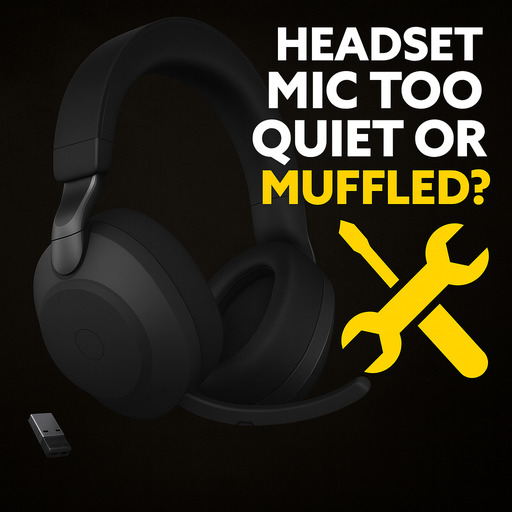
If your headset mic is too quiet or muffled even at max volume, this isn’t just you. It’s one of the most common complaints on gaming and office headsets across brands like Razer Kraken / BlackShark, HyperX Cloud, SteelSeries Arctis, Logitech G, Turtle Beach, Sony Gold / Inzone, and more.
This article will help you figure out:
- When it’s probably just a settings / software issue
- When it starts to look like a hardware problem inside the headset
- When it makes sense to start a repair and get it looked at instead of buying a new one
What “Too Quiet / Muffled” Usually Looks Like
Most people who end up needing a repair describe some mix of:
- Friends have to crank you to 150–200% in Discord or game chat just to hear you
- Input meters barely move (10–15%) even when you’re right up on the mic and speaking normally
- Your voice sounds distant, underwater, or muffled, even though the headset audio sounds fine
- You’ve set Windows / console / app input to 100%, tried “mic boost” or gain options, and it still isn’t usable
- The problem follows you to another PC, console, or phone
If that’s what you’re seeing, you’re not dealing with a one‑click fix.
Quick Sanity Checks (The Boring Stuff You Should Still Do)
Before we blame the headset itself, it’s worth spending five minutes ruling out the simple things.
1. Make sure the right mic is selected
On PC or Mac, triple‑check that:
- Your headset microphone is selected as the input device
- Your webcam / laptop mic isn’t being used instead
Same idea inside Discord, Zoom, Teams, Steam, and games — each app can pick a different input.
2. Adjust mic level in the OS and software
Most platforms give you at least two places to change mic volume:
- System mic level (Windows / macOS / console voice settings)
- App‑specific input level (in Discord, game chat, etc.)
SteelSeries, Razer, Turtle Beach and others even have their own software sliders for mic gain. If those are turned down, your mic will be quiet no matter what you do elsewhere.
3. Check mic position and direction
Some mics — like the SteelSeries Arctis ClearCast boom — are strongly directional. If it’s not sitting near the corner of your mouth, or it’s pointed the wrong way, you’ll sound quiet and thin even if the hardware is fine.
Get the mic:
- A couple of fingers away from your mouth
- Slightly off to the side (so you’re not breathing straight into it)
- Pointed the right way (check for markings on the capsule)
4. Test on another device
If you can, try:
- Another PC or laptop
- A console
- Or even plugging the headset into your phone (if it’s a 3.5mm model)
If the mic is only quiet on one device, it’s more likely a software / driver issue. If it’s quiet everywhere, now we’re getting into hardware territory.
When It’s Probably Just Settings
It’s more likely a software thing if:
- The problem started right after a big OS update, driver install, or app reinstall
- It only happens in one app (for example, Discord is quiet but everything else is fine)
- Switching to another PC or console fixes it instantly
- Other people with the same headset model report normal volume with similar settings
In those cases, it’s usually worth spending more time:
- Reinstalling drivers
- Resetting app configs
- Resetting your console’s audio settings
Online guides already go deep on that troubleshooting, especially for Windows 10/11 and console audio.
If you’d rather not live in settings menus forever though, here’s the line where it starts to look like a physical headset issue instead.
Signs Your Headset Mic Itself Is Failing
If you’ve done the usual software checks and you’re still fighting your mic every session, look for these patterns:
1. Quiet on every device, in every app
You’ve tried:
- Different USB ports / dongles
- Your PC and your console
- Multiple apps (Discord, games, browser mic tests)
…and your mic is still way quieter than it should be.
That’s exactly what you see in threads about Sony Gold wireless, Turtle Beach Stealth, Razer BlackShark / Kraken, Logitech G533, and others — people max out every slider, but meters still barely move.
At that point, it’s less about some hidden setting and more about how much signal the mic is actually sending.
2. People say you sound “underwater” or “inside a box”
A failing mic doesn’t always just get quieter — it can also lose clarity:
- Your voice sounds muddy or muffled compared to before
- Turning you up just makes the noise and room echo louder, not the words clearer
- You sound way worse than a clip of the same headset on YouTube or in reviews
Some budget headsets launch with average mic quality out of the box, but when something starts to go wrong inside, the tone can shift from “okay” to “distant, cardboard box, underwater” at the same volume.
3. It slowly got worse over time
A lot of people can pinpoint a rough timeline:
- “It used to be fine, then over a few months everybody kept asking me to talk louder.”
- “Now they have me at +200% in Discord and I still sound far away.”
That slow slide is classic wear‑and‑tear — flexing in the boom arm, stress on the tiny wiring, or aging components in the mic path — not some one‑day OS bug.
4. Moving the boom or cable changes how quiet / muffled you are
If:
- The mic gets quieter or noisier when you nudge the boom
- Slight movement makes you go from “okay” to “unusable”
- It sounds like the boom has a “sweet spot” even at max volume
…that’s usually a physical connection that’s starting to go, not a digital setting.
It’s Not Just Your Brand: This Hits a Lot of Headsets
Real complaints about quiet or muffled headset mics pop up on basically every brand:
- Razer Kraken and BlackShark – multiple owners report very low mic volume even with all boosts enabled, sometimes resorting to extra software just to get usable level.
- HyperX Cloud II / Cloud series – lots of threads about the mic being too quiet until people boost it hard with software or EQ, and some still can’t get it loud enough.
- Sony Gold wireless / Sony headsets – people connect them to PC or console and find the mic topping out at very low input percentages even with everything at 100%.
- Turtle Beach headsets – from Stealth series to wired models, users complain about extremely low mic volume or needing heavy software workarounds.
- Logitech G / Corsair / others – long‑running threads where experienced users say, “I know all the settings, it’s still too quiet even maxed out.”
So no, you didn’t just get “the one weird broken unit.” This is a known pain point across gaming and office headsets.
Why a Hardware Problem Makes the Mic Quiet
Without getting inside‑baseball technical, a few parts inside your headset can cause low or muffled volume when they start to fail:
- The capsule itself (the tiny microphone at the end of the boom) can lose sensitivity or get contaminated / damaged.
- The wiring through the boom or cable can develop partial breaks or high resistance after thousands of bends.
- The tiny preamp / electronics that boost the mic signal can drift out of spec or get damaged.
All of that lives inside the headset. No amount of clicking around menus will permanently fix issues in that path.
That’s why you sometimes see people online say, “I’ve tried everything — this has to be a hardware issue.” And they’re usually right.
When a Repair Makes More Sense Than a New Headset
Most decent gaming / wireless headsets live somewhere in the $60–$200+ range, depending on whether they’re wired or wireless and what features they offer.
A repair starts making a lot of sense when:
- You like everything else about the headset — comfort, sound, noise‑cancelling, battery life
- The only thing really letting it down is how quiet or muffled your mic is
- You’d rather not toss yet another device in the trash over one failing part
On the other hand, if:
- The headband is cracked
- Earcups are destroyed
- The battery barely holds a charge, and the mic is quiet
…then it’s more of a “full‑system retirement” conversation.
If This Sounds Like Your Headset
If you’re here because:
- Your headset mic is too quiet or muffled even though you’ve maxed all the usual settings
- It’s happening across multiple apps or devices
- Friends keep complaining, or you’re tired of sounding like you’re in another room
—you’re almost certainly dealing with something going on inside the headset, not just in software.
At that point, your options are basically:
- Live with it
- Buy a new headset
- Or start a repair and get a mail‑in quote to see if fixing yours makes more sense
If you want to keep the headset you already like — and just get your voice back to a normal level — starting a repair is often the cleaner, cheaper play than rolling the dice on a totally new setup.

%20(7).png)