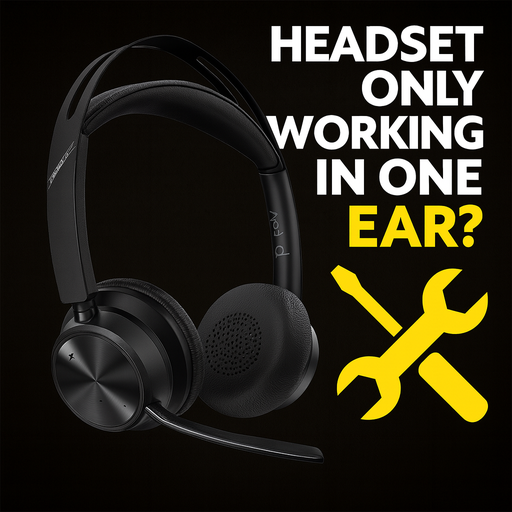
You fire up a game, a call, or some music… and suddenly only one side of your headset works.
Maybe:
- The right ear is completely dead
- The left side is way quieter
- Or the sound cuts in and out when you touch the cable
You try wiggling the plug, twisting the cord, replugging everything — sometimes it comes back for a second, then disappears again.
If your headset only plays in one ear (or one side is much quieter), this isn’t rare. It happens across gaming and office headsets from brands like HyperX, Logitech, Razer, SteelSeries, Turtle Beach, Sony, JBL, Beats and more.
This article will help you:
- Understand the difference between a setting issue and real hardware damage
- See the common failure patterns across many models
- Decide when it’s worth repairing instead of replacing
Does This Sound Like Your Headset?
Most people who end up needing repair describe some version of:
- One ear is completely silent, the other sounds normal
- One side is much quieter, even with balance centered
- Sound briefly comes back if you push, twist, or bend the cable or earcup
- The problem slowly got worse: first “glitchy,” now basically permanent
- It happens in every app and game, not just one program
If you’re nodding to most of those, you’re probably dealing with something physical inside the headset, not just a random software glitch.
Quick Checks Before You Blame the Headset
Let’s get the simple stuff out of the way — the things that can make it seem like one side is dead even when the hardware is fine.
1. Check the balance setting
On PCs and phones you’ll usually find a left/right balance slider in the sound settings.
It sounds obvious, but there are real cases where one channel got accidentally set to 0%, making that side totally silent until the user reset it.
Make sure:
- Left and right are both at the same level
- Any mono / accessibility modes aren’t forcing audio to one side
2. Make sure the plug is fully seated (for wired)
With 3.5 mm jacks, it’s very easy to be almost plugged in:
- A partially inserted plug can send audio to just one ear
- Splitter cables (mic + headphone) can also create one‑sided audio if not fully clicked in
Unplug completely, then plug back in firmly until you feel a click.
3. Test on another device or port
If possible, try:
- Another PC / laptop / controller
- Another USB port or audio jack
- For wireless, another console or Bluetooth device
If the headset works perfectly on another device, you might be looking at a driver, port, or console issue rather than a failed headset.
If it’s one‑sided everywhere, now it’s more likely the headset itself.
When It Starts Looking Like a Hardware Problem
Once the quick checks are done, here are the red flags that point to a physical failure.
1. Moving the cable or earcup makes the sound cut in and out
This is the classic pattern:
- You find a “sweet spot” by bending the cable
- Or squeezing / twisting the earcup
- One side briefly comes back, then dies again if you let go
That behaviour strongly suggests a stressed or broken wire or connection in the path to that speaker — not a software issue. Users with Turtle Beach, HyperX, and other headsets describe this exact thing before discovering a damaged internal cable or joint.
2. The issue slowly got worse over time
A lot of people can trace a timeline:
- It started as an occasional “right side drops out if I move”
- Then it became a regular glitch
- Eventually that side stayed dead no matter what
That gradual decline is typical of cables and solder joints slowly breaking down from being bent, pulled, or twisted — especially where the cable enters the earcup or at the y‑split.
3. It’s one ear only, across every device and app
If:
- Left is fine, right is dead (or the opposite)
- It happens on your PC, console, and phone
- It doesn’t matter which game or app you use
…then software is basically off the hook. At that point, the audio is making it out of your source just fine — it’s getting lost somewhere in the headset’s own wiring or driver.
Real-World Examples of “One Ear Dead” Failures
You can see the same story repeat across brands:
- A HyperX Cloud II owner tracked their issue down to “a wire inside the right ear cup split in two” after the right side stopped working.
- Turtle Beach support pages for models like the XLa and PX22 specifically talk about one side not working and walk through basic connection checks — and if those fail, they point to headset hardware as the likely culprit.
- General “headphones only work in one ear” guides explain that when balance, plugs, and source issues are ruled out, the remaining causes are almost always a damaged cable, plug, or driver connection inside the headphones.
In other words: it’s not just your specific brand. This is a common way wired and wireless headsets age out.
What’s Actually Failing Inside the Headset?
Without going into teardown details, most “one side dead” issues boil down to one of these physical problems:
- Stressed cable near the plug
- Years of bending at the same spot, wrapping tightly, or yanking the plug can fracture the tiny copper strands inside.
- Break inside the y‑split or headband
- For dual‑sided headsets, a very thin wire runs through the headband to the far earcup. That wire flexes every time you put the headset on or toss it into a bag.
- Loose or cracked solder joint in the earcup
- Where the cable connects to the speaker driver, repeated flex and vibration can cause micro‑cracks that eventually open up.
Any of those can leave you with perfect sound on one side and nothing (or very faint sound) on the other, even though everything on the source side is configured correctly.
When a Repair Makes Sense vs. Replacing the Headset
Whether you should repair or replace comes down to a simple trade‑off:
Repair is usually worth considering if:
- It’s a mid‑range or high‑end headset (gaming or office)
- You like how it fits and sounds, and everything else works
- The only real issue is one ear dead / one ear quiet
- You’d rather not throw away good hardware for a single failed connection
Headsets in the $80–$300 range are very common now; tossing one because of a single broken channel is painful if it can be fixed for less than a new one.
Replacement makes more sense if:
- The headband is cracked or badly warped
- Earpads are destroyed and the padding is gone
- The battery is also weak (on wireless models)
- There’s been serious liquid or impact damage on top of the one‑sided issue
At that point, you’re stacking multiple aging problems, and a fresh headset may simply be the better long‑term move.
If This Sounds Like Your Headset
If you’re here because:
- Your headset only works in one ear, or one side is way quieter
- You’ve already checked balance, plugs, and basic settings
- Moving the cable or earcup changes the sound (even briefly)
- The issue follows you across devices and apps
—you’re almost certainly dealing with a hardware problem inside the headset, not just another Windows or console quirk.
Your real options are:
- Live with one‑sided audio
- Buy a completely new headset
- Or start a repair and have the headset properly diagnosed and fixed if it’s still worth saving
If you like the headset you already have and just want both ears back, starting a repair is often the simplest way to get there without gambling on a whole new setup.

%20(7).png)