
Last updated: May 16, 2026
Kitchen Water Filtration Guide: Choosing the Best Filter for Your Home
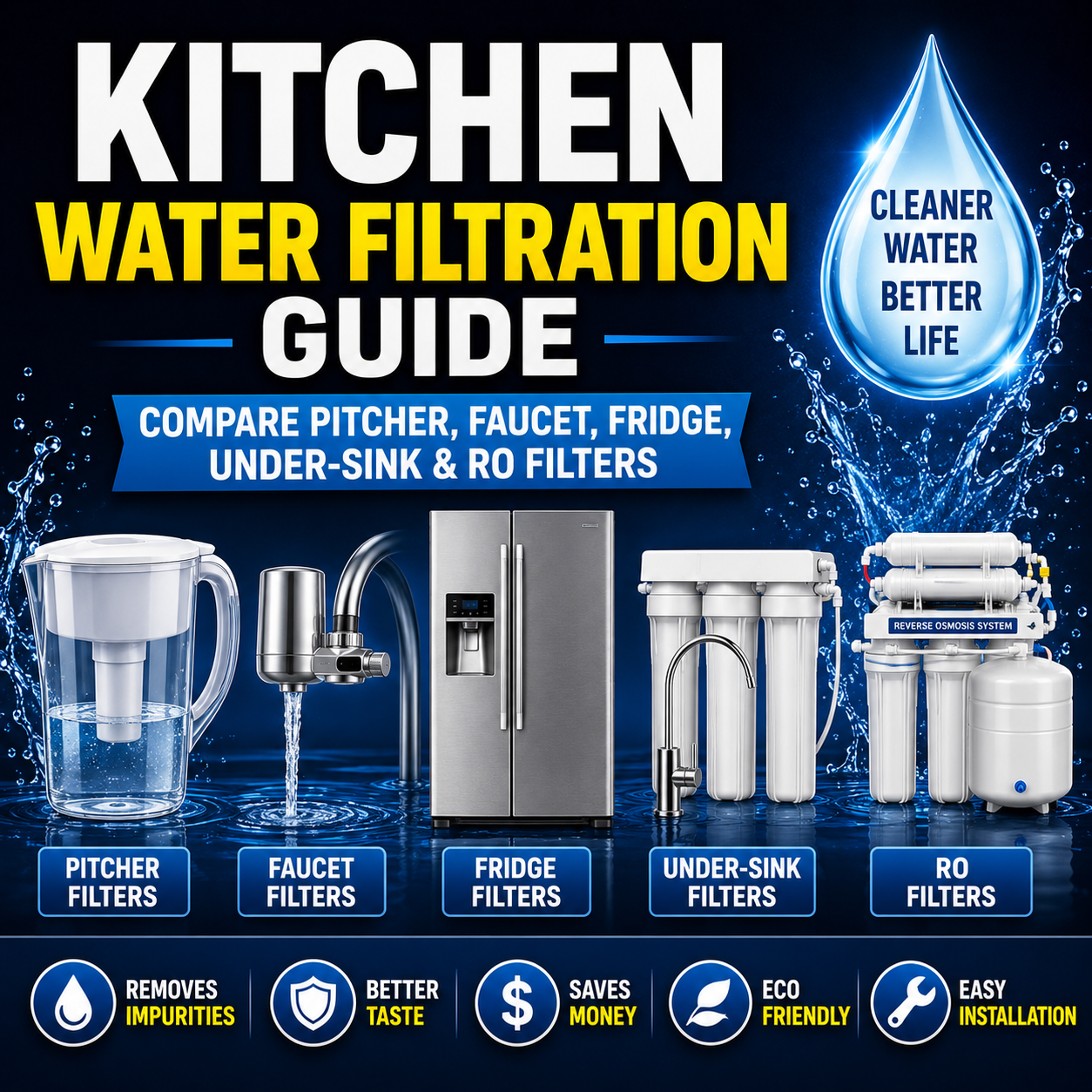
The best kitchen water filter depends on what you want to improve: taste, chlorine odor, lead reduction, PFAS reduction, hard-water scale, refrigerator ice quality, or whole-home water treatment. This guide compares pitcher filters, faucet filters, refrigerator filters, countertop systems, under-sink filters, reverse osmosis systems, and whole-house filters so you can choose the right setup without overbuying.
For most homes, the best starting point is simple: check your water quality, decide where you want filtered water, and match the filter type to the contaminants you care about. A pitcher may be enough for better-tasting drinking water. A refrigerator filter may be enough for ice and dispenser water. An under-sink or reverse osmosis system may make more sense if you want stronger filtration at one main kitchen tap.
Short answer
If you want the easiest option, start with a pitcher filter or faucet-mount filter. If you mainly use fridge water and ice, replace your refrigerator water filter. If you want stronger filtration at the kitchen sink, compare under-sink filters and reverse osmosis systems. If you want treatment for every tap in the house, consider a whole-house system.
Best shortcut: Choose based on your main problem. Taste and odor usually do not require the same system as lead, PFAS, hard water, or whole-home treatment.
Kitchen water filter comparison chart
Use this chart to compare the main filter types by installation, cost, maintenance, and best use case. Each row includes one main action link so the page stays clean and useful instead of feeling overloaded with links.
| Filter Type | Best For | Pros | Tradeoffs | Typical Buyer Intent | Best Next Step |
|---|---|---|---|---|---|
| Pitcher filter | Easy drinking-water filtration with no installation | Low upfront cost, portable, renter-friendly | Small capacity, slower refill, recurring cartridge cost | “I want better-tasting water today.” | Compare pitchers |
| Faucet-mount filter | Filtered water directly from the kitchen faucet | Easy install, no counter space needed, convenient switching | May not fit pull-out or sprayer faucets | “I want filtered tap water without plumbing work.” | Compare faucet filters |
| Refrigerator filter | Fridge dispenser water and ice | Already built into many refrigerators, easy replacement | Must match the exact filter number or fridge model | “My fridge says replace filter.” | Compare fridge filters |
| Under-sink filter | Higher-capacity filtered water at the kitchen sink | Hidden under the sink, better capacity than pitchers | Requires installation and periodic cartridge changes | “I want a cleaner kitchen drinking-water setup.” | Compare under-sink filters |
| Reverse osmosis system | Stronger filtration for one main drinking-water tap | Often targets a broader range of contaminants than basic carbon filters | Higher cost, more installation, may require tank or drain connection | “I want serious drinking-water filtration.” | Compare RO systems |
| Countertop filter | Stronger filtration without permanent under-sink installation | Good for renters, easier than plumbing-heavy systems | Uses counter space, may need manual filling or setup | “I want better filtration without modifying plumbing.” | Compare countertop filters |
| Whole-house filter | Filtering water before it reaches multiple fixtures | Covers showers, laundry, sinks, and appliances depending on system | Highest cost, more complex installation, may need professional help | “I want water treatment for the whole home.” | Compare whole-house filters |
Buying note: This chart is a starting point, not a guarantee. Always check the product’s performance data sheet, installation requirements, filter replacement costs, and certification claims before buying.
How to choose the right kitchen water filter
1. Start with the water problem you actually have
Do not start by asking, “What is the best water filter?” Start by asking what you want to reduce or improve. Taste and odor are different from lead, PFAS, sediment, hardness, bacteria, or whole-home chlorine reduction.
- Bad taste or chlorine smell: pitcher, faucet, fridge, or carbon under-sink filter may be enough.
- Lead concerns: look for filters certified for lead reduction, not just general taste improvement.
- PFAS concerns: check the product’s performance data sheet and certification claims carefully.
- Hard water scale: a water softener or scale-control system may be more relevant than a basic drinking-water filter.
- Whole-home concerns: consider a whole-house filter, but do not buy one if only your kitchen drinking water matters.
2. Match the filter to the location
If you only drink water from the refrigerator dispenser, replacing the fridge filter may be enough. If you cook, make coffee, and fill bottles from the sink, an under-sink filter may be more convenient. If you want filtered water without installation, a pitcher or countertop system is usually easier.
3. Check replacement-filter costs before buying
A cheap system can become expensive if the replacement filters cost a lot or need frequent replacement. Before buying any pitcher, under-sink unit, RO system, or whole-house filter, check the price and availability of the replacement cartridges.
4. Check certifications and performance data
Do not assume every filter with the same shape or price removes the same contaminants. Look for a performance data sheet and check exactly what the filter is certified or tested to reduce.
Pitcher water filters
Pitcher filters are the easiest way to start filtering drinking water. They require no installation, work in apartments and rentals, and are easy to replace. They are best for people who want better-tasting drinking water without changing plumbing.
Best for
- Renters
- Small households
- Better-tasting drinking water
- Low upfront cost
- People who do not want to install anything
Tradeoffs
- Limited capacity
- Slower filtration
- Must refill manually
- Replacement filters still add recurring cost
Faucet-mount water filters
Faucet filters attach directly to your kitchen faucet and let you switch between filtered and unfiltered water. They can be a good middle ground between a pitcher and an under-sink system.
Best for
- People who want filtered water from the faucet
- Small kitchens
- Simple installation
- A lower-cost alternative to under-sink filtration
Tradeoffs
- May not fit pull-out, sprayer, or designer faucets
- Can slow faucet flow
- Visible on the faucet
- Not as clean-looking as an under-sink system
Refrigerator water filters
Refrigerator filters are built into many fridge water and ice systems. They are convenient because the filter is already part of the appliance, but they are not universal. You need the exact filter family for your refrigerator.
Best for
- Fridge dispenser water
- Ice maker water
- People who already use their refrigerator’s built-in filter system
Tradeoffs
- Must match the correct filter number
- OEM replacements can be expensive
- Aftermarket options need careful fit and certification checks
If your refrigerator says “replace filter,” remove the old cartridge and search the exact filter number printed on it. Do not order by refrigerator brand alone.
Under-sink water filters
Under-sink filters are a strong choice if you want filtered water at the kitchen sink without refilling a pitcher or attaching something to the faucet. Some systems use a dedicated filtered-water faucet, while others connect inline with your existing cold-water line.
Best for
- Daily drinking water
- Cooking water
- Coffee and tea
- Cleaner countertop setup
- Higher capacity than pitchers
Tradeoffs
- Requires installation
- May need under-sink space
- Replacement cartridges can cost more than pitcher filters
- Some systems require a separate faucet hole
Reverse osmosis systems
Reverse osmosis systems use a membrane and additional filtration stages to reduce many dissolved contaminants. They are usually more expensive and more involved than basic carbon filters, but they can be a strong option for people who want more serious drinking-water filtration at one main tap.
Best for
- People who want stronger point-of-use filtration
- Homes with specific contaminant concerns
- High-use drinking-water households
- People comparing premium water filter systems
Tradeoffs
- Higher upfront cost
- More installation steps
- May require a drain connection
- Some systems use storage tanks
- Replacement stages must be maintained on schedule
Countertop water filters
Countertop filters can be useful if you want stronger filtration than a pitcher but do not want to install an under-sink system. Some countertop systems connect to a faucet, while others are filled manually.
Best for
- Renters
- People who do not want plumbing work
- Families that want higher capacity than a pitcher
- People comparing countertop RO or gravity systems
Tradeoffs
- Uses counter space
- Some models are slow
- Some require manual filling
- Can be more expensive than basic pitchers
Whole-house water filters
Whole-house filters treat water before it reaches multiple fixtures in the home. They can make sense if your concern affects more than drinking water, such as sediment, chlorine smell throughout the house, or water quality issues that affect showers, laundry, fixtures, and appliances.
Best for
- Filtering water for more than one tap
- Sediment problems
- Whole-home chlorine taste or odor concerns
- Homes where water affects fixtures, laundry, or showers
Tradeoffs
- Highest upfront cost
- More complex installation
- May require professional installation
- Not necessary if you only want drinking-water filtration at one faucet
Water filter certifications: what to check before buying
Water filter marketing can be confusing. A product may say it is “tested to” or “certified to” a standard, but you still need to check exactly which contaminants it is certified or tested to reduce.
Common standards include:
- NSF/ANSI 42: commonly associated with aesthetic effects such as chlorine taste and odor.
- NSF/ANSI 53: associated with contaminants that have health effects, such as lead and certain other contaminants.
- NSF/ANSI 58: associated with reverse osmosis systems.
- NSF/ANSI 401: associated with certain emerging contaminants.
Important: certification to a standard does not automatically mean a filter reduces every possible contaminant covered by that standard. Check the product’s performance data sheet and the exact reduction claims.
Reference: NSF standards for water treatment systems.
Best kitchen water filter by situation
| Situation | Start With | Why |
|---|---|---|
| I want the easiest setup | Pitcher filter | No installation, low upfront cost |
| I mostly use my fridge dispenser | Refrigerator filter | Uses the filter system already built into your fridge |
| I want filtered sink water | Under-sink filter | Better capacity and convenience than a pitcher |
| I want stronger filtration at one tap | Reverse osmosis | More advanced point-of-use filtration than basic carbon filters |
| I rent and cannot modify plumbing | Pitcher or countertop filter | Portable and removable |
| I want treatment for all taps | Whole-house filter | Filters water before it reaches multiple fixtures |
Maintenance tips before you buy
- Check replacement cost: The system price is only part of the cost. Replacement cartridges matter.
- Write the install date: After installing a filter, write the date on the cartridge or nearby label.
- Do not ignore flow changes: Slow flow may mean a filter is clogged or overdue.
- Keep the manual: Under-sink, RO, and whole-house systems may have multiple replacement stages.
- Verify certifications: Check the product’s exact claims and performance data sheet.
What not to do when choosing a kitchen water filter
- Do not buy the most expensive system before knowing your water problem.
- Do not assume every filter removes lead, PFAS, or other specific contaminants.
- Do not assume “NSF certified” means the same thing for every product.
- Do not buy a refrigerator filter without checking the exact filter number.
- Do not buy a whole-house system if you only need one drinking-water tap filtered.
- Do not ignore replacement-filter costs.
- Do not install a system beyond your plumbing skill level.
FAQ
What is the best kitchen water filter?
The best kitchen water filter depends on your water quality, budget, installation limits, and contaminant concerns. A pitcher is easiest, a refrigerator filter is convenient for fridge water and ice, an under-sink filter is better for daily sink use, and reverse osmosis is often chosen for stronger point-of-use filtration.
Is an under-sink filter better than a pitcher?
An under-sink filter is usually more convenient and higher capacity than a pitcher, but it costs more and requires installation. A pitcher is easier and cheaper to start with.
Is reverse osmosis better than a regular water filter?
Reverse osmosis can reduce many contaminants that basic carbon filters may not target, but it is more expensive and requires more maintenance. It is not always necessary for every home.
Do I need a whole-house water filter?
You may need a whole-house filter if your water issue affects multiple taps, showers, laundry, or appliances. If you only care about drinking water at the kitchen sink, an under-sink or countertop system may be enough.
Can I install a kitchen water filter myself?
Many pitcher, faucet, refrigerator, and countertop filters are simple to use. Under-sink, reverse osmosis, and whole-house systems may require more installation skill. Follow the manufacturer’s instructions or hire a plumber if needed.
How often should I replace a water filter?
Follow the manufacturer’s replacement schedule. Replacement timing depends on the filter type, rated capacity, water quality, and household usage.
What does NSF certification mean for water filters?
NSF/ANSI standards identify different types of performance claims, such as taste and odor reduction, health-related contaminant reduction, reverse osmosis performance, or emerging-contaminant reduction. Always check the specific contaminants a product is certified to reduce.


%20(7).png)