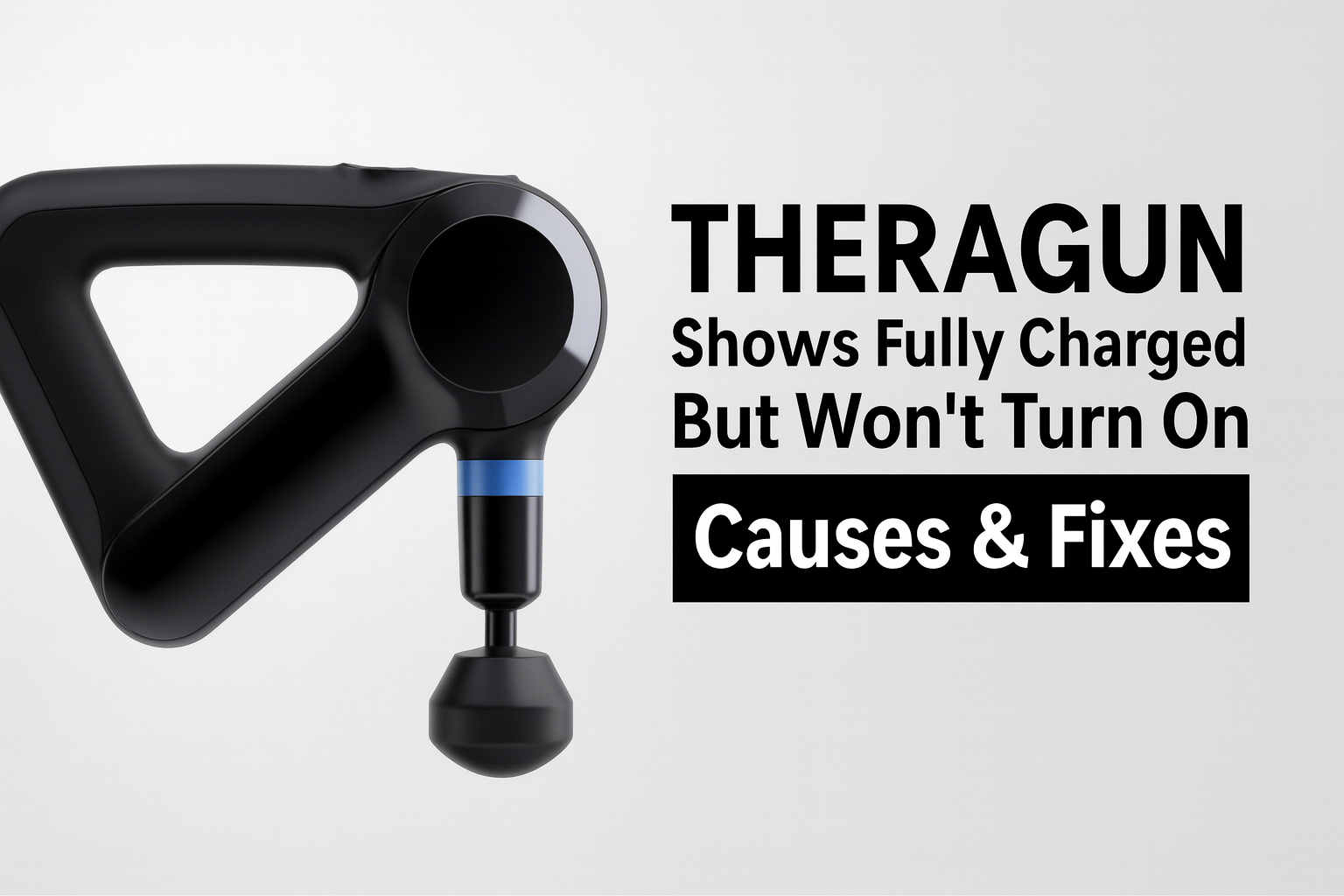

If your massage gun used to last through full sessions but now dies fast, loses charge while sitting, or only works for a few minutes off the charger, you’re usually dealing with a real battery or charging-system problem — not just a random glitch. That fits the same general failure pattern your current Theragun post already targets: the device appears charged or partially functional, but the battery system can’t deliver usable power the way it used to. (Mad Labs Repair)
In plain English: a massage gun can still look like it is charging normally while the battery pack itself is no longer healthy enough to hold or deliver power under load. Therabody’s own support pages show that these devices rely on LED or battery indicators to display state of charge, but those indicators do not guarantee the pack is still performing well once the motor starts pulling current. (Therabody TW)
If your massage gun battery won’t hold a charge anymore, the most likely causes are:
As lithium-ion batteries age, capacity fades and internal resistance can rise. Higher resistance makes voltage sag more under load, which can trigger early shutdown even when the battery meter still looks decent. (Battery University)
This issue usually shows up in one of a few ways:
Maybe it used to last multiple sessions. Now it lasts a few minutes.
This is the same family of issue as your current Theragun article: it may seem full or mostly full, but once load is applied, the device shuts down. (Mad Labs Repair)
You charge it, put it away, and a few days or weeks later it is nearly empty again.
That usually points away from a simple button issue and more toward the battery or charging system. Your existing Theragun post explicitly describes “only works while plugged in” as a battery-pack or battery-management clue. (Mad Labs Repair)
If the battery is already failing, repeatedly running it down and charging it back up usually does not “retrain” it into being healthy again. Battery University notes that lithium-based batteries lose capacity with age and use, and once internal resistance has risen enough to create performance problems, that behavior rarely reverses on its own. (Battery University)
So if your massage gun is doing the same thing over and over:
Use the correct charger or cable for the device and make sure the connection is solid. Therabody’s support pages show model-specific charging behavior and indicator states, including low-battery and full-battery signals. (Therabody TW)
Look for:
If the device has sat for a long time, give it a full uninterrupted charge before testing.
This is the key test:
If the failure only becomes obvious when the motor starts working hard, that strongly suggests a battery-performance problem, not just a display issue. Battery University explains that high internal resistance causes voltage to drop under load and can trigger early shutdown. (Battery University)
This is the most common cause.
Lithium-ion batteries lose capacity over time. Battery University describes capacity as a key health indicator for lithium-based batteries, and reduced capacity means less usable runtime even if the device still appears to charge normally. (Battery University)
That makes this symptom more likely if:
This is the part many people never hear about.
A battery can still show reasonable voltage at rest, but once the motor demands current, the voltage can sag hard enough that the device shuts down. Battery University specifically notes that rising internal resistance causes more voltage drop under load and can trigger early cut-off. (Battery University)
This is why a massage gun can:
Sometimes the cells are not the only issue.
A bad charging path, unstable connector, or charging-board fault can leave the battery undercharged or inconsistently charged even when the indicator makes it seem normal. Your current Theragun post already treats the battery pack and charging electronics as the main diagnosis bucket for this family of symptoms. (Mad Labs Repair)
If a massage gun sits for months unused, especially very low or very high in charge, that can accelerate battery aging. Battery University’s guidance on lithium-based batteries notes that storage conditions matter and that capacity loss is tied to both age and battery stress. (Battery University)
That is why some people pull a massage gun out after a long break and suddenly discover:
If your massage gun:
…then this article is probably not describing your problem.
This post is specifically for the case where the battery behavior itself has gotten obviously worse.
Stop charging or using the device and get it checked if you notice:
Your current Theragun post already draws that same line, and it is the right one: once heat, odor, or visible damage show up, this is not a “keep testing it” situation anymore. (Mad Labs Repair)
A lot of the time, yes.
This type of issue is often still repairable when:
That fits the positioning of your Massage Gun Repair service page, which explicitly invites people to send photos and describe the issue so you can tell them honestly whether repair makes sense. (Mad Labs Repair)
Repair gets less attractive when:
Usually yes if:
Usually no if:
That “is it worth fixing?” angle fits your overall site positioning, which emphasizes out-of-warranty devices, honest diagnosis, and “fix what’s worth keeping.” (Mad Labs Repair)
Only if you are very comfortable working around battery-powered electronics.
Battery-pack work is not the same as replacing an external cosmetic part. Community repair reports on Theragun devices show that successful battery work can involve opening the unit, testing cells, and rebuilding or replacing pack components — not just pressing reset and hoping. (iFixit)
So for most people, this is not the best DIY category.
If your massage gun battery won’t hold a charge anymore, the problem is usually one of three things:
If it charges but dies quickly, shuts off under load, or only behaves normally while plugged in, that is usually a real hardware issue — not just a weird battery reading. (Battery University)
If you want a straight answer, the most useful details to send are:
That fits your current contact and quote flow, which asks for the repair service, brand/model, and a description of what is going wrong. (Mad Labs Repair)
%20(7).png)
Fix what’s worth keeping.
Copyright © 2025 Mad Labs Repair. All Rights Reserved