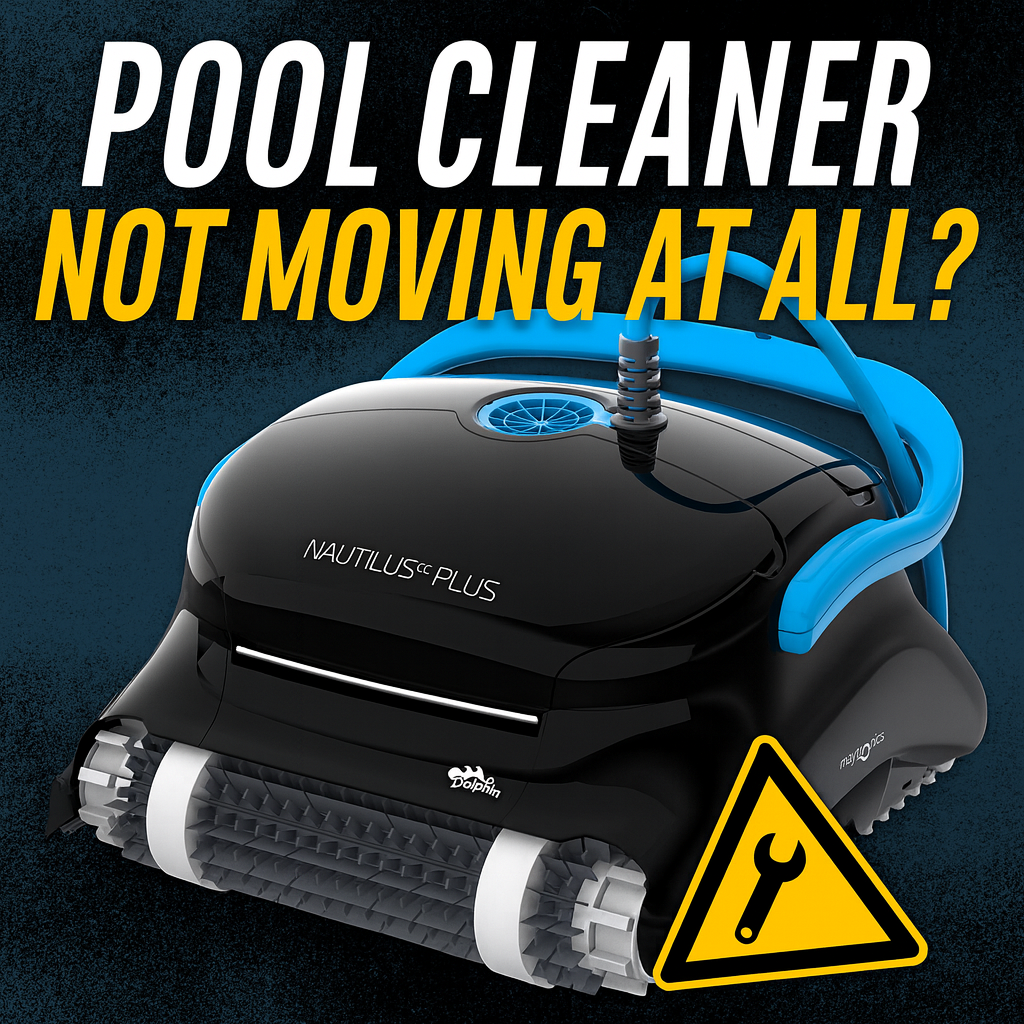
You drop the robot in, hit “Start”… and it just sits there.
Or worse, it moves for a second and then camps out in one corner of the pool, humming but not actually cleaning anything.
Good news: in most cases, a robot pool cleaner that won’t move is not “dead forever” – it’s telling you something very specific is wrong in the power, drive, or navigation system. A lot of those problems are repairable.
This guide will walk you through:
- Quick checks you can safely do at home
- The most common reasons a pool robot won’t move
- When it’s worth repairing vs. replacing
- How a mail‑in repair works if you decide to fix it properly
Quick Safety Note (Worth Reading)
You’re dealing with a device that mixes electricity + water.
It’s totally fine to do basic checks like cleaning filters and inspecting the cable. But if a fix involves opening the robot, dealing with motors, control boards, or sealed compartments:
That’s bench‑repair work – not a DIY job in flip‑flops by the pool.
If anything looks burned, melted, flooded, or cracked, unplug everything and stop right there.
Step 1 – Make Sure the Robot Is Actually Getting Power
It sounds obvious, but this eliminates a lot of “dead” robots.
✅ Check the outlet & GFCI
- Unplug the power supply from the wall.
- Plug something else (like a lamp) into the same outlet.
- If that doesn’t work, reset the GFCI or breaker.
If the outlet works but your power supply has no lights at all, there’s likely:
- An internal fault in the power supply, or
- Damage from a surge / water intrusion
That’s a repair‑bench problem.
✅ Check the power supply cord & robot cable
Look for:
- Cuts or crushed spots in the cable
- Burn marks or melted connectors
- Loose plug where the cable meets the power supply or the robot
If jiggling the cable makes the lights flicker or robot briefly twitch, you’re probably looking at:
- A failing connection / broken conductor in the cable
- Loose or corroded plug contacts
Again: repairable, but not something to “tape up and hope for the best.”
Step 2 – Confirm You Actually Started a Cleaning Cycle
Many newer robots have schedules, modes and delay timers that make behavior confusing.
Check:
- Mode / Program – make sure you’ve selected a normal clean cycle (not “delay start”).
- Start Button – for some units, you must press Start after choosing the mode.
- App / Remote – if you use an app or remote, confirm it really connected and sent the command.
If the power supply shows a normal “cycle running” light but the robot in the water does nothing, move on to the next section.
Step 3 – Is It Completely Dead, or Just Stuck in One Area?
This matters.
- Case A: Does not move at all
No tracks, no brushes, no pump movement. It just sits there. - Case B: Moves a little, but stays in one spot or keeps returning to the same area
Maybe the pump runs, but it only wiggles or covers a tiny patch of floor.
We’ll handle both.
Case A: Robot Pool Cleaner Won’t Move At All
If the robot powers up (you hear a hum or feel vibration) but there is zero motion, here are the usual suspects.
1. Clogged Impeller or Stuck Debris
Many robots won’t move if the pump can’t push water.
Try this (with the unit unplugged from power):
- Remove the unit from the water and drain it.
- Open the filter basket / cartridge area.
- Look for:
- Leaves or sticks jammed in the impeller
- Rocks or heavy debris in the intake
- If you can see the impeller, gently spin it with a non‑metal object (like a plastic cable tie). It should move freely.
If the impeller is jammed solid or wobbles around on its shaft, that’s a sign of motor or bearing damage – a repair shop job.
2. Overfilled or Clogged Filters
Some cleaner designs will shut down or refuse to move if flow is too restricted.
- Pull the filter basket(s) or cartridges out.
- Hose them off thoroughly.
- Try running the robot for a few minutes without filters (if the manual allows it).
If it suddenly moves normally without filters, you’ve just confirmed your issue is flow restriction – dirty filters, clogged intakes, or both.
3. Broken / Slipped Drive Belts or Worn Tracks
If the pump runs (you can feel water movement at the outlet) but the robot doesn’t move forward at all, the drive system may be the problem:
- Rubber tracks worn smooth or split
- Drive belts that slipped off or snapped
- Sprockets with broken teeth
With the unit unplugged and out of the water:
- Try turning one track by hand.
- Watch whether the opposite side moves.
- Look underneath for obvious loose belts or hanging rubber.
Anything involving loose belts, worn tracks, or stripped cogs is repairable – but usually involves opening the casing.
4. Failed Drive Motor or Internal Gearbox
Inside the robot is usually:
- A pump motor (for water flow) and
- One or more drive motors connected to gearboxes and tracks.
Symptoms of a failing drive motor:
- You hear the pump running, but tracks never move.
- The robot “jerks” once when you start it, then nothing.
- It used to work after a “tap” or wiggle, and now it’s completely dead.
This typically means:
- Water intrusion into the motor compartment
- Burned windings from overload
- Seized bearings / gears
All of that needs proper bench testing, replacement parts, and resealing to keep it waterproof.
5. Internal Control Board or Sensor Fault
If the robot:
- Won’t move at all
- Power supply lights look normal
- Motors sometimes twitch when starting, then shut down
…the internal control board may be detecting a fault and shutting everything down to protect the motors.
We see this a lot after:
- Lightning or power surges
- The robot being left outside in heavy rain
- Cracked housings letting water reach the electronics
Diagnosis means opening the shell, testing components, and checking for corrosion or burned spots – again, shop work.
Case B: Robot Pool Cleaner Only Cleans One Spot or Tiny Area
If your robot technically “moves” but only covers a small patch, keeps circling near the deep end, or returns to the same area over and over, here’s what usually causes that.
1. Tangled or Heavy Cable
The floating cable can act like a leash.
Look for:
- Big loops or kinks in the cable
- Sections that are water‑logged and sinking
- The cable always pulling from the same side of the pool
What you can do:
- Lay the full cable straight in the sun for a bit to relax twists.
- When you spool it up, use large loops instead of tight wraps.
- Start the robot in the center of the pool so the cable has equal reach.
If the cable insulation is cracked or water‑logged, it’s time for a replacement; that’s a repair‑shop item.
2. Worn Brushes or Tracks
If the robot tries to move but seems to spin in place or struggles to climb even small slopes:
- Brush material might be worn down
- Tracks may be smooth and slipping on the pool surface
This can confuse the navigation system and cause the robot to “hunt” without actually traveling far.
Look for:
- Flat spots on brushes
- Tracks that feel slick instead of grippy
- Excessive play or slop when you move the tracks by hand
These are classic wear parts – replacing them is a normal part of a full rebuild.
3. Partially Clogged Impeller / Low Flow
The pump might kind of run, but with low flow, the robot can’t grip the floor or walls properly.
Signs:
- Robot starts to climb, then falls back
- It drifts aimlessly or only moves when near the outlet
- You feel weak flow at the water outlet on the robot
Clean filters, check the impeller area, and re‑test. If flow is still weak, the pump motor could be worn or partially seized.
4. Navigation / Sensor Issues
High‑end robots use:
- Tilt sensors
- Gyros
- Software‑based mapping
A failing sensor or corrupted control logic can make it behave like it’s drunk: repeating the same path, circling one area, or stopping randomly.
Unfortunately, there’s no “home fix” for this beyond power‑cycling and factory resets. Past that, it’s down to diagnostic tools and board‑level repair or replacement.
When Is It Worth Repairing a Robot Pool Cleaner?
In many cases, a robot that won’t move is absolutely worth repairing.
It makes sense to fix it when:
- It’s a higher‑end cleaner (Dolphin, Polaris, Hayward, Maytronics, etc.).
- It’s less than ~6–8 years old and hasn’t been rebuilt before.
- The shell isn’t cracked and there’s no major structural damage.
Replacing a decent robot often means $800–$1,800+ for a new unit. A proper repair usually targets the exact failed parts – drive motor, pump motor, tracks, belts, cable, control board – and brings the unit back with fresh wear parts instead of gambling on a new model.
It’s not usually worth repairing when:
- The body is cracked or badly UV‑damaged.
- It’s been fully flooded inside and corroding for a long time.
- It’s a very low‑end or “big‑box special” robot that was cheap to begin with.
If you’re not sure which camp yours is in, a professional diagnosis is the easiest way to decide.
How a Mail‑In Robot Pool Cleaner Repair Works (Mad Labs Style)
Here’s how we handle robots that won’t move or are stuck in one spot:
- Quick Online Intake
You tell us the brand, model, and exactly what it does (or doesn’t do). Attach a short video if you can – we love that. - We Get It on the Bench
Once it arrives, we:- Open and inspect for water intrusion or cracks
- Test the power supply, cable, motors & control board
- Check tracks, belts, brushes, impeller, sensors
- You Get a Real Diagnosis
We tell you exactly why it stopped moving and what it needs:- Example: “Drive motor seized + worn tracks” or
- “Cable conductor broken at plug + clogged impeller.”
- You Decide
You’ll get a repair quote so you can decide whether to:- Approve the repair and get the robot fully rebuilt, or
- Pass and have it returned.
- Back to Cleaning Instead of Sitting on the Pool Floor
Once it’s repaired and tested in water, it ships back ready to go – not sitting in the corner of your pool acting like an expensive decoration.
Robot Still Not Moving? Here’s Your Best Next Step
If you’ve:
- Checked power and outlet
- Cleaned filters and intake
- Verified the cable isn’t tangled
- Looked for obvious track/brush damage
…and your robot pool cleaner still won’t move or only cleans one patch, the next step is proper diagnostic testing.
That’s what we do all day at Mad Labs Repair.
👉 Snap a few pictures of your robot and the power supply, and reach out for a repair quote.
We’ll tell you if it’s repair‑worthy, what’s likely failed, and whether it makes more sense to fix it or replace it.
Your robot’s job is to keep your pool clean – not to sit stuck in one place. Let’s get it moving again.