
Last updated: June 8, 2026
Ricoh GR or Pentax WG Camera Not Working? First Sort the Repair Problem
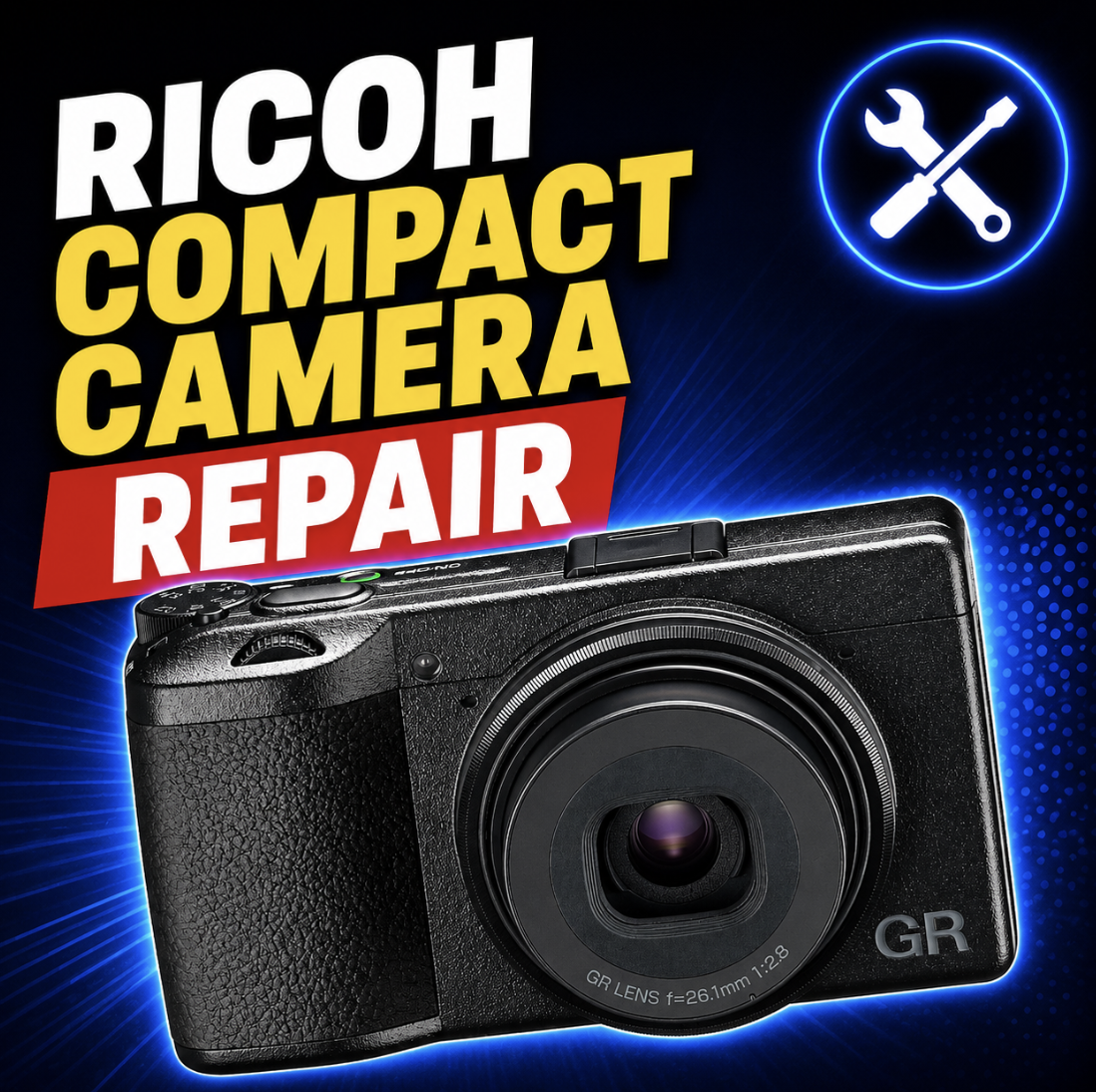
Ricoh compact camera repair starts with a split that matters: do you have a Ricoh GR pocket street camera or a Pentax WG rugged waterproof camera?
They are both compact cameras, but they fail in different ways. A Ricoh GR problem is usually about sensor dust, dust in the lens path, a lens that will not extend, USB-C charging, storage, controls, a cracked LCD, or a premium-camera repair decision. A Pentax WG problem is usually about fog, water intrusion, seals, battery/card doors, stuck buttons, macro lights, sand, drops, or whether the rugged rating was exceeded.
Mad Labs offers independent mail-in repair help for Ricoh and Pentax compact cameras. We are not Ricoh or PENTAX warranty service. If your camera is still under warranty, has no physical/liquid damage, or may qualify for official Ricoh/PENTAX service, check official support first.
Two cameras, two repair lanes
A generic compact-camera repair page is not good enough for Ricoh. GR owners and WG owners usually have completely different problems.
Important: Do not troubleshoot a GR like a waterproof camera, and do not troubleshoot a WG like a premium street camera. The first step is knowing which lane you are in.
Is this a GR problem or a WG problem?
Use this quick sorter before you think about parts. It helps keep a dust-cleaning problem from turning into a water-damage conversation, and it keeps a waterproof-camera leak from being treated like a normal compact-camera glitch.
Ricoh GR sensor dust, lens dust, and dust spots
Ricoh GR dust is one of the highest-intent repair searches in this category. GR cameras are small enough to live in pockets and bags, and owners often notice dust spots when shooting plain skies, walls, or bright scenes at smaller apertures.
GR cameras include dust-reduction features, but that does not mean dust can never become a problem. Dust spots in the image, dust visible inside the lens path, and general dirt on the front element are three different situations.
| What you see | What it may mean | What to do first |
|---|---|---|
| Dark spots at small apertures | Possible sensor dust. | Test against a plain bright wall or sky. Check if the spots stay in the same place. |
| Speck visible inside the lens | Dust or debris in the optical path. | Do not open the camera unless you accept the risk. Check warranty/service first if eligible. |
| Smudge on the front glass | External dirt, oil, or residue. | Clean gently with proper lens-cleaning tools before assuming internal dust. |
| Dust after pocket carry | Possible lint or fine debris entry. | Stop pocket carrying without a case and document the spots before service. |
Do not rush into DIY disassembly. GR cameras are compact and delicate inside. Opening one can affect warranty, damage ribbon cables, or create a bigger problem than the dust itself.
Ricoh GR lens stuck, lens error, or camera shuts off
Ricoh GR cameras use a retracting fixed lens. That is part of what makes them pocketable, but it also means impact, grit, or pressure can cause real mechanical trouble.
If the lens will not extend, will not retract, sits crooked, grinds, clicks, or the camera powers on and then shuts itself off, do not keep cycling the power over and over. Repeated attempts can make mechanical damage worse.
Repair-worth-it note: A lens issue on a GR III, GR IIIx, GR IV, or special-edition GR is usually more worth diagnosing than the same failure on an old low-value compact.
GR USB-C charging, battery, storage, microSD, and file transfer
Modern GR cameras bring another repair lane: USB-C charging and transfer. GR IV also adds a storage workflow that can involve internal memory, microSD, and USB-C file transfer instead of the older full-size SD habit many photographers are used to.
Data note: Camera repair and photo recovery are not the same service. If the images matter, say that before sending the camera or card.
GR cracked screen, controls, hot shoe, HDF, and image issues
GR cameras are small enough to go everywhere, which means screens, dials, buttons, hot shoes, and control wheels take abuse. Some complaints are hardware. Others are settings.
| Problem | Check first | Repair is more likely when |
|---|---|---|
| Cracked LCD | Check whether the camera still powers on, shoots, and saves images. | The camera works otherwise and the screen is physically damaged. |
| Sticky dial or button | Check for dirt, pocket lint, drink residue, or impact around the control. | The control is stuck, mushy, cracked, or no longer registers. |
| Hot shoe issue | Check accessory seating, flash settings, and whether the shoe is bent or dirty. | The shoe is loose, physically damaged, or accessories never trigger. |
| Image looks hazy or soft | On HDF models, check whether the Highlight Diffusion Filter is enabled. | The image stays hazy with HDF off and the lens/sensor may need inspection. |
| Photos look blurry | Check shutter speed, Snap Focus distance, macro mode, stabilization, and lens cleanliness. | Blur started after impact or focus fails in normal conditions. |
| Shake reduction concern | Check shooting conditions, shutter speed, and settings before assuming IBIS failure. | The camera shows errors or blur changed after a drop. |
HDF note: HDF is supposed to soften highlights and reduce the crisp look when enabled. That can be beautiful, but it can also be mistaken for a lens problem if you forget it is on.
Pentax WG water, fog, seals, doors, and saltwater damage
Pentax WG cameras are built for rougher conditions, but waterproof ratings are not magic. Depth, time, pressure, door condition, seal condition, sand, salt, shock, age, and user handling all matter.
Do not lump every WG model into the same rating. A WG-8, WG-90, and WG-1000 are different cameras with different rugged specs and different repair economics.
Do not charge a wet camera. If you see fog, water, corrosion, or moisture inside a WG camera, stop powering it on and do not plug it in.
WG buttons, macro lights, cracked screen, drops, and no power
WG repair is not only about water. These cameras get used at beaches, pools, jobsites, boats, hikes, and family trips. Buttons can stick. The LCD can crack. The battery door can break. Macro lights can stop working. A drop can hurt more than the outside shell shows.
Looks broken, but may be a setting or simple check
Some Ricoh and Pentax complaints are not repair-first. This section is here to save you from mailing in a camera that needed a setting changed, a card swapped, or a safer test.
| Complaint | Check first | Why it matters |
|---|---|---|
| GR HDF image looks soft | Check whether HDF is enabled. | HDF intentionally creates softer, diffused highlights. |
| GR photos are blurry | Check Snap Focus distance, shutter speed, macro mode, and lens cleanliness. | Settings can look like focus failure. |
| Dust spots only in certain tests | Confirm with a plain background at small apertures. | Not every mark is sensor dust. |
| GR won’t charge | Try another cable, charger, battery, and outlet. | The cable or battery may be the problem. |
| microSD not detected | Test another card and formatting. | Cards fail more often than people think. |
| WG door feels tight | Check for sand, debris, or gasket seating. | Do not force a waterproof door closed over debris. |
| WG buttons sticky | Check for salt, sand, sunscreen, and residue. | Residue can mimic button failure. |
Stop using it now if you see these signs
Some symptoms get worse when you keep testing. If you see any of these, stop cycling power, stop charging, and do not force moving parts.
When Ricoh or Pentax compact repair makes sense
Repair makes the most sense when the camera has enough value, the damage is contained, and the likely repair is not more expensive than replacement.
When replacement may be smarter
A useful repair page should be honest. Some Ricoh and Pentax compact cameras are better replaced than repaired, especially if the failure is severe or the camera is lower value.
| Situation | Why replacement may make more sense | Possible exception |
|---|---|---|
| Older compact with major lens failure | Lens assembly work can cost more than a used replacement. | Rare model, sentimental value, or clean donor parts. |
| Severe saltwater corrosion | Multiple boards, buttons, contacts, and lenses may be affected. | Very early inspection before corrosion spreads. |
| WG-1000 with major board/water damage | Lower replacement value can make deep repair hard to justify. | Simple door, screen, button, or contained damage. |
| GR lens, screen, controls, and board all damaged | Multiple-system repairs can approach replacement cost. | High-value GR IV or special model where repair still pencils out. |
| Parts are unavailable | Some older Ricoh/Pentax compact parts may be hard to source. | Donor camera or non-parts repair. |
Simple rule: If the repair cost gets close to the price of a clean replacement, replacement is usually smarter unless the camera has special value to you.
Ricoh/PENTAX official repair first
If your Ricoh GR or Pentax WG camera is still under warranty, has no physical/liquid damage, or may qualify for official Ricoh/PENTAX service, check the official repair path first. Warranty decisions can depend on proof of purchase, serial number, model, damage history, and the exact issue.
Independent mail-in repair is usually more useful for out-of-warranty cameras, secondhand purchases, physical damage, dust cleaning outside warranty, stuck lenses, cracked screens, water intrusion, broken ports, damaged doors, failed controls, or when you want a repair-worth-it diagnosis before replacing the camera.
Important: Mad Labs is independent repair help. We are not Ricoh-authorized warranty service and cannot promise warranty coverage, part availability, or that every GR or WG camera is economical to repair.
What to send with your mail-in request
The more specific you are, the better the repair path becomes. “Ricoh broken” is hard to diagnose. “GR IIIx has dust spots at f/16 and a clean front lens” or “WG-8 has fog inside after saltwater use” is much more useful.
Need mail-in help for a Ricoh GR or Pentax WG?
Start by sorting the camera. If it is a GR, the repair question is usually dust, lens extension, USB-C, controls, screen, storage, HDF mode, or premium-camera value. If it is a WG, the repair question is usually water, fog, seals, doors, buttons, macro lights, drops, sand, or whether the rugged rating was exceeded.
Send the model, symptom, photos, and damage history. Mad Labs can help sort whether the camera looks like a repair candidate, an official Ricoh/PENTAX support case, a data/photo concern, or a replacement decision.
FAQ
Do you repair Ricoh compact cameras?
Mad Labs offers independent mail-in repair help for Ricoh and Pentax compact cameras. Common repair candidates include Ricoh GR dust, stuck lenses, cracked LCDs, USB-C charging problems, sticky controls, Pentax WG fog or water intrusion, broken doors, stuck buttons, and out-of-warranty physical damage.
Which Ricoh and Pentax compact cameras can be diagnosed?
Common models include Ricoh GR III, GR IIIx, GR III HDF, GR IIIx HDF, GR IV, GR IV HDF, GR IV Monochrome, GR II, older GR models, Pentax WG-8, WG-90, WG-1000, WG-80, WG-70, and older WG cameras.
What is the difference between Ricoh GR repair and Pentax WG repair?
Ricoh GR repair is usually about dust, lens extension, USB-C charging, storage, screen, controls, or premium street-camera value. Pentax WG repair is usually about water, fog, seals, doors, macro lights, sand, stuck buttons, drops, and rugged-camera damage.
Can Ricoh GR sensor dust be cleaned?
Sensor dust may be cleanable, but the right path depends on warranty status, model, severity, and whether the dust is on the sensor or inside the lens path. Check official service first if the camera may still be covered.
Why does my Ricoh GR have dust spots in photos?
Dust spots that stay in the same place, especially at small apertures against bright plain backgrounds, may be sensor dust. External lens dirt, internal lens dust, or file/display artifacts can look different, so document the issue before repair.
Why won’t my Ricoh GR lens extend or retract?
A GR lens may fail to extend or retract because of impact, sand, pocket pressure, grit, motor trouble, or internal lens guide damage. Do not force the lens or keep cycling power if it grinds or sits crooked.
Why does my Ricoh GR turn on and then shut off?
A GR that turns on and shuts off may have a weak battery, lens movement failure, power-board issue, storage problem, or internal fault. If the shutdown happens when the lens tries to move, stop cycling power repeatedly.
Why won’t my Ricoh GR charge by USB-C?
Check the charger, cable, battery, outlet, and USB-C port. If the port is loose, damaged, angle-sensitive, or gets unusually hot, mail-in diagnosis may make sense.
Can a cracked Ricoh GR screen be replaced?
A cracked GR screen can be a good repair candidate if the camera powers on, shoots, saves images, and the damage is mostly limited to the LCD or touch/display assembly.
Why is my Ricoh GR HDF image soft or hazy?
On HDF models, check whether the Highlight Diffusion Filter is enabled. HDF intentionally creates softer, diffused highlights. If the image is still hazy with HDF off, the lens or sensor path may need inspection.
Can a Pentax WG waterproof camera get water damage?
Yes. Waterproof ratings depend on model, depth, time, seals, doors, impact, age, sand, salt, and handling. If water or fog appears inside, stop using and charging the camera.
Why is there fog inside my Pentax WG camera?
Fog can mean moisture entered the camera or condensation formed inside. If it follows water use, saltwater, a door issue, or a drop, treat it as a water-intrusion concern.
Why won’t my Pentax WG turn on after swimming?
No power after swimming can be caused by water intrusion, battery contact corrosion, seal failure, board damage, or door damage. Do not charge it until it has been inspected.
Why are my Pentax WG buttons stuck after beach use?
Sand, salt, sunscreen, and dirt can jam small buttons and work into seals. Do not force stuck buttons; document the exposure history before sending the camera in.
Should I contact Ricoh or Pentax warranty first?
If your camera is still under warranty, has proof of purchase, and the issue looks like a covered defect, check official Ricoh/PENTAX service first. Independent mail-in repair is usually more useful for out-of-warranty, secondhand, physically damaged, water-damaged, or warranty-ineligible cameras.
Is Ricoh compact camera repair worth it or should I replace it?
Repair is usually more worth considering for GR III, GR IIIx, GR IV, special-edition GR models, WG-8, and contained damage like dust, LCD, USB-C, controls, or doors. Replacement may be smarter for severe saltwater corrosion, major lens/board failure on older models, or repairs that approach replacement cost.

%20(7).png)