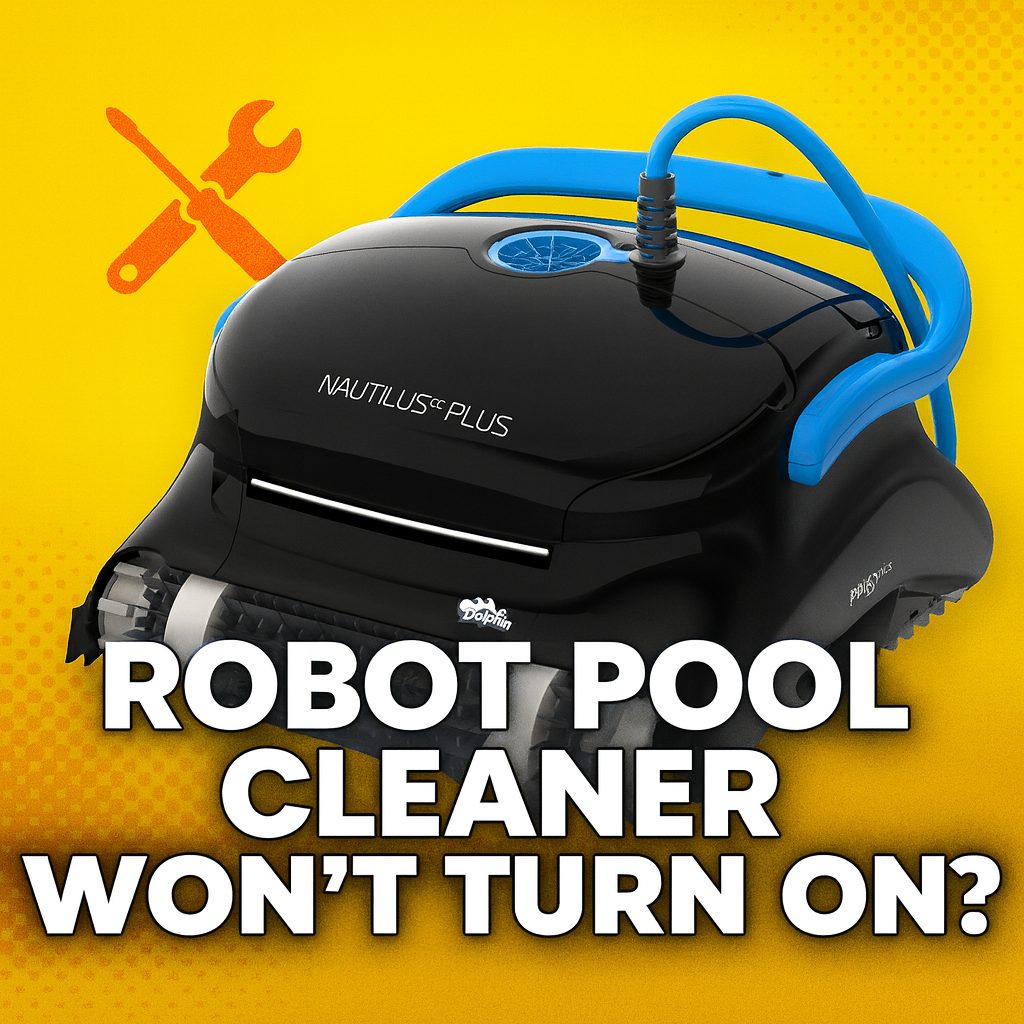
You roll out the power supply, plug everything in, hit the button and…
Nothing.
No lights.
No relay click.
No little robot friend cruising the pool.
Whether it’s a Dolphin, Polaris, Aiper, Hayward, Pentair, or any other brand, a completely dead robot is one of the most stressful pool problems. Owners immediately wonder if they just lost a $700–$2,000 machine.
The good news: a lot of “won’t turn on” problems are simple and safe to check.
Manufacturers like Maytronics (Dolphin) and retailers that troubleshoot Polaris and other brands all start with the same basic flow:
- Confirm the outlet and GFCI
- Check the power supply and cables
- Separate “bad power supply” from “bad robot”
- Only then consider internal motor or board failure (Maytronics)
This guide follows that pattern, but in plain language.
We’ll walk through:
- Basic safety (important)
- Plug‑in robots: how to separate outlet vs power supply vs robot
- Cordless/battery robots: how to treat “no response”
- What’s safe to DIY vs when to stop
- Where Mad Labs fits in
Before Anything Else: Safety First
A robot pool cleaner is still electrical equipment around water.
- Never open a sealed power supply box.
- Never open sealed motor pods or housings yourself.
- Always unplug from the wall before connecting or disconnecting the floating cable. (Inyo Pools)
Everything in this blog is about external checks you can safely do as an owner.
If you see burned, melted, or obviously damaged electrical parts at any point, stop there.
Step 1 – Confirm the Outlet & GFCI (Yeah, Really)
It feels insulting, but every official guide starts here for a reason. (Maytronics)
Try this:
- Unplug the robot’s power supply.
- Plug a known‑good device into the same outlet – a lamp, hair dryer, phone charger, etc.
- If that device doesn’t work, you probably have:
- A tripped GFCI, or
- A bad outlet / breaker
Reset the GFCI or breaker if you know how. If the outlet is still dead, the problem isn’t your robot – it’s your house power.
Extension cord warning
Manufacturers often say don’t use extension cords with robotic pool cleaners at all, for both safety and reliability reasons. (Maytronics)
If you’re using one:
- Remove the extension cord from the equation.
- Plug the power supply directly into a known‑good, grounded outlet.
If a direct outlet suddenly works but your extension didn’t, you found your culprit.
Step 2 – Does the Power Supply Turn On by Itself?
This is the single most useful test for corded robots (Dolphin, Polaris, etc.).
Dolphin’s official FAQ and troubleshooting guide explicitly tell you to unplug the blue robot cable from the PSU and see if the power supply will turn on and stay on with nothing attached. (Maytronics)
How to do it:
- Unplug the PSU from the wall.
- Disconnect the floating cable from the PSU (usually a twist‑lock or push‑in connector).
- Plug the PSU back into the wall.
- Press the power button.
Now watch:
- If the PSU stays off (no lights, no click):
The problem is very likely in the power supply itself or the short black cord to the wall. - If the PSU turns on and stays on with the cable disconnected:
The power supply is probably OK, and the problem is in the floating cable or the robot. (Maytronics)
This one test separates two very different repair paths.
Step 3 – If the Power Supply Won’t Turn On at All
You’ve confirmed the outlet is good, tried a different outlet, disconnected the robot cable… and the PSU still won’t wake up.
Common real‑world causes:
- Internal failure in the PSU (capacitors, control board, etc.)
- Water damage – e.g., the PSU was left in the rain or splashed and then stopped turning on (I Love My Aquabot)
- Rarely, a blown fuse in older power supplies (many newer models no longer use user‑serviceable fuses) (Trouble Free Pool)
What you can safely check
- Look for obvious cracks, burn marks, or melted spots on the PSU housing or chords.
- Check the black cord to the wall for cuts, chew marks (pets love cords), or crushed sections. (I Love My Aquabot)
If you see direct cable damage, stop using it. A replacement PSU or cord is usually the next move.
If the PSU looks fine but won’t power on, the fix is internal electronics work or full replacement, not a DIY project.
Step 4 – PSU Turns On, But the Robot Is Completely Dead
This is a different scenario:
- Power supply lights come on
- You hit start
- Nothing happens in the pool – no movement, no bubbles, no sound
Or the power supply errors out immediately when you plug the robot cable back in. (Inyo Pools)
At that point, the PSU has power, but something between the PSU and the robot motors is failing.
4a – Inspect the Floating Cable
- Run your fingers along the entire length of the cable:
- Cuts, nicks, chew marks
- Sections that look crushed or sharply kinked
- Pay attention to both ends:
- The connector at the PSU
- The connector where it enters the robot
Forum cases show robots working again after people repaired or replaced a frayed cord right at the power box or at the robot entry point. (Reddit)
If there’s obvious damage, that alone can short or open the circuit and leave the robot totally dead.
4b – Check the Cable Connection
For twist‑lock and push‑in connectors:
- Make sure the plug is fully seated and locked at the PSU.
- Check for corrosion, bent pins, or greenish deposits on the contacts – signs of water intrusion.
If the PSU throws an error or shuts off as soon as the cable is connected, that points to a short in the cable or robot rather than the PSU.
4c – When It’s Inside the Robot
If:
- PSU is good
- Cable looks healthy
- Connections are clean and tight
- But the robot shows zero signs of life…
…you’re probably looking at:
- A failed motor/control pod
- A fault on the internal power/control board
- In rare cases, a stuck or failed internal start relay
Owners in pool forums often get to this point by measuring full voltage at the end of the cable but no response from the robot – which is the classic “it’s inside the machine now” moment. (Reddit)
That’s when the unit needs bench testing, not more backyard guessing.
Step 5 – Cordless / Battery Robots That Won’t Turn On
Cordless robots (Aiper Seagull series, some Polaris models, etc.) skip the external PSU but add batteries and charging docks to the mix. (Aiper)
Common “no power” causes here:
- Battery not actually charged
- Bad charger / dock
- Dirty or corroded charging contacts
- Internal battery degradation after 1–2 seasons
- Stuck or failed power button / internal board
Quick checks
- Confirm charge:
- Make sure it actually completed a full charge cycle.
- Look at the charge indicators (solid vs blinking LEDs). (Aiper)
- Inspect charging contacts:
- On both the robot and the dock, check for debris, scale, or corrosion.
- Gently clean with a dry cloth or cotton swab.
- Try a soft reset:
Some models let you hold the power button for ~10 seconds to reset the electronics. Expert Q&As for Aiper/Polaris cordless cleaners often recommend this as a first step. (JustAnswer) - Battery age:
- If the robot is 18–24 months old and lived outside, an internal battery that won’t hold charge anymore is very common. (JustAnswer)
If the charger and contacts are healthy but your robot still won’t respond, you’re into “replace the battery pack or internal board” territory.
What’s Reasonable to DIY vs When to Stop
Safe owner checks
Good to do yourself:
- Testing the outlet & GFCI with another device
- Plugging the PSU directly into a known‑good outlet (no extension)
- Trying the PSU with the robot cable disconnected
- Visual inspection of:
- PSU housing
- Black wall cord
- Floating cable
- Connectors & pins
- Basic cordless checks:
- Confirm full charge
- Clean charging contacts
- Try a soft reset
Time to stop DIY
Hit pause and call in help if:
- The power supply won’t turn on at all on a known‑good outlet
- The PSU turns on but shuts off or errors as soon as you plug in the robot cable
- There’s clear cable damage or any sign of heat/burning
- A cordless robot shows no response even with a confirmed good charger and a reset
- You find yourself tempted to open a sealed PSU or motor pod
At that point you’re dealing with high‑voltage sections, sealed electronics, and water‑exposed hardware. That’s where DIY turns into “new robot time” or “pay a pro,” and we’d rather you choose intentionally, not blindly.
How Mad Labs Fits Into a “Won’t Turn On” Robot
Mad Labs Repair is built for exactly this moment:
“My expensive thing is just… dead. I don’t know if it’s a $20 fix or a $900 paperweight.”
For robot pool cleaners, here’s what we actually do:
1. Symptom → Likely Cause Map
You tell us:
- Brand & model
- Corded vs cordless
- Exactly what it does (no lights? PSU lights but no robot? charger lights but robot dead?)
- How old it is and how it failed (slow death vs sudden)
We translate that into likely failure zones:
- Outlet / GFCI
- PSU
- Cable
- Battery / charger
- Motor pod / control board
2. Repair vs Replace Clarity
Based on the model and the common failure patterns, we’ll tell you straight:
- “This sounds like a PSU. Here’s about what that usually costs.”
- “On this model, internal motor pod failure often costs more than the robot is worth.”
- “If it’s a bad battery pack, repair might make sense if you like the robot.”
No fluff, just odds.
3. Actual Repair Path
From there we either:
- Handle the job through Mad Labs (mail‑in, simplified), or
- Route you to a trusted specialist or authorized center for your brand, already equipped with your symptom details.
Either way, you’re not left in the dark with a dead robot and zero plan.
What To Do Right Now
If your robot pool cleaner:
- Gives you no lights, no click, no movement,
- You’ve verified the outlet, tried a different one, and checked the basics above,
…you’re exactly the person this page was written for.
Mad Labs Repair – “Mail‑in repair, simplified.”
Tell us your brand, model, and “won’t turn on” story, and we’ll help you decide if it’s a quick fix, a real repair, or a robot that’s earned its retirement.

%20(7).png)