
Last updated: May 26, 2026
Stairlift Repair in Philadelphia, South Jersey & the Delaware Valley
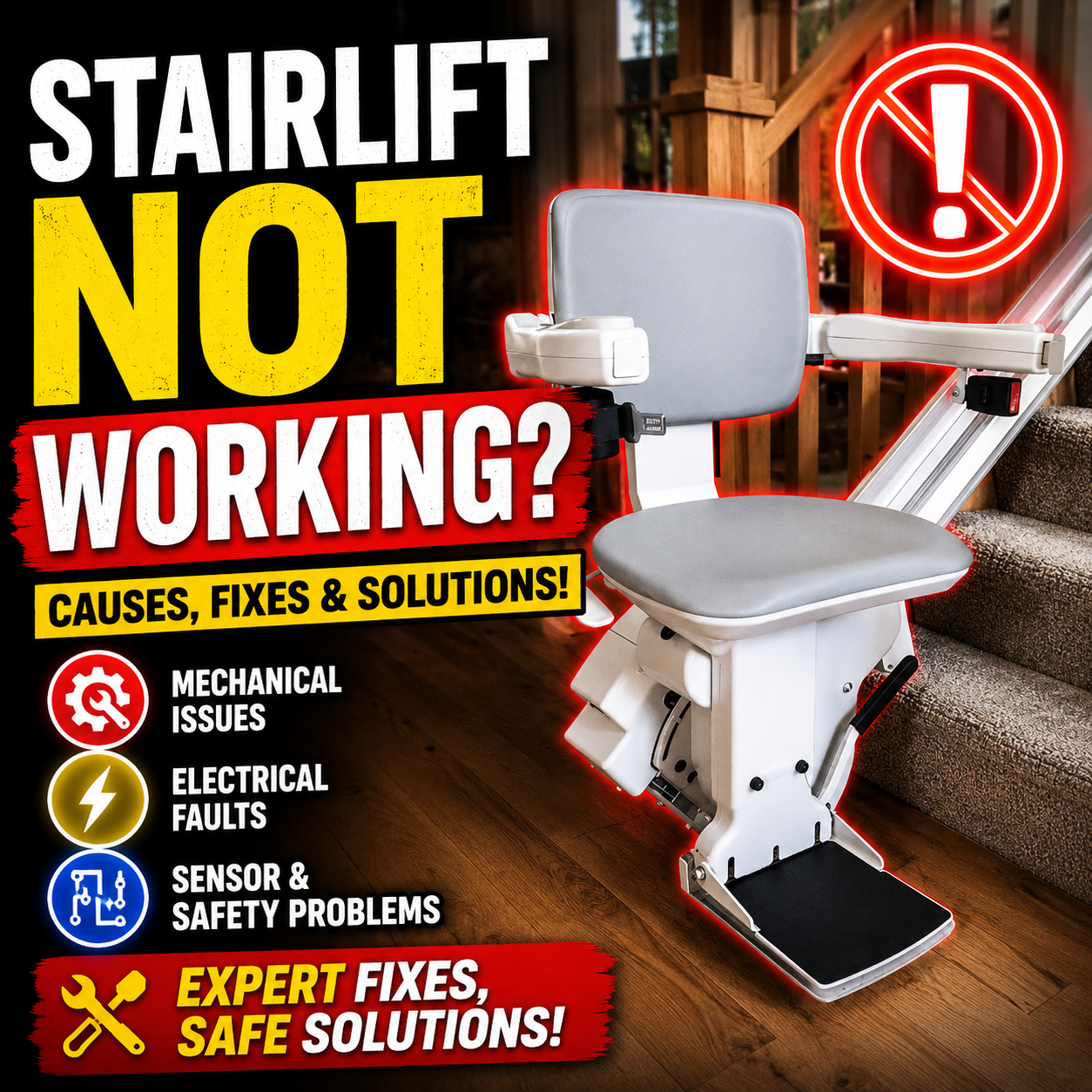
When a stairlift stops working, it does not feel like a small home repair. It can trap someone upstairs. It can keep a parent from reaching the bedroom. It can turn a normal morning into a stressful family phone call where everyone is asking the same thing: “Who fixes these?”
Maybe the chair is beeping. Maybe it will not charge. Maybe it moves a few inches and stops. Maybe it is stuck at the top of the stairs, and nobody in the house remembers who installed it.
This guide is for homeowners and caregivers looking for stairlift repair in Philadelphia, South Jersey, and the Delaware Valley. It explains what may be going wrong, what you can check safely, what should be left alone, and how to describe the problem when requesting local repair help.
Quick answer: what should you do first?
If your stairlift is beeping, not charging, stuck, stopping halfway, or completely dead, do not force it. Start with simple checks: make sure the charger is plugged in, the outlet has power, the key switch is on, and nothing is blocking the rail, footrest, or carriage.
If the lift still will not run normally, the next step is to contact a qualified stairlift or accessibility lift technician. Many issues can be diagnosed, including weak batteries, charging problems, sensor issues, remote problems, rail obstructions, worn parts, wiring faults, or error codes.
Important: If the lift is still under warranty, the original installer or authorized dealer may need to handle the repair. If it is out of warranty, older, inherited with the home, or the installer is unknown, a qualified local stairlift/accessibility lift company may still be able to inspect it.
Common stairlift problems people search for
Most stairlift repair calls start with a plain-English symptom. You do not need to know the technical cause before asking for help. A good description of what the lift is doing is enough to get the diagnosis moving.
The main thing is not to guess your way into a bigger problem. A stairlift has batteries, chargers, sensors, switches, rails, rollers, remotes, wiring, and safety systems. Over time, one small issue can make the whole lift stop.
First: is this an emergency?
If someone depends on the lift every day, treat the problem as urgent. A broken stairlift is different from a broken appliance. The person using it may not have another safe way to get upstairs or downstairs.
Stop using the lift if it stops suddenly, makes grinding or popping sounds, smells hot or electrical, moves unevenly, has loose parts, or no longer feels safe. Do not bypass sensors, remove covers, force the chair, or keep testing it while someone is seated.
Basic checks are fine. Look for an unplugged charger, a tripped breaker, a turned-off key switch, or something sitting on the rail. But electrical, mechanical, sensor, and safety-system work should be handled by someone qualified to service this type of equipment.
Why stairlifts break at the worst possible time
A lot of stairlifts quietly do their job for years. Then one day, they beep, stop, or refuse to move. That does not automatically mean the whole system is ruined. It means the lift needs to be checked like the mechanical accessibility device that it is.
In this region, the house itself can add complications. Philadelphia rowhomes, South Jersey split-levels, older twins, duplexes, shore homes, and exterior porch setups all have their quirks. Narrow stairs, outdoor moisture, heavy daily use, long periods of non-use, and older electrical outlets can all play a role.
Do you have to call the manufacturer?
Sometimes, yes. Sometimes, no.
If your stairlift is under warranty or was recently installed, the original installer or authorized dealer should usually be your first call. Warranty work may have rules about who can service the lift and what parts are covered.
But many homeowners are not in that situation. Maybe the lift is older. Maybe it came with the house. Maybe the installer is unknown. Maybe the company that installed it is no longer nearby. Maybe the lift is out of warranty.
Call the original dealer first when
- The lift is still under warranty.
- It was installed recently.
- You have the original paperwork.
- The manufacturer requires authorized service for the issue.
Local repair help may be possible when
- The lift is out of warranty.
- The installer is unknown.
- The lift was inherited with the home.
- The issue appears to be battery, charging, sensor, remote, or general service related.
A local accessibility equipment company, mobility dealer, stairlift service company, or licensed lift/elevator professional may be able to inspect and repair the unit depending on the brand, model, condition, parts availability, and local requirements.
Bruno, Harmar, Acorn, Stannah, Savaria and other stairlift brands
You do not need to know everything about your stairlift before requesting help. But the brand matters because parts, error codes, batteries, rails, remotes, and service procedures can vary.
Bruno stairlift repair
Common calls include beeping, charging issues, battery replacement, chair not moving, remote problems, and inherited units where the installer is unknown. Warranty and dealer status should be checked before any non-authorized service is assumed.
Harmar stairlift repair
Harmar units may need battery, charging, sensor, remote, rail, or error-code diagnosis. Exact model information helps a technician understand parts and service options.
Acorn stairlift repair
Acorn searches often come from homeowners with beeping, charging, or stuck-chair problems. A qualified company may ask for photos, the model, and whether the lift is straight or curved.
Unknown brand or inherited lift
This is common. Take photos of the chair, rail, charger, controls, and any label or display screen. A technician may be able to identify the brand before deciding whether it can be serviced.
Careful wording matters: Do not assume every company repairs every brand. Some companies only service the brands they sell. Some handle out-of-warranty units. Some can do batteries and maintenance but not discontinued parts, custom curved rails, or locked manufacturer-specific repairs.
What a stairlift repair technician may check
A proper repair visit should not be a guessing game. Depending on the lift and the symptom, a technician may check the charging system, batteries, wiring, controls, safety sensors, rail, rollers, drive components, and error codes.
| Symptom | Possible direction | What to tell the technician |
|---|---|---|
| Stairlift is beeping | Battery, charger, parking position, obstruction, sensor, or error condition | When it beeps, how often it beeps, and whether any light/code appears |
| Stairlift is not charging | Outlet, charger, battery, contacts, connection, or charging station issue | Whether the charger light is on and where the chair is parked |
| Chair is stuck | Low battery, obstruction, sensor, limit, rail, wiring, or mechanical fault | Where it is stuck and whether it moved before stopping |
| Remote does not work | Remote battery, pairing, receiver, safety condition, or lift power issue | Whether the armrest controls still work |
| Grinding or scraping noise | Roller, rail, drive, alignment, debris, or worn component issue | Where the noise happens and whether it gets worse under load |
What about porch lifts, wheelchair lifts, and vertical platform lifts?
A stairlift carries a seated person along a rail attached to the stairs. A vertical platform lift, often called a VPL, carries a person standing or in a wheelchair on a platform. These are common for porches, decks, garages, and entrances where a ramp would be too long or impractical.
Outdoor access problems
Common issues include no power, weather exposure, beeping, stuck platform, door/gate problems, or uneven movement.
Daily mobility issues
If a wheelchair lift will not move, check only basic power and emergency-stop items before calling for service.
Safety-system issues
Gate latches, platform sensors, safety pans, key switches, and emergency stops can all prevent operation.
These lifts should be handled carefully. If the lift is stuck, beeping, moving unevenly, or making mechanical noise, do not bypass safety features or let an unqualified handyman guess their way through it.
Written for Philadelphia, South Jersey and nearby Delaware Valley homes
This page is focused on homeowners and caregivers in the local region where stairs are part of everyday life: rowhomes, twins, split-levels, duplexes, older single-family homes, condos with interior stairs, and homes with exterior porch lifts.
Should you repair or replace the stairlift?
That depends on the age of the unit, the brand, the condition, the symptom, and whether parts are still available. A good technician should be able to explain the difference between a reasonable repair and a lift that is no longer safe or practical to maintain.
Repair may make sense when
- The lift worked recently.
- The issue seems battery or charger related.
- The chair powers on but beeps or shows a code.
- The brand is known and parts are available.
- The rail and chair are in decent condition.
Replacement may be worth discussing when
- The unit is very old and parts are discontinued.
- The lift has repeated failures.
- The rail, drive, or carriage is badly worn.
- The user’s mobility needs have changed.
- The repair cost is too close to replacement cost.
What to gather before you request stairlift repair
Before calling, take two minutes to gather the basics. This can save time and help the request get routed to the right type of technician.
Simple script: “My stairlift is a Bruno/Harmar/Acorn/unknown brand. It is indoors/outdoors. It is on a straight/curved staircase. The issue is that it is beeping/not charging/stuck/stopping halfway/making noise. It is located in [city or ZIP]. It is/is not under warranty. Someone uses it every day.”
Can an old stairlift be repaired if you do not know who installed it?
Often, it is at least worth having it evaluated.
This is common in Philadelphia and South Jersey homes. A family buys a house and there is already a chair lift on the stairs. Or a parent had one installed years ago, but nobody remembers the installer. Or the lift sat unused for months and now the family needs it again.
Unknown installer does not automatically mean impossible repair. What matters is the brand, model, condition, safety, and parts availability. A qualified stairlift service company may be able to identify the unit from photos or an on-site inspection.
Need help with a stairlift, chair lift, porch lift, or wheelchair lift?
If your lift is beeping, not charging, stuck, dead, making noise, or stopping halfway, use the form below to share the brand, symptom, and location. Include photos if you have them.
The goal is simple: help match the issue with the right type of local accessibility lift professional based on the lift type, service area, warranty status, and urgency.
- Lift type: stairlift, chair lift, porch lift, wheelchair lift, or vertical platform lift
- Brand: Bruno, Harmar, Acorn, Stannah, Savaria, Handicare, unknown, or other
- Symptom: beeping, not charging, stuck, dead, remote not working, grinding noise, error code, or stopping halfway
- Location: city and ZIP code
- Warranty status: under warranty, out of warranty, or unknown
- Urgency: whether someone depends on the lift daily
FAQ
Why is my stairlift beeping?
A beeping stairlift is usually trying to alert you to a status or fault. It may be related to low battery power, charging position, a loose power connection, an obstruction, a seat or footrest sensor, or an error code. If the beeping does not stop after basic checks, call a technician.
Why is my stairlift not charging?
A stairlift may stop charging because the charger is unplugged, the outlet has no power, the chair is not parked on the charging point, the charging contacts are dirty or misaligned, or the batteries are weak. Battery and charging issues are among the most common stairlift service calls.
Can a stairlift battery be replaced?
In many cases, yes. Stairlift batteries are service items, but the right battery and installation process depend on the brand and model. A technician can test whether the batteries are failing or whether the real issue is the charger or charging circuit.
Can someone repair a stairlift if they did not install it?
Sometimes. It depends on the brand, model, warranty status, parts availability, and local requirements. If the lift is under warranty, the original installer or authorized dealer may need to handle it. If it is out of warranty, a qualified local accessibility lift company may be able to inspect and repair it.
Do I need the manufacturer for stairlift repair?
Not always. Warranty repairs and certain brand-specific repairs may need an authorized dealer. But for many out-of-warranty units, local stairlift service companies, accessibility equipment dealers, or qualified lift technicians may be able to help.
Is it safe to troubleshoot a stairlift myself?
Basic checks are usually fine: look for a tripped breaker, unplugged charger, turned-off key switch, or visible obstruction. Do not open the unit, bypass sensors, remove covers, force the chair, or work on wiring. If the lift still will not operate normally, call a professional.
Do porch lifts and wheelchair lifts have similar repair issues?
Some issues overlap, such as no power, beeping, dead controls, charging problems, obstruction sensors, or safety switches. But porch lifts, wheelchair lifts, and vertical platform lifts have different equipment and should be inspected by someone qualified for that lift type.
Should I repair or replace an old stairlift?
Repair may make sense if the lift worked recently, parts are available, and the problem is isolated. Replacement may be worth discussing if the unit is very old, unsafe, repeatedly failing, badly worn, or no longer fits the user’s needs.


%20(7).png)