Last updated: May 28, 2026
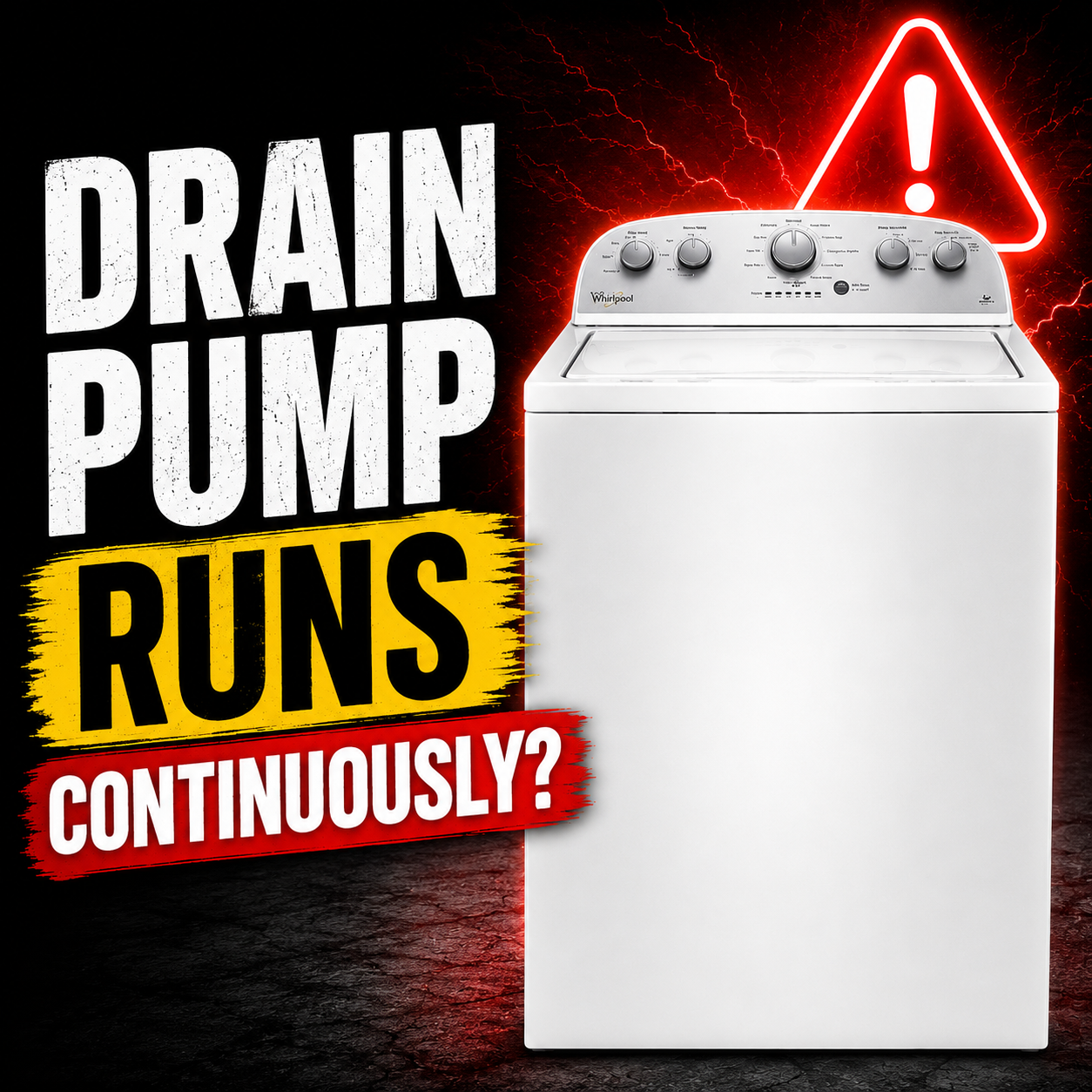
Whirlpool WTW4816FW3 Drain Pump Runs Continuously? How to Tell If It’s the W11603810 Control Board
If your Whirlpool top-load washer starts running the drain pump as soon as it is plugged in, it is natural to blame the pump. But that can be an expensive guess.
A drain pump that runs continuously does not always mean the drain pump is bad. In many cases, the pump is only doing what the washer’s control system is telling it to do. The real question is why the washer thinks it needs to drain.
This guide is written for Whirlpool WTW4816FW3 owners and related Whirlpool-family top-load washer owners who are seeing a pump-stuck-on symptom, possible F3E1-style pressure behavior, or a suspected W11603810 control board problem. The goal is simple: help you slow down, check the obvious pressure-system issues first, and decide whether the pump, hose, board, local appliance service, or mail-in board repair makes the most sense.
Quick answer: don’t buy a drain pump yet
If the drain pump runs only during the drain part of a cycle, the pump may simply be doing its job. But if the pump starts running as soon as the washer is plugged in, keeps running with no cycle selected, or only stops when the washer is unplugged, the problem may be in the pressure-sensing path or the main control board.
Before replacing the pump, check the washer model number, any stored error behavior, the pressure hose, the drain hose setup, and the control board part number. If the pressure hose path looks clear and connected but the washer still falsely commands the pump to run, the W11603810 board may become a repair or replacement candidate.
Safety first: Unplug the washer before opening the console, checking hoses, removing the control board, or touching internal parts. This guide does not recommend live-voltage testing for homeowners.
Symptom checklist
This page is for a very specific kind of washer failure. If several of these sound familiar, you are in the right place.
Models and board numbers involved
This guide is centered around the Whirlpool WTW4816FW3 and the W11603810 control board because that model/board combination is commonly discussed with this drain-pump-stuck-on symptom pattern.
Related Whirlpool-family top-load washers may have similar symptoms, but do not assume the same board fits your washer. Whirlpool, Amana, and Maytag-family machines can look similar from the outside while using different control boards, harnesses, software, pressure-sensing layouts, or replacement part numbers.
Compatibility rule: Always verify by the washer’s full model number, serial number, original control board label, and connector layout. Do not buy or mail a board based only on a symptom.
You may also see references to related board numbers such as W11578565 in discussions or parts listings. Treat those as numbers to verify, not as automatic substitutes. A superseded, alternate, or similar-looking board still needs to be confirmed against your exact washer.
Why the washer may keep draining
A washer does not drain randomly. Something is telling the drain pump to run.
In normal operation, the control board runs the drain pump when the washer needs to remove water. The control system also needs to know whether water is still in the tub. That is where the pressure-sensing system matters. If the washer thinks water is present, or if it does not trust the water-level signal, it may keep trying to drain.
That is why replacing the drain pump can miss the real issue. If the pump is being commanded on constantly, a new pump may simply run constantly too.
Drain pump vs pressure hose vs control board
This is the decision point that matters. A constantly running pump can be a pump problem, but it can also be a pressure-system or board-command problem.
| What you see | More likely direction | Why it matters |
|---|---|---|
| Pump runs only during normal drain | Normal drain behavior or actual drain/pump issue | The board may be commanding the pump correctly |
| Pump runs immediately when plugged in | Control logic, pressure system, or board issue | The pump may be energized when it should not be |
| Pump runs with tub empty | False water-level/pressure reading or board fault | The washer may think it still needs to drain |
| Pressure hose is kinked, loose, split, or blocked | Pressure hose/path issue | The board may receive bad water-level information |
| Pressure hose path checks out but pump still runs | Control board or pressure-sensing circuit suspicion | The board may be misreading or falsely commanding the pump |
| New drain pump did not fix it | Not likely a pump-only failure | The original pump may not have been the root cause |
What F3E1-style pressure behavior may mean
On many Whirlpool-family washers, an F3E1-style fault is associated with the water-level or pressure-sensing system. In plain English, the washer is not happy with the information it is getting about water level.
That matters because the washer uses water-level information to decide whether it is safe to continue, fill, spin, or drain. If that signal looks wrong, the machine may behave like it needs to keep draining even when the tub appears empty.
Important: Do not treat F3E1 as an automatic “bad board” code. Check the pressure hose and pressure path first. A blocked, disconnected, kinked, leaking, or wet pressure hose can create symptoms that look like a board problem.
Safe checks before buying parts
These checks are meant to help you avoid buying the wrong part. They are not a substitute for a technician, and they do not involve live-voltage testing.
Do not probe the board live, jump relay contacts, bypass safety features, run the washer open, or guess at board components unless you are qualified to do that work.
When the W11603810 board becomes suspicious
The control board becomes more suspicious after the basic pressure and drain setup checks have been done. The board is not the first thing to blame, but it is a real possibility when the pump is being commanded at the wrong time.
Pump runs while “off”
If the pump starts as soon as the washer is plugged in and no cycle is selected, the issue may be upstream of the pump.
Pressure path checks out
If the pressure hose is connected, clear, dry, and not kinked, but the machine still behaves like it needs to drain, the board becomes more suspicious.
Pump replacement failed
If a new drain pump runs continuously too, the pump was probably not the part making the decision.
At that point, the W11603810 board may be worth testing, replacing, or sending in for repair evaluation — especially if the part is expensive, unavailable, or backordered.
Repair vs replace: pump, hose, board, or washer?
The right move depends on what actually failed. Here is the practical breakdown.
| Option | When it makes sense | When to pause |
|---|---|---|
| Replace drain pump | Pump is noisy, seized, leaking, clogged, damaged, or not running when commanded | If the pump runs constantly, the pump may not be the decision-maker |
| Clear or replace pressure hose | Hose is blocked, kinked, loose, split, wet inside, or disconnected | If the hose/path looks perfect and the symptom continues |
| Replace control board | Board is confirmed failed, available, correct for model, and cost-effective | If compatibility is uncertain or the board is expensive/backordered |
| Mail-in board repair | Board is suspected, part is expensive, unavailable, or the failure pattern may be repairable | If the pressure hose path has not been checked yet |
| Replace washer | Washer has multiple major failures, severe rust, tub/transmission issues, or repair cost is too close to replacement | If this is an isolated control/pressure issue on an otherwise usable washer |
When mail-in W11603810 board repair makes sense
Mail-in control board repair can make sense when the washer is otherwise worth saving, the pressure hose path has already been checked, and the drain pump appears to be running because the control board is falsely commanding it.
It is especially worth considering when the replacement board is expensive, hard to find, backordered, or when you want the original board evaluated before spending money on another part.
- The washer model and board number have been verified.
- The pump runs continuously as soon as the washer is plugged in.
- The tub is empty, but the washer still acts like it needs to drain.
- The pressure hose is connected and not obviously blocked or damaged.
- You have a short video of the symptom.
- You have clear photos of the board label and washer model tag.
What to send before mailing a board
Good photos can prevent wasted time. Before mailing a control board, send the basics.
Limited parts and tool searches
Disclosure: Some links in this section may be affiliate links. If you buy through them, we may earn a commission at no extra cost to you. These are broad search links, not guarantees that a part fits your washer. Always match parts by full model number and original part label.
Use these only after diagnosis
Do not buy a pump, hose, or board just because the washer is draining. Use these searches only after you have narrowed down the likely failure.
Buying rule: If a listing does not clearly match your exact model and original board/part number, do not assume it fits.
When to call a local appliance technician
Call a technician if you are not comfortable opening the washer console, removing the control board, checking the pressure hose, or deciding whether the pump is being commanded correctly.
Also call a technician if the washer has other major symptoms: leaking, burning smell, damaged wiring, repeated breaker trips, tub problems, spin problems, or more than one fault at the same time.
FAQ
Why does my Whirlpool washer drain pump run continuously?
A continuously running drain pump can be caused by a normal drain command, pressure-sensing problem, blocked or disconnected pressure hose, bad water-level information, or a control board that is falsely energizing the pump. The pump itself is not always the root cause.
Is the drain pump bad if it never shuts off?
Not necessarily. If the pump runs constantly as soon as the washer is plugged in, the pump may simply be obeying the control board. Check the pressure hose path and control behavior before replacing the pump.
What does F3E1 mean on a Whirlpool washer?
On many Whirlpool-family washers, F3E1-style behavior is associated with water-level or pressure-sensing trouble. That can involve the pressure hose, air dome path, sensor circuit, wiring, or control board. Verify using the tech sheet for your exact model.
Is W11603810 the correct board for my washer?
It may be, but do not assume. Confirm using your washer’s full model number, serial number, original board label, and connector layout. Similar Whirlpool-family washers can use different boards.
Is W11578565 the same as W11603810?
Treat W11578565 and W11603810 as numbers to verify, not as automatic substitutes. Some parts may be superseded, replaced, or related, but compatibility must be confirmed for your exact washer before ordering or mailing a board.
Can the W11603810 control board be repaired?
In some cases, yes. Control board repair depends on the failure, board condition, component availability, and whether the board has physical damage, corrosion, burned areas, or processor/software-related failure. A board should be evaluated before repair is promised.
Can I replace the control board myself?
Some careful DIY users can remove and replace a washer control board, but the washer must be unplugged first and all connectors should be documented with photos. If you are not comfortable opening the console or handling electronics, call a technician.
Should I replace the washer instead?
Replacement may make sense if the washer has several major problems, rust, tub/transmission issues, wiring damage, or repair costs close to a new machine. If the washer is otherwise in good condition and the issue is isolated to the control/pressure system, repair may be worth considering.
What should I send before mailing my board for repair?
Send a photo of the washer model/serial tag, the control board label, the connector layout before removal, a short symptom video, and any notes about F3E1-style behavior, previous pump replacement, or pressure hose checks.


%20(7).png)